








The feature debut from visual artist Alex Prager also stars John C Reilly, Kathryn Newton and Juliette Lewis
Dir: Alex Prager. US. 2026. 83mins
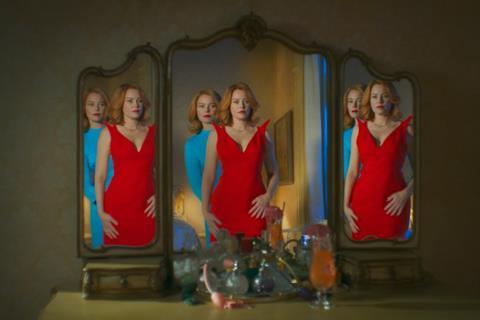
From the moment Carol (Elizabeth Banks) allows a lookalike android to enter her home, DreamQuil wears its influences on its sleeve. A mix of Stepford Wives, Rear Window and Rosemary’s Baby, the high-concept sci-fi finds Carol unmoored in her marriage with Gary (John C. Reilly) and as a mother to Quentin (Toby Larsen). So, she turns to the people at DreamQuil, who promise an immersive therapy that will help her reclaim herself. It’s a decision that will flip this dystopian high-concept sci-fi into a harried psychological thriller, whose enthralling style is not enough to overcome its cliched storytelling.
The film is too enamored with the fantasy it has created
DreamQuil, which premieres at SXSW, is the feature debut of renowned artist Alex Prager. The visual language of her shorts and photography is heavily influenced by classic Hollywood motifs and destabilize the bounds between artifice and reality; a quality that’s on strong display here. It also sees Prager reunite with Banks, with whom she collaborated – alongside other actors including Bryce Dallas Howard, Brad Pitt, Ryan Gosling and Michael Shannon – on her 2013 three-channel video installation ’Face In The Crowd’. Banks’s star power should help sell DreamQuil, particularly to genre devotees.
Carol’s fantasies far exceed her reality. In the film’s arresting opening, she lays in a bed of poppies in a sexual embrace with a burly hunk ripped from a cheap romance novel. The experience feels tangible and exciting – until its spell is broken by Gary, who opens the door to Carol’s virtual reality MYTH machine to inform her that a woman has plunged to her death. But the film immediately moves on from this and, by the time we return to this event, we can barely remember it.
Instead, we’re granted a blurred window into Carol’s life. She and her modest family live in a not-too-distant future wracked by air pollution so severe people are required to wear transparent masks. Gary, therefore, has turned the porch of their apartment into a greenhouse, and even bought a chicken to raise. He dreams about returning to the country, while lawyer Carol wants to remain in the city. Carol is physically and emotionally distant, often spending more time in the MYTH machine than with Gary or her son. Much like the resplendent mid-century interior of her home, she is seemingly stuck in a different time than her own, confined to serving the prescriptive life of a 1950s housewife.
DreamQuil has a solution (supposedly). The company’s CEO Margo Lace (Kathryn Newton) sells herself via intrusive ads — the film teases deeper thoughts about consumerism that never fully coaleces — as a path for women to find their ’new normal’ again. Desperate, Carol turns to DreamQuil, which will require her to leave her home for on-site treatment while a robot is dispatched to continue her housework. The treatment, which involves a nurse (played by Juliette Lewis) probing Carol’s memory with Total Recall invasiveness, is seemingly quick and painless. But when Carol returns home, she not only discovers that this robot looks exactly like her, but that her family has come to love the android more than her.
With such an arresting premise and impeccable design and costuming—this is the kind of aesthetically pleasing work, filled with gorgeous matte paintings and fanciful miniatures, one expects of Prager—this is a promising debut. It’s s a shame, then, just how much the inchoate screenplay lets it down. It’s not just the characterisations that are incoherent, this is a film partly guided by dream logic. Carol’s psychological struggles are reduced to hokey questions about identity, motherhood, marriage, suicidal ideation, sentience, personal data and male egotism. The script skims the surface of these subjects, using them more for genre fodder than for the pursuit of larger answers. Far too often, the film is too enamored with the fantasy it’s created to look beyond it.
Consequently, Banks, in a dual-role, appears to be groping for the ties that bind her characters to this story. In that regard, Banks’ tireless efforts to imbue both versions of Carol with two different flavors of detachment—the cold, robotic kind and the burned-out human type—is commendable. Like Carol, however, this imaginary world works too hard against Banks for her to succeed, as we move full throttle toward a tragic ending that should spell melancholy but instead lacks revelatory points to fully land.
Production companies: Brownstone Productions, Landay Entertainment, Big Valley Pictures, Patriot Pictures
International sales: Hanway Films
Producers: Elizabeth Banks, Max Handelman, Alison Small, Vincent Landay, Michael Mendelsohn, Alex Prager
Screenplay: Alex Prager, Vanessa Prager
Cinematography: Lol Crawley
Production design: Annie Beauchamp
Editing: Matt Chessé, Jennifer Chung, Brad Besser
Music: Nigel Godrich, Ali Helnwein
Main cast: Elizabeth Banks, John C. Reilly, Juliette Lewis, Sofia Boutella, Kathryn Newton, Lamorne Morris, Toby Larsen, Anna Marie Dobbins