
















Screenwriter and short filmmaker Abinash Bikram Shah’s engaging first feature bows in Cannes Un Certain Regard
Dir/scr: Abinash Bikram Shah. Nepal/Germany/Brazil/France/Norway. 2026. 108mins
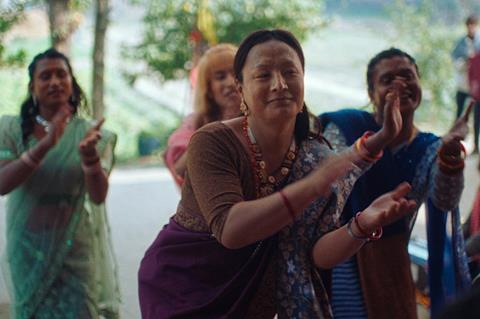
The kinnar community is a South Asian socio-cultural group of transgender, non-binary and intersex people that is popularly identified as a harbinger of good fortune. Ironically, its members are just as fiercely demonised and discriminated against by for their non-conformity. Their sharp, characteristic claps accompany traditional celebratory performances at occasions like weddings; in other contexts, those same claps are feared as a curse or decried as a show of intimidation or obscenity. In Abinash Bikram Shah’s Nepali debut feature Elephants in the Fog, those rhythmic claps become an emphatic assertion of identity, resilience, rebellion and empowerment.
Has a contemporary urgency while mining the ancient spiritual traditions
With trans rights in flux in South Asia and legislative decisions swinging between the reformist and the regressive, Elephants in the Fog has a contemporary urgency while mining the ancient spiritual traditions. Shah has previously written the screenplay for features including Min Bahdur Bham’s 2015 Venice Critics Week winner Kalo Pothi: The Black Hen, while his 2022 short Lori won a Special Jury Award in Cannes. He now makes a strong, stimulating and sensitive feature film debut, which bows in Cannes Un Certain Regard. Engaging and emotional, it should attract curiosity from the festival circuit.
Set in a small Nepalese village, surrounded by a forest that is home to wild elephants, the film has Pirati (Pushpa Thing Lama) – the matriach of one of the kinnar families – at its centre. In love with the percussionist of her troupe, Master (Aashant Sharma), she dreams of eloping to Delhi and starting a new life with him. But this breach of the traditional vow of chastity could force the close-knit community to sever ties with her. Before she can make a move on her decision, one of her daughters, her favourite Apsara (Aliz Ghimire), disappears. When the villagers and police refuse to help she decides to investigate on her own, only to arrive at an impenetrable heart of darkness.
Shah presents an intimate look into the unique, complex reality of the kinnars, and owes a great deal to Noé Bach’s fluid cinematography. Filmed almost entirely on location, the camera frames the isolation of the village, the intimidation of the jungle and the chaos of the city where Pirati regularly meets her lover. While, the wide shots capture the expanse of an elephant vigil, there are also delicate close-ups on faces. The bleak mood and darkness is punctured by bursts of mirth and vivid colours. Editors Andrew Bird and Paris J. Ludwig bring tautness, tension and a definitive trajectory to the narrative while negotiating the conventions of multiple genres, while Frédéric Alvarez’s music gives aural propulsion to Pirati’s mission.
Elephants in the Fog may be about the othering of the third sex, and the ignorance, prejudices and hatred of the mainstream, but the film treats them with sensitivity, respect and warmth. Shah reframes a community that is often reduced to loud and boorish stereotypes in conventional South Asian cinema. He captures the pulse of the kinnar family, its spaces, daily rhythms, customs and interpersonal interactions. It is an affecting portrayal — the ties that bind, the strength and solace in sisterhood. Shah redefines the contours of families as not being necessarily biological but one founded on love, care and security. Here, family is a choice rather than an inheritance.
This character-driven film benefits from an impressive ensemble of professional actors and the non-professionals. Each character is memorable – especially Pirati played with enormous depth by Pushpa Thing Lama. Her inscrutable, stoic face is like a canvas containing turmoil and traumas as well as indomitable strength, and there is an admirable gravitas and dignity to her persona
The film is bookended by wild elephants. It begins with villagers conducting nightly patrols to protect their homes and fields, with one member of Pirati’s family volunteering with them each night; the kinnars and the villagers living in harmony. The end marks a full circle, with the threads of camaraderie undone. It’s the wild elephants, once a threat, who instead become an ally of the marginalised.
Production companies: Underground Talkies Nepal, Les Valseurs, Die Gesellschaft DGS
International sales: Best Friend Forever martin@bffsales.eu
Producers: Anup Poudel, Justin Pechberty, Damien Megherbi, Michael Henrichs
Screenplay: Abinash Bikram Shah, Sandeep Badal
Cinematography: Noé Bach
Production Designer: Mausam Aggrawal
Editing: Andrew Bird & Paris J. Ludwig
Music: Frédéric Alvarez
Main cast: Pushpa Thing Lama, Sahab Din Miya, Jasmine Bishwokarma, Aliz Ghimire, Joel Gurung, Aashant Sharma, Sanjay Gupta, Umesha Pandey






No comments yet