














Eve Hewson, Colman Domingo and Colin Firth also star in the director’s 37th feature
Dir: Steven Spielberg. US. 2026. 145mins
When we ponder the great mysteries of the cosmos, perhaps the biggest question is not whether life exists beyond Earth, but how we would (and should) respond to irrefutable proof that it did. That’s the quandary at the heart of Steven Spielberg’s propulsive yet unapologetically sentimental Disclosure Day, in which the truth of extraterrestrial contact becomes a valuable commodity guarded by a powerful few.
Big, bold, sentimental Spielbergian stuff
Spielberg’s 37th feature, released in the year he turns 80, sees the filmmaker returning to familiar themes – aliens, yes, but also humanity, morality, technology and the control of information – with a dynamism that is entirely of the moment. Disclosure Day is not a reinvention of the wheel; it feels like a quintessential Spielberg movie, recalling key moments from his 50-plus-year screen career, and will likely fare best with existing fans who respond to his traditional, passionate cinema-as-spectacle aesthetic.
Those Spielberg fans will surely turn out when the film releases globally from June 10, and the presence of stars including Emily Blunt, Josh O’Connor, Colman Domingo and Colin Firth will also likely help the film’s box office chances. (Fathers’ Day audiences may well give a second week boost to a film that will rely more on longer legs than an opening weekend bonanza.) It is unlikely to topple previous Spielberg behemoths like Jurassic Park (1993, £1.1bn), ET: The Extra Terrestrial (1981, $797m), or the OG blockbuster Jaws (1975, $491m), and could struggle to match the year’s other big sci-fi, Project Hail Mary ($680m to date). It should, however, track higher than recent Spielberg fare The Fabelmans (2022, $46m), West Side Story (2021, $76m) or The Post (2017, £194m).
It’s 20 years since Spielberg last made an alien movie, 2005’s Tom Cruise-starrer War Of The Worlds ($604m), and this time around he and screenwriter David Koepp take a lighter approach. Disclosure Day undoubtedly has more in common with Close Encounters Of The Third Kind (1977) and ET, although it moves away from the halcyon nostalgia of those works into something more urgent and immediate.
The story is set in a divided modern world in which the threat of global conflict is destabilising already fragmented societies. Against this volatile backdrop, cybersecurity expert Daniel (O’Connor) has stolen extensive data from digital security company WARDEX, proving not only the existence of extraterrestrials, but that the US government and military have utilised alien craft and their occupants for technological exploitation and inhumane experimentation. (That’s seen in upsetting fictional black and white archival footage that has devastating echoes of Spielberg’s Schindler’s List.)
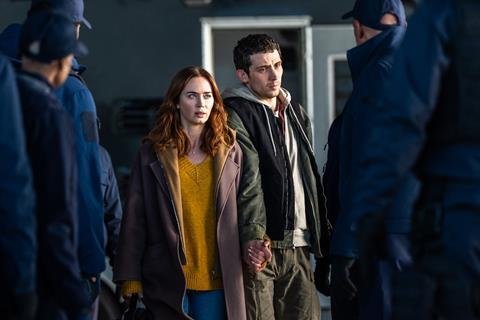
Miles away, in Kansas City, local weather reporter Margaret (Blunt) is eying a step up in her career when, out of the blue, she develops a fluency in foreign languages and the ability to read people’s minds and understand their lived experience. Initially terrified, she nevertheless feels compelled to track down Daniel and help his cause. Margaret is holding on to a terrible secret from her childhood; only when she finds the strength to confront it will she truly understand her purpose. Blunt is outstanding, sharing with O’Connor a sympathetic mix of grit and vulnerability, her bewilderment and confusion also bringing moments of comedic levity.
Daniel, too, has hidden secrets, but his desire to share what he knows with the world is largely driven by the idea that “the truth belongs to everyone”; one of several lines of dialogue that flirts with didacticism, and lays bare the egalitarian ideals that power much of Spielberg’s output including the likes of The Post (2017) and Bridge Of Spies (2015). These are shared by WARDEX’s former ‘Director Of Biological Assets’ Hugo (Colman Domingo, excellent), who has also defected, and who later wields a passionate, if somewhat preachy soliloquy about the importance of empathy for human survival. It’s big, bold, sentimental Spielbergian stuff, for sure – and reaches fever pitch by the closing scenes – but it’s all largely held in balance by the film’s breathless energy and excellent performances across the board.
One of those comes from Eve Hewson as Daniel’s girlfriend Jane, whose devout Christian faith makes her wary of the truth’s potentially destructive potential. If we have proof of higher beings, she reasons, why wouldn’t people of all faiths worship them instead of an unknowable God? Hewson is commanding in this smaller role, shouldering the physical and psychological challenges of a character that acts as a spiritual bellwether amid the scientific and political maelstrom.
Jane’s ideological reasoning may be shaky, and her arc very much backgrounded, but it adds an additional layer to a story that is sketched in shades of grey. Indeed, the strength of Spielberg’s filmmaking has always lain in his ability to mine the recognisable – often fallible and unreliable – human emotions at the heart of such epic stories. Everyone here truly thinks they are doing the right thing, including Noah (Colin Firth), the ironically-named head of WARDEX, who believes that uncovering the truth would cause catastrophic unrest – although he is clearly also desperate to protect his position of privilege and influence.
Spielberg and regular cinematographer Janusz Kaminski hold this tension in their visual language. Careful framing, lighting, camera angles and movement speak to both the fantastical wonder and messy, unpredictable reality of this unfolding situation. In one key scene, the sun shining through a window casts a beatific celestial glow as a difficult truth is revealed; in another, an intimate close-up sees Daniel reassure Margaret via the simplest of human touches. At other moments, the ordinary becomes heightened; the pouring of cereal into a bowl takes on a significance as loaded as ripples in a Jurassic Park water glass. And glass itself becomes a key motif; reflections and refracted light conveying shifting allegiances and transparency – or lack of it.
Also sympatico with Spielberg’s approach is composer John Williams, who, at 94, has now scored 30 features for the director. One may well expect his trademark leitmotifs and sweeping orchestration but while the score is recognisably Williams, it is a restrained and pensive work that, surprisingly, works to play down the intensity. Daniel and Margaret are not traditional heroes; rather ordinary people attempting to feel their way through an extraordinary situation, and the music responds in kind. There is none of the swashbuckle of Indiana Jones or the pomp of Jurassic Park; often questioning, sometimes hesitant, the score builds in confidence and authority alongside the characters.
Despite some slower, more introspective moments, the pace doesn’t sag much under the weight of the material, with plenty of fluidly shot, deftly edited action sequences – including a thrilling train sequence that harks back to a pivotal scene in Spielberg’s biographical The Fabelmans (2022). Viewers hoping for Independence Day-esque levels of alien action may, however, be disappointed; Disclosure Day is very much a human story. Spielberg has long been fascinated with the concept of information (and misinformation) as both weapon and tool, and ultimately gives this science fiction fable the feel of a gritty 1970s conspiracy thriller; a bombastic underdog, truth-to-power tale – albeit one with cosmological consequences.
Production companies: Universal Pictures, Amblin Entertainment
Worldwide distribution: Universal Pictures
Producers: Kristie Macosko Krieger, Steven Spielberg
Screenplay: David Koepp, from a story by Steven Spielberg
Cinematography: Janusz Kaminski
Production design: Adam Stockhausen
Editing: Sarah Broshar
Music: John Williams
Main cast: Emily Blunt, Josh O’Connor, Colin Firth, Eve Hewson, Colman Domingo, Wyatt Russell, Elizabeth Marvel, Henry Lloyd-Hughes