









Genden Phuntsok, Tom Hiddleston and Willem Dafoe star in Jennifer Peedom’s muted Zurich opener
Dir: Jennifer Peedom. US/Australia. 2026. 125mins
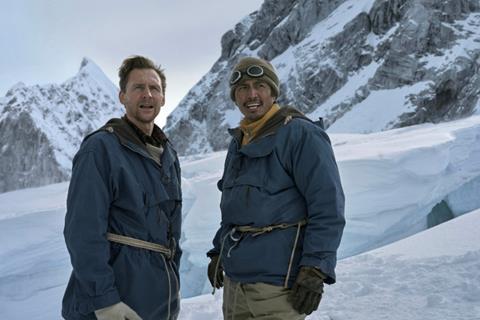
The 1953 summiting of Mount Everest is usually told from the perspective of famed New Zealand explorer Edmund Hillary. But Australian filmmaker Jennifer Peedom’s drama focuses on the less-heralded man by Hillary’s side. Tenzing stars Genden Phuntsok as Tenzing Norgay, a Himalayan climber who had long been obsessed with Everest, his scaling of the highest point on Earth proving to be a physically as well as emotionally harrowing experience. This earnest picture gives the expedition the proper grandeur and sense of danger, and the performances (including Tom Hiddleston as Hillary) are nicely restrained. But some narrative choices and an overly tasteful treatment end up undercutting what should be a stirring spectacle.
Feels carefully manicured to present a duly heroic portrait of its main character
Tenzing opens the Zurich film festival after premiering at Telluride and playing Toronto; Apple releases the picture on October 9 in the US and will then begin streaming the film on October 16. Hiddleston adds commercial clout, and the supporting cast includes Willem Dafoe. Older viewers and history buffs are the film’s most likely target audience, while others may just appreciate the stunning mountain views.
The film sees Peedom making her narrative debut after crafting documentaries such as Sherpa that have chronicled the Himalayan region. Shooting in Nepal and New Zealand, the director wants to deliver a rousing adventure while also celebrating Norgay’s historic feat – which has too often been ignored in the rush to venerate Hillary. Consequently, Tenzing isn’t just a story about this epic climb but also a recounting of the traumas Norgay endured in the years before the expedition.
Growing up on the Tibetan Plateau in the 1920s, Tenzing Norgay (Phuntsok) is not ethnic Sherpa and is therefore treated like an outsider in the Himalayan community. But ever since he was a boy, he has been enamoured of Chomolungma — the Tibetan name for Mount Everest — and has helped lead foreign explorers up the mountain, although no one has managed to reach the summit. But in 1953, an English team led by Colonel John Hunt (Dafoe) takes up the task, and Norgay convinces them to let him be part of the expedition, rather than just a simple Sherpa assisting them. Soon, he forms a bond with team member Edmund Hillary (Hiddleston) as they brave the extreme elevation and frighteningly cold weather.
Cinematographer Stefan Duscio films the mountains with a mixture of awe and terror, acknowledging the sheer enormity of the climbers’ quest. Tenzing eschews artificial obstacles, introducing the occasional precarious crevasse or violent avalanche but mostly letting the human drama be the principal suspense. Similarly, screenwriter Luke Davies allows the friendship between Norgay and Hillary to develop nturally, never giving either character a showy soliloquy or inventing artificial conflict. Admirably, the film consciously makes Hillary a supporting character with about as much screen time as Hunt, so that Norgay’s personal odyssey becomes the central focus. Indeed, it is Norgay’s deep knowledge of Everest that constantly guides the expedition and informs some of the most crucial decisions.
The problem is that Peedom relies on a familiar narrative trope to flesh out Norgay’s backstory. Samdrup Dorje Lama and Tenzin Dalha plays Norgay as, respectively, a boy and a young man and, once the older Norgay joins Hunt’s team, the 1953 climb is juxtaposed with flashbacks from different stages of his life, his often painful memories revisiting him as he tries to survive the climb. Tenzing illustrates his litany of heartaches — including the death of his beloved wife Dawa (Thinley Lhamo) — but the cliche of tying past and present together in such a tidy way makes this real story feel artificial. That said, all three actors portraying Norgay are affecting — especially Phuntsok, who depicts this mountaineer as a calm, quiet force determined to reach the summit.
Hiddleston is charming as Hillary, who himself is an outcast as the lone New Zealander among the English expedition. Without overstating the case, Tenzing suggests that Hillary respected Norgay as a fellow climber, looking past their cultural differences to achieve a shared goal. Those around Norgay are similarly impressed with his skill and resourcefulness, and Dafoe is particularly lovely as the buttoned-up leader who comes to admire Norgay.
But this lack of narrative friction speaks to the film’s nagging limitation, which is that its story is almost too resolutely uplifting. It’s not just the images of Everest that are pristine: Tenzing, which is executive produced by Norgay’s son Norbu Tenzing, feels carefully manicured to present a duly heroic portrait of its main character. The result is a biopic that serves as a necessary historical corrective but not one that is as gripping as the legendary climb that should have made Norgay’s name.
Production company: See-Saw Films
Worldwide distribution: Apple
Producers: Liz Watts, Emile Sherman, Iain Canning, Jennifer Peedom, Luke Davies, Desray Armstrong
Screenplay: Luke Davies, story by Jennifer Peedom and Luke Davies
Cinematography: Stefan Duscio
Production design: Melinda Doring
Editing: Simon Njoo
Music: Rebekka Karijord
Main cast: Genden Phuntsok, Tom Hiddleston, Willem Dafoe, Caitriona Balfe, Samdrup Dorje Lama