













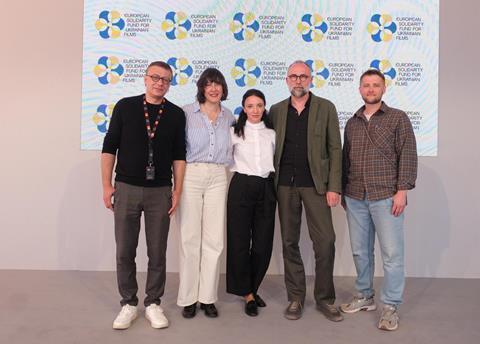
Ukrainian cinema took centre stage at Cannes on May 16 as the European Solidarity Fund For Ukrainian Films (ESFUF), in partnership with the Ministry of Culture of Ukraine and the Ukrainian Institute, unveiled five upcoming feature films from Ukrainian directors supported by the fund.
Presented at the CNC space in Cannes, the films are now seeking further co-production, sales and distribution partners.
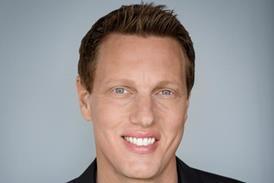
Oleg Sentsov’s Kai centres on a man experiencing a midlife crisis who enlists as a volunteer at the outbreak of Russia’s invasion. The film is produced by Germany’s Ma.ja.de. Fiction, Ukraine’s AT Films, France’s Playtime and Poland’s Apple Film Production.
Sentsov says the support for Kai has played a decisive role in moving the film forward. “The fund has created opportunities for Ukrainian filmmakers to remain in the profession during a time of historic challenges,” he says. “This may be just as important as the creation of individual films themselves because it is ultimately about preserving the voice and presence of Ukrainian cinema in the world.”
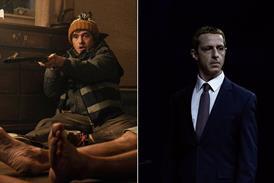
Philip Sotnychenko’s Times New Roman was also presented in Cannes, and is again set against the backdrop of Russia’s invasion. It focuses on a contemporary artist battling alcoholism and conflicts with his loved ones. It is produced by Lithuania’s Afterschool, Ukraine’s Viatel and Contemporary Ukrainian Cinema, Germany’s Superzoom Film and Latvia’s Trickster Pictures.
Also produced by Trickster is Mykola Zasieiev’s Magic Mountain, a collaboration with Ukraine’s 2brave productions. It continues the theme of the ongoing conflict with a story about a 12-year-old and his mother seeking solace in a Carpathian sanatorium as they await news of the boy’s father from the front lines.
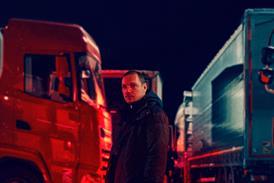
Marysia Nikitiuk’s Noah, produced by Croatia’s Petnaesta Umjetnost and Ukraine’s Directory Films, is about a man on the front lines who trains young sappers and rescues abandoned dogs until a sudden attack by overwhelming Russian forces puts him in a difficult moral dilemma.
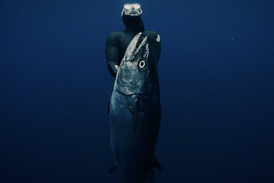
These fiction features are joined by Pavlo Dorohoi’s documentary The Ferryman from Norway’s Folk Film and Ukraine’s Eidos Productions, about a young man dreaming of becoming a professional kayaker who ferries wounded soldiers and civilians before being arrested.
European support
ESFUF launched at the 2023 Berlinale to support Ukrainian filmmakers amid Russia’s ongoing full-scale invasion of Ukraine. Spearheaded by the culture ministers of Germany, France and Luxembourg with 14 partners from 13 European countries and with a $1.2m (€1m) budget at the time, the emergency fund was designed to last for one year. Three years later, the continuing fund brings together some 19 partners including national film centres and ministries of culture from 18 European countries alongside the European Film Agency Directors (EFAD) with a bolstered 2026 budget of $1.7m (€1.5m) in production support.
The fund, which is co-ordinated by CNC, works to ensure the continuity of Ukrainian creative output and to strengthen co-operation between Ukraine and European partner countries. To date, 70 grants have been awarded to feature-length film projects spanning fiction, animation and documentary, representing $5m (€4.3m) in aid.
Twenty-one post-production grants and 28 development grants were awarded in 2023 and 2024. Originally designed to also support development, the fund has refocused its activities entirely towards production support since the end of 2024 and 21 projects have already received support.
The backing has fostered emerging talent and boosted exposure around the world. With ESFUF support, 18 films have already been showcased on the international festival circuit: Alina Gorlova, Simon Mozgovyi and Yelizaveta Smith’s documentary Militantropos screened at last year’s Directors’ Fortnight, Kateryna Gornostai’s Timestamp played in Competition in Berlin last year, and Olha Zhurba’s Songs Of Slow Burning Earth was selected for Venice in 2024.
Sentsov, an activist as well as a filmmaker who was imprisoned in Russia, received development support in 2023 for Ukraine-Croatia co-production Real, which premiered at Karlovy Vary. He received production support for his upcoming film Kai last year.
“It has been not only a financial resource for us, but also a sign of trust and solidarity from the European film community at a moment when it was critically important,” he says of ESFUF. “The conditions in which Ukrainian cinema is being created today require not only professional resilience, but also the feeling that you’re not alone.”
ESFUF closed its well-attended event by announcing two production calls for 2026, including one opening immediately with submissions accepted until June 2026.
Contact: Solene Tardieu






No comments yet