







The Palme d’Or-winning director’s latest is an ambitious, time-hopping drama set against the volatile 20th century
Dir/scr: Volker Schlöndorff. Germany. 2026. 118 mins
A beautiful plot of land by the calm waters of a lake in Brandenburg near Berlin is witness to several waves of 20th-century history in this ghostly, layered and often dread-inducing drama from veteran German filmmaker Volker Schlöndorff. Through a tight focus on the fictional inhabitants of these few acres over roughly 70 years, Visitation alludes to the rise of Nazism, the Holocaust, the Soviet takeover of eastern Germany, the death of communist idealism and the fall of the Berlin Wall. The danger of this time-hopping approach is glibness or formal coldness. Yet what emerges is a textured and compassionate view of these lives and how they relate to – and reflect – the world beyond.
A fitting late-career triumph.
Visitation launches in Cannes Premiere at the festival where Schlöndorff, now 87, won the Palme d’Or for The Tin Drum in 1979. Despite a long career in film and television in both the US and Germany, name recognition for Schlöndorff is not especially strong outside of Germany beyond the most seasoned followers of international cinema. But this German-language film’s accessible style, compelling conceit, strong performances and broadly fascinating subject matter should prove attractive to distributors and audiences.
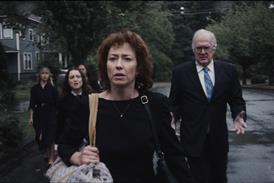
A brief black-and-white prologue introduces an ensemble of characters from across the decades emerging from the mist. The film switches to colour, and in the 1920s we meet a wealthy farmer who has earmarked a parcel of land as the inheritance for Klara, the youngest of his four daughters. But fate dictates otherwise for the first of several female characters whose liberty is trampled on. The film’s concern for the women and children of history is strong. That comes from the source: an extraordinary 2008 novel by Jenny Erpenbeck, a book so particular in its parallel detached and involved tones that any adaptation would struggle to capture them exactly. The film’s occasional narration pulls us closer to Erpenbeck’s voice, and Visitation mostly sticks to the book’s events.
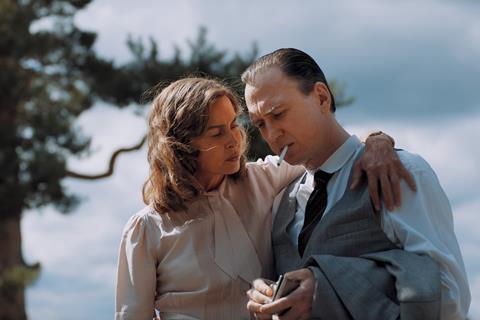
In 1930 the farmer offloads his land to two buyers: Arthur Engel (Ulrich Matthes), a Jewish cloth manufacturer, who builds a summer bathing house for three generations of his family, and a thrusting young architect (Lars Eidinger, delivering a performance of proud delusion) who is about to marry his second wife (Susanne Wolff, giving a subtle portrait of resilience). The couple builds a gleaming Bauhaus-style house, symbolic of a fresh start for the couple and a new era for Germany.
Here, Schlöndorff and cinematographer Axel Schneppat establish a crisp, unfussy visual style. Along with production designer Sebastian Soukup they indulge the house, the bathing house and their surroundings as if they are characters. It brings to mind other cinematic residences which similarly witnessed generational upheaval in Joachim Trier’s Sentimental Value and Mascha Schilinski’s Sound Of Falling. The period detail, which extends to the costumes, is engrossing.
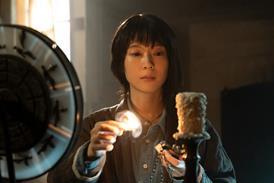
The 1930s and 1940s – grimly, inevitably – bring death and disappearance. By the 1950s, the house is occupied by an idealistic communist writer (Martina Gedeck, inhabiting the film’s key theme of strong women sunk by the weight of history), who, like many of the founding generation of the German Democratic Republic, has returned to Germany from exile in the USSR. Only two characters travel the entire film: the narrator (revealed to be the writer’s granddaughter looking back from the early 2000s) and a mute gardener who chops, prunes and digs regardless of the political weather. These two feel like allies: we share their all-seeing eyes, and much of the power and melancholy of Visitation lies in this large ensemble of characters knowing so little about the historical forces bearing down on them.
One of the challenges of adapting this book is that in the novel Erpenbeck’s knowing narrator enlightens us, in asides, about events far away from this lakeside location in a way that Schlöndorff mostly chooses not to. We sometimes have to make do with our imagination and a well-judged use of archive news footage (although the director avoids footage directly relating to the Holocaust). There’s a startling aerial shot of Berlin’s Unter den Linden, ravaged by war. The suggestions are enough.
Visitation is a ghost story of sorts – although it’s not the house and the land which these characters are haunting, but twentieth-century German history. You can imagine the attraction of telling such a sweeping story for Schlöndorff. His films have regularly explored the experiences, morals and choices of individuals in extraordinary political times. This is a fitting late-career triumph.
Production companies: Ziegler Film, Volksfilm, Studiocanal Film, Studio Babelsberg, Mideu Films
International sales: Studiocanal Paris, chloe.marquet@canal-plus.com
Producers: Regina Ziegler
Cinematography: Axel Schneppat
Editing: Florian Miosge
Production design: Sebastian Soukup
Music: Annette Focks
Main cast: Lars Eidinger, Martina Gedeck, Susanne Wolff, Michael Maertens, Ulrich Matthes, Detlev Buck, Angela Winkler, Wigand Witting