











Despite a buzzy premiere at Cannes, the documentary filmmaker struggled to sell the film’s US rights and is releasing it himself in the UK.
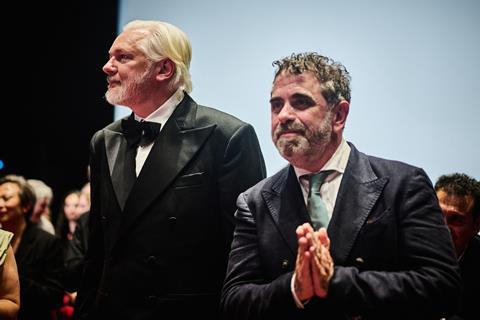
When US filmmaker Eugene Jarecki’s Julian Assange documentary The Six Billion Dollar Man premiered in Cannes last May as a special screening, the film seemed like an instant triumph.
Less than a year after he had been released from Belmarsh high security prison, WikiLeaks founder Assange turned up in a tuxedo on the Croisette, walking the red carpet alongside Rafael Correa, the former president of Ecuador who had given him sanctuary in his country’s embassy in London in 2012 when he was fighting against extradition to the US.
The film received strong reviews and won the festival’s L’Œil d’or prize for best documentary. But fast-forward six months and the continuing wariness about Assange within mainstream US media outlets is apparent.
Although The Six Billion Dollar Man was sold by WME Independent to Watermelon Pictures for North America in early November and has screened at festivals including Zurich, IDFA and Doc NYC, the documentary has been shunned by the major studios and streamers. At least, that’s what its director believes.
“Like WikiLeaks itself, the film about WikiLeaks now finds itself in a media blackout. It’s a film that mainstream streamers and mainstream media outlets do not want you to see. If they had wanted you to see it, they would have bought it,” he declares. “I get the feeling they’re scared of this kind of content.”
In Trump’s second term as US president, Jarecki suggests, major entertainment companies are stepping gingerly when it comes to subject matter that might upset the White House.
“We’re living in a time when those kinds of stories get the cold shoulder because there are pressures that make media employees fear for their jobs at a time when, if the president of the United States doesn’t like something, he sues the media company for such an amount of money that he crushes them into settlement.”
The days when Michael Moore’s political films like Fahrenheit 9/11 could gross more than $220m at the global box office do seem a long way in the rearview mirror.
Underdog
The director describes The Six Billion Dollar Man as “a massive underdog” in this season’s awards race. Jarecki’s own company Charlotte Street is overseeing a UK theatrical release on December 19, with several Curzon and Picturehouse sites already secured.
Watermelon is expected to launch the film in US cinemas early next year, but the subsequent digital release will be handled by the filmmakers.
“Instead of submitting ourselves to the indignity of the way that streamers, even if they took a film like this, would bury it behind more spectacular circus fare, we are going to bring it directly to the consumer,” says Jarecki.
The plan is for an online release model similar to that pursued by controversial US comedian Louis CK, who has made his work available to his fans exclusively on his own website.
“I think it will be the first time a movie wins [a prize at] Cannes and says, ‘Fuck it, we are bringing this directly to you. We’re not here to be compromised by a system that, at the moment, is not finding a way to service the public need for information.’”
The director is keeping details of his “guerrilla” online release plans under wraps for now, but believes there are “massive followings of people around the world who feel that governments aren’t telling them the truth” and who will pay to watch the documentary.
The Six Billion Dollar Man was made under the radar. Jarecki didn’t want to publicise the fact that he had gone to Moscow to interview Edward Snowden a week before the full-scale Russian invasion of Ukraine or that he had several sources putting themselves at huge risk to speak to him. But such secrecy means it was hard to build up buzz around the film in advance of the launch.
Another issue is the “love-hate” relationship between Assange and newspapers such as The Guardian and The New York Times that had initially chased after the scoops WikiLeaks provided. “But then they had to deal with Julian Assange, whom they found haughty, a tech guy, not a journalist like them, not someone who had paid his journalism dues,” says Jarecki.
The Six Billion Dollar Man has some influential industry figures behind it. Executive producers include billionaire Australian media magnate James Packer; Geralyn White Dreyfous, also an exec producer on Venice grand jury prize winner The Voice Of Hind Rajab; Mathilde Bonnefoy, an editor and producer on Laura Poitras’s Oscar-winning Edward Snowden doc Citizenfour; and Vincent Maraval.
The credits also acknowledge Nick Fraser, the former head of BBC Storyville (with whom Jarecki worked on his 2005 feature Why We Fight), as “consulting producer”, and thank everybody from Minnie Driver to Ted Hope and Tom Tykwer.
Chilling investigation
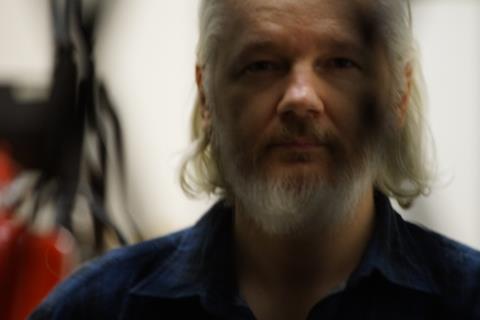
The film chronicles in chilling fashion how the US set out to crush Assange. It is now accepted that he was subjected to psychological torture during his time in the Ecuadorian embassy.
The title of the documentary isn’t just a nostalgic pun on the 1970s TV show starring Lee Majors but refers to a US-brokered deal allegedly worth over $6bn in IMF support to Ecuador for giving Assange up. The FBI’s main informant against Assange, Siggi the Hacker, was a young Icelandic fraudster and sexual offender who later admitted to making much of his testimony up.
By the time Jarecki started making the film, Assange was already in Belmarsh prison. “My job was to be an independent investigator,” he says. “I might have found that Julian Assange was a bad guy and if I had found that, I would have had to make that film.
“We tried to get to the facts that had not been told before,” he continues. “But you have to understand that the first facts that came to me shattered my brain. It was the evidence that Julian Assange had been tortured inside the Ecuadorean embassy in central London – and I didn’t know that the United States had paid a bounty of $6bn to the country of Ecuador to damage Julian Assange.”
Jarecki also discovered the US was “full-time eavesdropping” on Assange’s meetings with lawyers and doctors in the embassy, in flagrant contravention of any attorney-client privilege. The director had interviewed Assange in the Ecuadorian embassy for another project a few years before, but once he started work on the documentary, he had no direct contact at all with his subject. The next time they met face to face was in Cannes.
One still very sensitive subject is the rape and molestation allegation brought against the WikiLeaks founder in 2010. The two Swedish women involved appear in the film. While their testimony certainly doesn’t show Assange in a favourable light, the film also makes it clear that they felt railroaded by the authorities. They wanted him to have an HIV test, but it was the police, not the women, who decided to investigate for rape.
In the end, the US government dropped 17 of its 18 charges against Assange. He pleaded guilty to unlawfully obtaining and disclosing classified documents related to the US national defence and was released from Belmarsh in June 2024, 12 years after entering the Ecuadorian embassy.
Jarecki likens his documentary to a spy movie in the vein of All The President’s Men or Three Days Of The Condor, “a story full of “hidden narratives, spies, torturers, corrupt officials and task forces of defence and intelligence people trying to bring down one single controversial, lightning rod figure. There was so much that Hollywood couldn’t make this shit up.”
Although a patchwork of investors including Packer got behind the movie, Jarecki also took out loans “that put me in personal economic peril” to complete it. But he remains optimistic that his new online releasing strategy will work with audiences frustrated by the traditional studios, streamers and broadcasters.
“Basically, you have giant dinosaurs failing to service the public along information, education and even entertainment lines. When you see them not doing it, you take the law into your own hands.”






No comments yet