




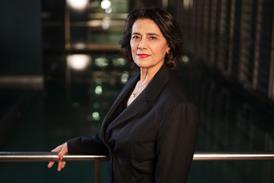





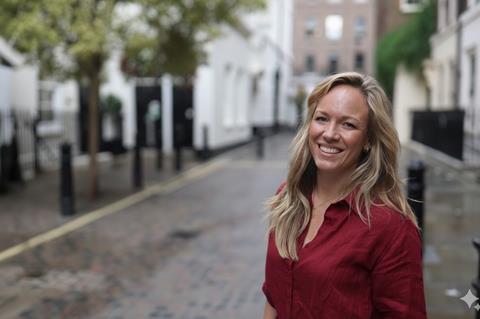
Eline van der Velden has found herself at the centre of a global media storm over her company’s creation of AI actress Tilly Norwood.
On social media, everyone from celebrities to unions have weighed in when van der Velden announced that talent agencies were interested in signing the digital avatar.
A self-confessed ‘glass half full girl’, van der Velden - the London-based founder of AI production company Particle6 - says the social media furore was an ”absolutely fascinating” experience. “The internet is a brutal place, but at the same time it showed a lot of people that our use of AI is a cut above the rest. I’m very much looking at the positive of it.”
For van der Velden, the experience also revealed how little is known about the current possibilities of AI tech. Many people believed Tilly was actually the first AI actress, when the reality is that they can be generated ‘in a split second’ with tools such as Veo3 or Higgsfield.
As much as the tech tools are impressive, they also have limitations, says van der Velden. It took Particle6 nearly six months to create Tilly, perfecting her over the course of multiple iterations so she didn’t look too airbrushed and fake.
“People are scared because they haven’t played around with the tools…then you realise it is actually quite hard to create good stuff.”
Humans are central to the process of creating good AI, she insists. “There is a lot of taste and judgement you need to get it right… It is a creative process – it is all about humans deciding in what direction to take it… there is human involvement in every step of the way.”
Rather than seeing AI as a job destroyer in the creative industries, she is convinced that an AI specialist like Particle6 is a “force for good”.
At a time when many projects are struggling to achieve the final 20-30% of their budget, van der Velden argues AI can help to reduce costs and to enhance creative possibilities, helping to get more into production and more actors working.
She’s also proud that it is a UK AI-focused firm that is making waves. “We need to make sure that British talent is at the forefront of this new creative renaissance as well, and that we don’t get left behind.”
Low-budget background
Dutch-born van der Velden studied physics at London’s Imperial College before working as an actress and comedian, achieving success on YouTube and BBC3 with her beauty queen comedy character Miss Holland.
She set up Particle6 in 2010 to make Miss Holland and other shows for digital channels, honing its ability to deliver impactful shows with low budgets. “We had that sort of YouTube mentality where everyone mucks in and we get it done on a lower budget,” recalls van der Velden.
It was natural for Particle6 to embrace ChatGPT soon after it launched in 2022 as a way of making programme budgets go further. Van der Velden recalls using it to help write programme synopses for 20 short videos it was making for Sky Kids, later using it for pre-production tasks such as budgets, risk assessments and call sheets.
When text to video models such as Sora launched in 2024, “I realised it was going to change everything,” says van der Velden.
At that point, Particle6 pivoted, reinventing itself as an AI production specialist.
Scaling up
The 16-strong company is now scaling up – van der Velden says she is aiming to triple its workforce in the next few months amid an influx of work.
“We’re growing organically at the moment,” says van der Velden, who says the company has not taken outside financing although “we’ve had a lot of investors circle us over the past year.”
Particle6 is hiring for roles which have only recently come into existence – such as AI DoPs and AI production coordinators.
An AI DoP is “someone with great taste and judgement and a great eye”, she explains, who will select the best shots that are generated by an AI technician’s prompts. An AI production co-ordinator, meanwhile, has “up to five times the output of a traditional production co-ordinator” thanks to AI tools.
Her advice for anyone wanting to move into AI production is to embrace the tech and to train themselves on it. “There are going to be so many jobs: train up in AI and put the word AI in front of your job title…if you call yourself an AI production co-ordinator, you are going to be in demand. The same goes for most other jobs.”
She reckons AI tools will lead to a three-fold increase in production. “We are going to see a massive increase in total production.”
She says Particle6 is talking to many other film and TV companies about co-producing projects that they have not been able to complete funding for, helping them to use AI to get their productions made at a lower cost. Earlier this week, it announced a new commission for an AI-led time travel series from The History Channel in the Netherlands. Streets Of The Past will use AI to recreate the country’s most famous streets, squares and canal sides.
For other projects, Particle6 might help create establishing shots or expensive nature scenes at a fraction of the usual cost. She says the company is focused on “helping traditional film and TV with lower budgets achieve great quality…We don’t want people to cut expensive scenes – we don’t want to compromise on the storytelling.”
It’s for this reason that the industry shouldn’t be scared of AI, says van der Velden. She reckons the industry is on the verge of a creative renaissance with more going into production – and more but different jobs.
She says “really big names” from film and TV have got in touch. “It’s actually the people at the absolute top of the industry who are really interested - because they are not afraid. They want to see where we can take this next… The middle layer is sort of treading on eggshells.”
Future landscape
Looking ahead, she suggests there will be three distinct kinds of genres in the AI world: animation, traditional live action and a separate AI genre.
Live action filmmaking will continue to thrive. “I very much believe we still want to see real actors in real films. But I also think it’s really interesting to watch an animation or an AI film.”
In September, van der Velden launched spin-off firm Xicoia with a focus on creating digital talent, like Tilly Norwood, via AI. Billed as the world’s first AI talent studio, it is designed to create, manage and monetise future digital stars.
In total, Xicoia aims to launch 40 digital stars like Tilly, each with their own backstories and personalities to appear in AI films, series, commercials and social media platforms. “We’ve been approached by a lot of people about putting Tilly in a movie. For now, we think Tilly should stay in the AI space.”
But where does she stand on the fact that many AI models are trained on copyrighted material, often without explicit permission? It’s complicated, she says. Models that have been trained on huge film catalogues, for example, should settle with the big studios.
“However, I, as an actor or a gaffer or whoever might have been involved in producing that stuff, I’m not going to see any money from that settlement. I could mope around about that. Or I could go, ‘Look, it’s trained on everything, including my stuff. But I’m also allowed to use it all. The whole of humanity is allowed to use these tools.”





No comments yet