

















This year’s American Film Market (AFM), which runs from November 10-15, is taking place at an interesting juncture for independent film.
Distinctive films such as Black Bear’s medieval fisherwoman comedy Wicker, Laika’s Wildwood and A24’s Elizabeth Holmes documentary You Can See Everything are outperforming expectations at the box office across the globe, and providing grounds for optimism.
“I definitely see the return of sophistication. The return of the frictive, of the singular, of the controversial,” says Architect Film Sales co-founder Calum Gray, whose slate includes Australian horror Wolf Cre3k.
But at the same time, as Netflix lays off 6% of its staff amid a tumbling stock price, and two huge buyers in Warner Bros and Paramount consolidate into the single Skydance entity, there are concerns that challenges lie ahead.
“I’m interested to see what Skydance does to the pay-TV landscape in the US. Losing one of those buyers isn’t going to be great – that’s not going to happen immediately, but I wonder if they’ll merge the teams… I’m interested to stress test how the US buyers are feeling,” adds Gray.
Despite the changes at Netflix, some sellers can see positive movement in the market from streamers.
Gray suggests the move into an advertising-based video on demand (AVoD) model means players including Netflix and Amazon need to re-focus on quality content, as opposed to quantity, which could be a good thing for the independents.
“By using AVoD metrics on retention rather than first click, [streamers] become a lot choosier because their business models change. A metric of retention just puts the bar up for us. We have to deliver things which hold an audience, which are distinctive conceptually, are packaged right.”
“What we need is for the streamers to support theatrical distributors’ releases by actively buying that pay-one [window] rather than self-generating,” adds Gabrielle Stewart, CEO of HanWay Films, which is launching Argentinian filmmaking duo Mariano Cohn and Gastón Duprat’s Mare Nostrum and Italian romantic comedy Honeymooners at AFM. “I see signs that they do.”
“It’s the least sexy market”
There is a solid showing from UK sales agents at this year’s AFM. While taking full-fat teams with all the marketing and acquisitions departments is no longer financially viable for most, the sales teams will be out in full force.
Some UK sellers have opted for a shared office space once again, this year housing Altitude, Blue Finch, Reason8, Screenbound, Celsius and The Mise en Scene Company.
UK sellers were delighted at how last year’s Fairmont Century Plaza venue worked out, closely located to the CAA, UTA and WME offices, after a few years of discombobulating venue-hopping. And with more restaurants understood to be opening this year at the back of the Fairmont building, the sellers are eager to get back.
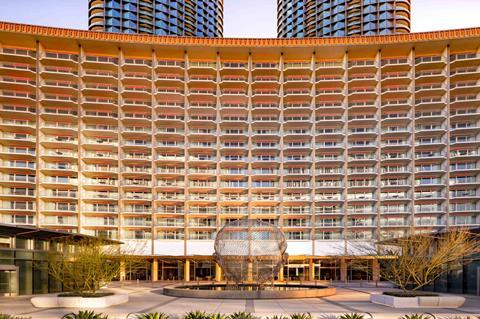
“It was my favourite market of last year because it is so well organised,” says Gray. “Efficient screening facilities, restaurants close to the main drag.”
“I can feel there’s so much more engagement from the agencies, the financiers [at the Fairmont]. AFM’s role in terms of connecting us to LA in business is there. When we were at Santa Monica, we were disconnected from the heart of the business,” says Stewart.
“It’s the least sexy one, compared to Berlin and Cannes and Toronto,” admits Mike Chapman, managing director of Blue Finch Films, which is selling horror thriller American Dollhouse at the market. “I’m hoping it will be like last year, which was very stable business, no major mess-ups, just all went to plan. It’s efficient, and all we need the market to be is efficient.”
“For the right packages, it is a good pre-sales market,” adds Protagonist Pictures’ new head of sales Sarah Lebutsch of AFM. The company will talk to buyers about its new packages: comedy It’s Alright starring and co-written by Paul Bettany and Robin Hood story The Lie Of Sherwood Forest.
“The big buyers are coming, and they are pre-buying there because, for better or worse, there isn’t the distraction of a festival.”
She does caveat that despite the range of US indie buyers that are growing in presence, from 1-2 Special to Angel Studios, that space remains tough for pre-sales. “It is probably a part of the world where pre-sales have become less prevalent, and we tend to sell more either off footage or on completion. But it’s not impossible.”
Engaging with buyers
On the international buyer side, a few absences have been noted. Some Australians are understood to have sat this year out. Middle Eastern buyers will be engaging remotely, although the region is perceived to be difficult to sell into right now, with the ongoing conflicts impacting buying power.
“A lot of those TV [deals] are linked to government budgets, so they have been forced to tighten those belts,” says Gray. “Some of those buyers are suffering a bit. I’m very sorry for that.”
Toronto’s inaugural market in September has also had an impact.
“There were a few buyers who went to Toronto expecting it to be more of a market and as a result aren’t coming to the AFM,” says Chapman. “Toronto is very expensive, AFM is very expensive, there are certain buyers from Latin America or Europe who are only doing one or the other.”
HanWay is prepared to engage remotely with such buyers.
“We are going to have a filmmaker event showing promos and filmmaker presentations,” explains Stewart. “We make sure that everyone attending is rewarded and gets to see it first, but then we make it available on a link because not everyone chooses to attend, and I understand that everyone’s having to make some financial decisions.”
For those buyers who did attend Toronto and will now be at AFM, any disappointments at the former could bring upsides for the latter. “Every buyer I’ve spoken to out of Toronto did not pick up very much that was playing in the festival. Maybe that means there’ll be more hunger at AFM,” suggests Chapman.
For Chapman, whose company is focused on genre titles, AFM comes at a useful point in the year. “We have a lot of films that either premiere or play at the key genre festivals around AFM. Beyond Fest has become more and more important to us. Having something premiere at Beyond and then being able to follow up with buyers at AFM is perfect timing. Sitges is around the same time, as is Fantastic Fest.”
Political shift
US politics will undoubtedly be a key talking point at AFM for local and international industry. It is the first major market since US lawmakers introduced a federal bill for a 20% transferable tax credit that will apply to above-the-line actors and directors as well as below-the-line workers.
“I’m delighted,” says Gray. “It will mean greater viability of finance plans coming out of the US, certainly for the lower and mid-level. We like good producers being able to greenlight more.”
“It’s a game changer for any films that you’re setting up in the US,” adds Stewart. “It’s an extra 20%, but at the same time, how much of it will be absorbed by talent agents asking for higher fees for their clients, because it encompasses above the line?
“I just hope that everyone approaches it holistically and continues to appreciate that they’ve got to support independent film,” she continues. “The biggest challenge is availability of talent and holding on to talent, because if they get offered a big paycheque from Netflix or Amazon, they’ll jump. And if that federal tax incentive is available for an Amazon series, and they’re going to manage to make it cheaper, they’ll probably pay the talent the extra, in a way that an independent film can’t. That balance of power isn’t going to change. It might even be increased.”
There is also the Democrats’ huge success in the US mid-term elections, which it is hoped will help bring about more global political and economic stability after an erratic two years under Donald Trump’s second presidential term. Whether the positive knock-on effect will be felt so quickly at AFM, no one can be sure.
“Most of the independent film industry will probably be feeling positively encouraged by these results, so it can only lighten the mood,” says Lebutsch.
“Republicans are blaming the war in Iran for the cost-of-living crisis, and it’s impacted the world’s cost-of-living crisis,” adds Stewart. “The fact that we can all feel incredibly certain that ending the war in Iran is of paramount importance now in America, that will take a lot of global pressure off everyone – cost of living, businesses. It has given us all a little boost.”






No comments yet