





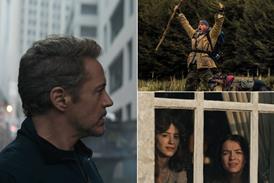
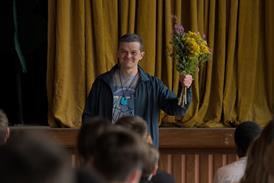

The family pair discuss the draw of brotherhood and the beauty, power and romanticism of nature that resulted in their first filmic collaboration.
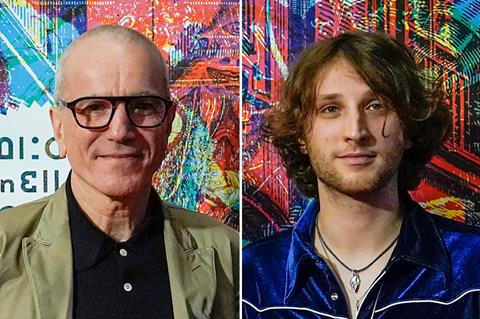
When artist Ronan Day-Lewis began to think about migrating into feature filmmaking, his celebrated actor father Daniel knew he wanted to be a part of it. The three-time best actor Oscar winner had retreated from acting after Paul Thomas Anderson’s Phantom Thread in 2017, saying he felt “hollowed out”, but found himself drawing from a replenished well as he set about co-writing a screenplay with his son.
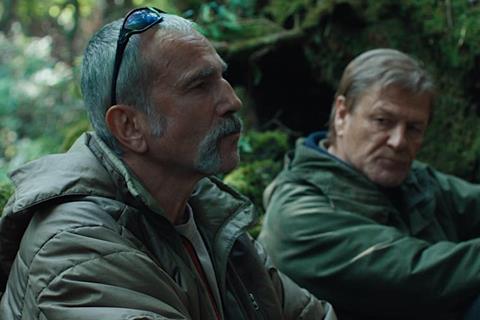
At first, knowing only that the story would concern brothers, the pair grew Anemone into the tale of soldier siblings Ray (Day-Lewis) and Jem Stoker (Sean Bean). The former lives a hermitical life in a woodland hut in the north of England; the latter, a man of deep faith, has become a husband to Ray’s ex-partner Nessa (Samantha Morton), and a father to his soldier son Brian (Samuel Bottomley). Two decades estranged since tours of duty during the Troubles in Northern Ireland, the brothers seek to reconnect haltingly when Jem visits Ray’s isolated shack.
Produced by Dede Gardner and Jeremy Kleiner at Plan B and released by Focus Features in the US and Universal Pictures in the UK, Anemone showcases the return of one talent and the arrival of another. The director and star – and joint screenwriters – sat down with Screen to discuss how they explored themes of grief, abuse and fractured family in an archetypal story with mythic underpinnings.
Screen International: How much of the story did you map out before the writing began?
Ronan Day-Lewis: I had this vague idea of wanting to do something with brothers. I have two brothers and I was fascinated by the beauty and tragedy of brotherhood. I wasn’t sure if it would be more of a coming-of-age story – something that felt a bit closer to my experience. Then when my dad had an idea of us potentially doing something together, we realised we both had the same fascination with brotherhood as a subject.
We would talk about these characters, and it became clear that it would be an isolated setting. The world of the film started to appear to us before we knew exactly where it was taking us, that it would have this pagan aspect, and just the idea of a person who’s living in this state of self-banishment in the middle of nowhere, and his estranged brother who shows up after 20 years. We didn’t know why they were estranged or why he had banished himself.
You always wrote together in a room.
Daniel: We did. It was a decision we made before we even started, and it was a good one. Ronan was writing everything down, and he was refining and distilling the language as it came out. We could have done that remotely but it would have been a bit weird, especially because the impulse was to have that time together. Therefore, let’s begin, and keep going, shoulder-to-shoulder, rather than on other sides of the continent.
At what point, Daniel, did you decide that you were going to be in the film?
Daniel: I was always going to be in it. I wanted to work with Ronan in that way – myself as an actor, him as a director. But I was equally fascinated by Jem’s experience. It came more easily to me because Jem was inspired by a very old friend of mine who had served a full career in the British armed forces and was a man of deep personal faith. But then I’ve always been attracted by less-familiar things, so Ray’s orbit finally had the bigger tug on me.
Is there any overlap between Ray’s life and your own?
Daniel: I never thought to try and define that connection. Certainly, people have suggested, “Well, he’s a recluse, you’re a recluse.” But that’s not my experience – I just live a quiet life. There’s a part of me that is drawn to the ascetic life, but I’ve never fully lived that life. We live in County Wicklow, close to Glendalough, the ancient religious community where St Kevin set up one of the most important centres for Christian learning in that part of the world. Then, too many people flocked to him and he ended up living out his life in a cave above a lake, known as St Kevin’s Bed. I have always been fascinated by that life. Perhaps, through Ray, I was allowed to do that.
What was it about Sean Bean that made you think of him as Jem?
Ronan: I saw him in Game Of Thrones when I was 13 and he’s just incredible. He was this mythic figure, and when we first started talking about him as Jem, I couldn’t imagine anyone else.
Daniel: I’d never worked with him. We met as youngsters at a casting session and I had a good feeling about him, followed his work over the years, really enjoyed his work, and I just felt the last few years he’s got better and better. I called him when I’d seen Time, that amazing piece of work with Stephen Graham. We literally had a shortlist of one person.
You have ties to Ireland. When did the background story of the Troubles fall into place?
Ronan: We knew early on that Ray had been involved in a conflict of some kind. It wasn’t immediately the Troubles. Having lived [in Ireland] from seven to 13, and learned about it in school, it baked itself into my imagination and my consciousness from an early age. And obviously my dad had his own deep connections to Ireland, before I was born.
Daniel: I spent a lot of time in west Belfast, particularly the Catholic area, Twinbrook. Very happy times there, but certainly the life of the city at that time was shocking to me. To get into the city centre… there was almost like a cage around it. You had to go through turnstiles manned by British soldiers. I remember being deeply shocked by the proximity of armed men out in the open. And the absurdity of it – houses that backed onto each other, thinking about each other as if they were an alien species. But what had never occurred to me was to think about the everyday life of a soldier on those streets. So it was right and proper we spent time exploring that.
How much of the fathers-and-sons theme comes from yourselves? There must have been times during film shoots when you were apart for extended periods?
Ronan: Early on, as a child, they just took us with them. [Ronan’s mother is filmmaker Rebecca Miller.] But once we were of an age when we couldn’t just up and leave school, then there were times when dad was off working on something for a while. And even though there was no autobiographical connection to Brian, that sense of the mystery of the parent’s secret life or past life was something I could connect to. My dad’s work was always mysterious to me.
Daniel: My relationship with my father [poet laureate Cecil Day-Lewis] was probably closer to Brian’s… imagining the absent father. He might have been there in the house until I was packed off to boarding school, but we tiptoed around him. The household was organised around his needs, his work. He was very self-absorbed. He was kind and patient up to a point, and then he wasn’t. I’ve tried to remember conversations I had with him when I wasn’t in trouble and I can’t really think of any. To some extent, that’s what happens, especially if your parent dies when you’re young [Cecil died when Daniel was 15]. You’re in communication with an imagined father for the rest of your life.
Ray has banished himself to a shack in the woods. How did you find the location?
Ronan: There were certain natural locations that we’d imagined for the film, which Anglesey, where we ended up shooting, had already. The forest comes up directly to the beach. Very unusual. It was important to have that slightly magical jutting together of these elemental components: forest, beach, sea. We were looking for places to construct the hut, and the locations manager brought us to these woods. We were wandering through the trees and caught a glimpse of something. We walked over and it was this clearing that was the perfect size.
Daniel: With this shell of a house.
Ronan: The bones of this structure were the exact right dimensions.
Daniel: So then Chris [Oddy, production designer] built a roof on it. It was just walls.
Ronan: We also built a replica [in the nearby Aria Film Studios], so scheduling-wise we could shoot night scenes during the day. And there were certain shots that would involve removing a wall and operating a crane inside the hut.
Daniel: I was wary about it. Locations give you something for nothing. On a soundstage, you’re always investing something that’s needed, in terms of your spirit, into that place to make it come alive. But because we had that living example in the woods, it’s almost like the energy transferred somehow, to the stage. And Chris made it perfect. Once you closed the door, you couldn’t tell the difference.
There is a painterly aspect to many of the exterior shots. Ronan, did you consciously import that from your artwork?
Ronan: My painting practice for the last few years has been increasingly getting attracted to these mundane subjects, but then imbuing them with this mystical power, and the sense of this spiritual, unknown element that’s breathing right beneath the surface of this veneer of reality. I wanted to find a visual language [for Anemone] that was able to take this framework of reality that the film had to sit on but imbue it with something that felt mythic. Because, on paper, this could be a kitchen-sink film.
Do you feel in tune with that spirituality when you’re out in nature?
Daniel: I definitely do. That is something I have in common with Ray, the tendency towards paganism, just feeling the spirits in the trees and the lakes. It goes back to the earlier question about the austerity of the ascetic life. But when you do live that life, you’re living in connection with things that are nourishing you in so many different ways. It may seem to an outsider or a city dweller that there’s a paucity of sensory experience, but the opposite is true.
Ronan: There’s a brutal, rough romanticism in the concept of the film that the landscape and the actual environment added to. We were always catching these touches of the sublime.
Looking back, how was the experience of working together?
Daniel: It was very moving to me. To be right next to Ronan, doing this. With such ease as well. We went from writing the film to making it in a very natural way.
Ronan: It’s hard to put into words how much it meant, knowing each other so deeply, and having adored his work for so long, and felt so fascinated by his process. Then to be able to work so intimately and collaboratively for such a long period of time.
Will you work together again in the future?
Daniel: I’d love to. It’s all about the common ground. You’ve just got to share the right kind of madness at the right time.
Ronan: It’s like a group psychosis.
And Daniel, are you open to again working with other filmmakers?
Daniel: There are things I’m interested in, in principle, and a couple of people I’m chatting to about maybe doing something. It always begins with a kernel of an idea, that may sprout and blossom into something.






No comments yet