













This CPH:DOX premiere follows the beleagured fishing communities of England’s north east coast
Dir. Jeanie Finlay. UK. 2026. 99mins
On 25 September 2021, an unprecedented ecological disaster occurred. A mass die-off of crabs and lobsters saw the beaches of England’s north east coast turn black with the remains of dead or dying sea creatures. It was an extinction event; not just for the crustaceans, but also for the fishing industry which has supported the local community for centuries. Jeanie Finlay’s powerful picture shows the struggle of indefatigable fisherman spokesman Stan Rennie to make himself heard by the politicians who claim to fight for the interests of the people, speaking truth to power with a broad Teesside accent.
Finlay’s links to Teesside combined with her humanist approach makes for a potent combination
It’s a film with a personal connection for Finlay, who grew up in the region and whose mother still swims in these coastal waters three times a week. It’s also a return to the region as a filmmaker – Finlay’s breakthrough film, 2011 SXSW-premiering title Sound It Out, was an affectionate portrait of the last remaining record shop in Teesside. Finlay’s links to Teesside combined with her empathetic, humanist approach to storytelling make for a potent combination. It’s a film that offers both a specifically local account and tells a story with global resonance.
Following the success of Finlay’s previous film, Your Fat Friend, which won Sheffield’s audience award and was released in the US, UK and other territories including Australia and the Nordics, All The Rivers Spill Their Stories To The Sea should be a title of interest for documentary distributors. More than this, it should be essential viewing for the environmentally conscious and for anyone with an interest in holding the economic idealogues of Westminster to account.
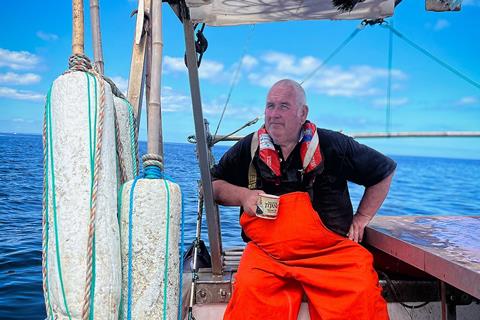
At the start of the film, Stan, buoyant in his fishing boat and wearing his fish-themed braces, describes himself as “the luckiest man in the world”. He has everything he wants and needs in life: a loving family living nearby, a close-knit community, a decent living. But take one element from that equation and nothing adds up. Following the mass die-off in what has traditionally been a rich fishing ground for crabs, lobsters and prawns, Stan’s lobster boat struggles to cover the cost of its diesel, let alone provide enough to support a family.
Even so, Stan considers himself one of the more forunate ones: he at least has savings to fall back on. Other younger men have mortgages to pay and school-age children to support. Their grave, haunted expressions give a sense of the unimaginable stress facing the community. It’s for these men, and for the eco-system that previously supported them, that Stan takes on the new mantle of campaign leader and environmental activist.
In doing so, Stan finds himself at odds with the Tory mayor of Teesside, Ben Houchen, who has fast-tracked the development of the first of a proposed batch of post-Brexit freeports. (These special economic zones with tax and customs exemptions perhaps merit their own dedicated investigative documentary). The problem with the accelerated development of a formerly heavily industrialised region is that there is a chemical legacy in the rubble of the destroyed infrastructure. The fishermen put two and two together and link the die off to increased and deeper dredging in the mouth of the Tees.
Crowdfunded independent scientific studies support the theory, with the chemical pyridine a likely culprit. But the Environment Agency dismisses this potentially expensive possibility, blaming first an algal bloom, and then a “unique pathogen”. The mayor, protective of his ambitious redevelopment plans, goes on the attack, dismissing Stan and his fellow campaigners as “activists”. Man of the people Houchen is, it turns out, only a man of the people who agree with him.
It’s a sobering story of a David and Goliath battle that doesn’t end with the triumph of the little guy. But Finlay counters the dispiriting details of political indifference by showcasing the fishermen’s spirit and their gallows humour. She also has a keen eye for details that lovingly evoke the textures of the wider community and, in a sensitive score, music choices that complement the emotional complexity of the situation. Ultimately, the film is a celebration of the region and its people, and a much-needed amplification of voices that are all too frequently drowned out in the rush to redevelop.
Production companies: Glimmer Films, I Am Charlie
Contact: Glimmerama hello@glimmerfilms.com
Producers: Jeanie Finlay, Charlie Phillips
Cinematography: Jeanie Finlay, Mark Bushnell, James McAleer, James Cook
Editing: Nicole Hálová
Music: Lomond Campbell


