







Director James Griffiths and writers/stars Tom Basden and Tim Key recount how trying to turn their 2008 Bafta-nominated short into a feature nearly became “one of life’s regrets”
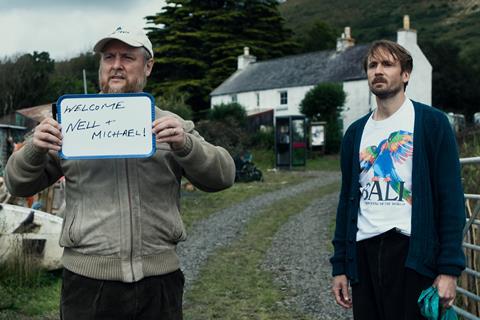
The Ballad Of Wallis Island swiftly amassed a word-of-mouth following when it hit UK and Ireland cinemas in May, with Richard Curtis hailing it as “one of the greatest British films of all time”. The Sundance world premiere has taken $3.4m (£2.5m) in the UK and Ireland to date, and $6.1m globally for Universal/Focus Features.
But behind the seemingly smooth growth of the film’s fanbase was almost two decades of anxiety for filmmaker James Griffiths. “I was worried we would never get to make the film,” he says. “It was becoming one of life’s regrets for me.”
Griffiths first met Tom Basden and Tim Key, the writers and stars of the film, when he auditioned them to appear in an advert he was directing, with Basden landing the part. The actors were already pals from the Cambridge Footlights student sketch comedy troupe. (Key never studied at Cambridge University but had managed to infiltrate the group.)
A short, The One And Only Herb McGwyer Plays Wallis Island, grew out of some sketch work the trio were experimenting with, and was nominated for a Bafta in 2008.
“That gained some interest with Film4, who wanted to develop something with us,” recalls Griffiths. “They partnered us up with Big Talk, but it was formative years, and we got a bit distracted and moved away from the ethos of the short film. We were told it was too small to develop into a movie, that there wasn’t enough in it.”
The project was shelved as the film’s heart got lost amid too many voices from producer partners and financiers. “Like a long walk up a windy beach to a café that’s closed,” in Griffiths’ words.
A friendship between the trio remained, despite Griffiths moving from the UK to the US, where he forged a career directing pilots for ABC Studios, such as Black-ish. Basden and Key continued to write out of their shared flat in Kentish Town, north London, and built careers as firm stalwarts on the UK TV and stand-up comedy scene.
“Whenever we got back together for a curry and a beer and a chat about what we’re doing, we talked about that as the thing we were still proudest of,” says Griffiths of the short.
Motivating factor
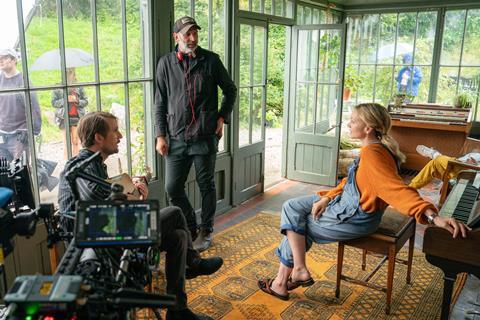
When Griffiths decided to return permanently to the UK around the time of the pandemic, there was one project on his mind – and the smallness of Ballad might now be its strength. “We could just shoot it on an island, and create our own bubble,” he recalls.
Basden and Key started writing a script for the feature in 2020, expanding it from the two-hander short about an eccentric fan and their favourite musician to include a female lead. The story of Charles, played by Key, was born, an eccentric widower and lottery winner who invites a once-successful folk duo and former couple, Herb McGwyer (Basden) and Nell Mortimer (Carey Mulligan), to give a private concert at his remote island home.
The project was put on the back burner once again when the UK post-pandemic production boom kicked in. “It got busy with lots of projects because the industry went mad for filming, so we all disappeared and made things,” says Griffiths, whose credits include upcoming Netflix series Grown Ups, Apple TV’s Bad Sisters and 2014 UK comedy Cuban Fury. “We came back to it again, post-Covid. It took a few attempts.”
The script had found its way to Rupert Majendie at Baby Cow. He had just produced 2022 UK indie feature Brian And Charles, a tonally similar comedy drama, sold by Bankside Films and distributed by Focus Features. Majendie brought Ballad to Bankside, with Focus boarding to help finance and distribute once Mulligan had said yes to the role of Nell. Griffiths says the budget was “very small”, but the Focus money helped to make the film “more comfortably than we initially planned”.
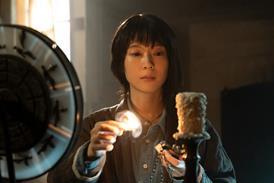
The shoot lasted 18 days around Pembrokeshire, Wales in the rainy summer of 2023. The region presented some challenges. Finding a beach not owned by the National Trust and therefore available for shooting in August was a hurdle. A key, heartfelt scene launching lit paper lanterns into the air almost didn’t happen, as the practice is banned along the Welsh coast.
“That was also Carey’s first scene, so she turned up on this production, and it was literally guys pulling on fishing wire to get these lanterns in the air, feeling very student short-film vibes,” laughs Basden. “But I look at it now and it’s one of my favourite scenes.”
Another highlight for Griffiths is a scene involving Herb, who has pursued a mainstream solo career, reuniting with Nell to play a song for Charles for the first time around a dinner table. For the director, it presents a direct comparison between McGwyer and his own career.
“There are a lot of personal things in the film. Looking back at your career and wondering how you got there, and thinking, ‘I’m quite proud of my pop era, but knowing that’s not who I am.’ Coming back to the film was my chance to press a reset button and say, ‘This is who I am.”’
For Basden, the music requirements of his role were rather daunting. “It was the area of the film I felt the most nervous about. It was a case of me writing songs at home with my guitar, recording little demos, sending them to Tim and James, and eventually to Carey and by extension [musician and Mulligan’s husband] Marcus Mumford and hoping at no point anyone would raise a flag and say, ‘Stop, stop now, you shouldn’t be doing this and we should get someone who actually does this as their job.’
“Luckily,” he adds, “everyone was very supportive and trusting. And we didn’t have a lot of time to rehearse and overthink it. We underthought it.”
Mulligan had given birth not long prior to filming, limiting prep time. “We practised the songs a couple of times,” recalls Basden. “We would sing them a bit in the makeup truck, next thing you’re on set and you’re recording them.”
A further point to navigate was Basden and Key shifting from writers to actors when on-set, and allowing Griffiths to shepherd his vision. “We’re variations on a theme, in terms of being able to cut yourself off from your other contributions to the film, and just become an actor,” reflects Key. “I probably find it easier to do that. Between me and Tom, the average is about right. I helped to settle Tom a little bit; he was fighting fights to make the film better all the time.”
Did they ever consider a TV series as opposed to a film project, given the trio’s TV chops? Basden has created, written and starred in the BBC’s Here We Go and ITV’s Plebs, while Key is well-known as Sidekick Simon in the Alan Partridge oeuvre.
“One of the real strengths of it, both as a short and later as a feature, was that it had a clear sense of what the ending was,” says Basden. “When you’re making a comedy show for TV, the temptation is for nothing to change at the end, and this isn’t that kind of story.”
Ballad was rewarded with three wins at the British Independent Film Awards – including Basden and Key for both screenplay and joint lead performance – and its reception has exceeded the expectations of its makers. “We never tested it in front of an audience, only in front of Focus,” says Griffiths, who expected the picture would head straight to a streamer, without a theatrical run.
“It was a well-timed film,” reflects Key. “There was some mad stuff happening while the film was coming out, globally.”
“It’s lovely to make a film about small things, because they’re the big things in our own lives, aren’t they?” muses Griffiths. “Maybe that’s what people have connected with – the humanity in it.”




No comments yet