












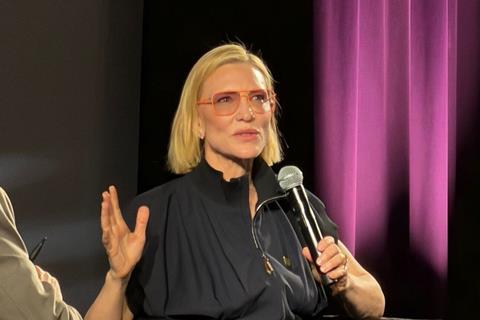
Cate Blanchett said the #MeToo movement “got killed very quickly” while discussing politics, film festivals and AI in a wide-ranging conversation at Cannes Film Festival.
The Australian actor and producer said the #MeToo movement was shut down because the industry could not solve the problem.
“It got killed very quickly which I think is interesting,” Blanchett explained. “There are a lot of people with platforms who are able to speak up with relative safety and say this has happened to me and the so-called average woman on the street, person on the street, is saying me too. Why does that get shut down? Why does, why does that get shut down?
“What it revealed is a systemic layer of abuse, not only in this industry, but in all industries,” she continued. “And if you don’t identify a problem, you can’t solve the problem, you shut that problem down. If you shut that conversation down, you can’t move on.”
Blanchett said most film sets she works on today are still disproportionately male.
“What happens is the jokes become the same and you just have to brace yourself slightly,” she went on to say. “Now I’m used to that but it just gets a bit boring. It gets boring for everybody when you walk into a homogeneous workplace, and I think it has an effect on the work.”
Politics at festivals
Blanchett was in Cannes to announce the second cohort of the Displacement Film Fund for refugee filmmakers and those telling stories of displacement. She spoke of the evolving importance of film festivals for political discussions.
“It’s a sad state of affairs when film festivals suddenly become the only places where one can talk about wars, conflicts, genocides as if they’re going to be solved here,” Blanchett said.
“It’s very important to keep those things on the public radar. I just wish that the question times in various parliaments around the world were much more honest and working towards solutions, because it’s appalling and enraging what’s going on in the world.”
Consent for AI
Unsurprisingly, the topic of AI came up. Blanchett recently co-founded RSL Media which is developing a not-for-profit system to provide human consent for AI usage.
“Human consent has to be placed front and centre, so that innovation can sit side by side with the human hand,” she explained “There is now an inevitability with AI, and it’s a very powerful tool. Like any powerful tool, it needs to be handled with respect and with caution.”
On whether AI has the potential to entirely replace human actors, Blanchett brushed off the idea, though suggested it may have some interesting uses.
“I find the notion of homogeneity incredibly dull and very uninspiring,” she said,
“I mean, that’s an interesting toy to play with, and it might be useful in some arenas. I think it’s when it becomes more chromatic, and you realise perhaps what is really behind that is the fact that they think it’s cheaper.”






No comments yet