












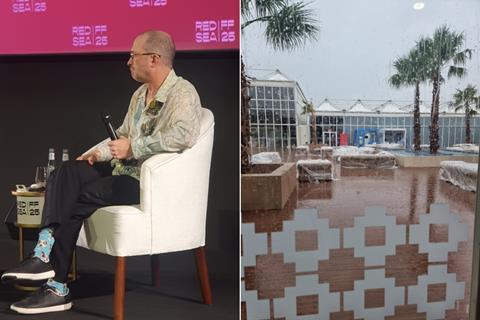
Darren Aronofsky became the only show in town at Saudi Arabia’s Red Sea International Film Festival on Tuesday (Dec 9), pushing ahead with his In Conversation talk as the rest of the festival closed due to inclement weather.
Storms in Jeddah on Tuesday afternoon led to the festival closing all venues, including the main Culture Square site with its cinemas and the Souk industry site, and cancelling all screenings and activities for the rest of the day.
This evening’s festival gala at the US Consulate, typically attended by the high-profile international talent in town for the festival, has also been cancelled.
Guests are being advised to stay indoors amid thunder and lightning. As of 15:30 local time, there was persistent light rain but that was enough to overload Jeddah’s limited drainage systems. The festival is scheduled to run until Saturday, December 13.
Despite the disruption, Aronofsky arrived on time for his talk at the Culture Square venue at 14.00 local time. After warning the audience as he entered the room that the talk could be cut short due to flooding, the US director was able to complete a one-hour session in conversation with neuroscientist Heather Berlin.
“Shall we all watch Noah together?” quipped Aronofsky, about his 2014 biblical flood adventure. “Which was banned in Saudi Arabia back in the day.”
“If everyone in the room wants to swim home, we’ll take one or two more questions,” joked Aronofsky during the Q&A portion of the talk, which he ended by imploring the audience to watch his latest film, Caught Stealing on Netflix, “if you can get home with the flood”.
Netflix-Warner Bros
Shielded from the weather, the conversation session proceeded as normal – although with a notably different focus from the career discussions held by other Red Sea guests.
Aronofsky took in subjects including science, transcendence and religion and found time to answer a question on the hot industry topic of the week, the potential acquisition of Warner Bros by Netflix, and subsequent hostile bid for Warner Bros Discovery by Paramount.
“I have not digested it yet,” said Aronofsky. “My sense is it’s not going to be a smooth road. It feels like everyone’s freaking out about it. I don’t want to comment on it because I don’t understand any of it. It’s very easy to fall into rally points right now.
“The only thing I’d say is, it’s always good to have more buyers. So any time there’s consolidation, it’s bad,” continued the filmmaker. “We already only have a limited amount of buyers. When we want to make a TV show or movie, you send it out to everyone, and hope a few of them get hungry for it, and you get a bidding war that gives you what you need to make a piece of art.
“Having one less player is always bad, so that’s a bummer. But there could be an upside. I just don’t know, it’s too early.”
The filmmaker also discussed Primordial Soup, the technology firm he founded earlier this year for storytelling that uses AI.
“It’s evolving super quick,” said Aronofsky. “When I first saw some of the images coming out of the [AI] models, I recognised it was going to have a big impact on what I do, so I started a company to think about how to use those tools.
“The problem is what’s coming out of those models now is content that looks super high production value, but it only lasts for eight seconds. It’s generally meaningless, but it’s attracting more and more of the world’s attention because it’s looking better and better. It’s like sweeter and sweeter candy.
“I don’t think that staring at those little clips for 10 seconds is doing much for us,” added Aronofsky, who has started the company to allow storytellers to use these tools for their means.
“[AI] will be able to make really crappy stories pretty soon. I think a human collaborator can then take that and turn it into art,” he said, comparing it to how artists used imagery in the early days of the internet.
“I don’t know if we’re making the rules or the boundaries,” said Aronofsky of Primordial Soup, which was unveiled in May during Google’s annual developer conference. “We’re looking for the artists out there who are going to use these tools.”
He added that “when Google makes one of these models, they actually don’t know what it does. It’s actually infinite, what you can pull out of it. It’s how you decide to approach that.
“So we’ve been pushing these companies, saying ’ Hey, build us storytelling tools’. Don’t just make things that are there to entertain us, but how do we create stuff out of this primordial soup that can actually be useful for storytelling?”
RSIFF runs until Saturday, December 13.





No comments yet