












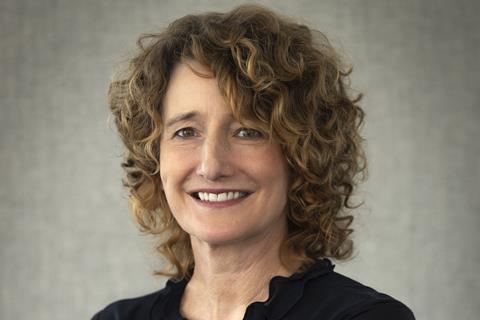
Tricia Tuttle has confirmed she wants to continue as festival director of the Berlinale and significant support from the international industry “renewed my clarity after a few challenging weeks”.
In an interview with German press agency dpa, details of which have been provided by the festival to Screen, Tuttle said, “I am immensely proud of my team, the festival and I want to continue the work we have started together in full trust and with institutional independence.”
The festival director explained she spoke to German culture minister Wolfram Weimer on Tuesday, February 24, at a time when she “was questioning whether I could continue effectively in an environment where my leadership, and the integrity of the Berlinale, were being publicly questioned in serious ways”.
“We discussed the possibility of my resignation by mutual agreement. Those were honest conversations,” said Tuttle.
A supervisory board meeting to discuss the Berlinale’s future was scheduled for Thursday, February 26. When news of this meeting broke the day before, the international industry showed significant support for Tuttle, with over 3,000 signatories to a letter in defence of her position, plus separate shows of support from leading Israeli filmmakers, and from over 500 Berlinale staff.
“The wider reaction underscored that the debate was not about one ceremony, one festival week or one person alone, but about the broader principle that cultural institutions must be trusted to operate within democratic and legal frameworks,” said Tuttle to dpa. “That is a powerful message. And in truth, this has also renewed my own clarity after a few challenging weeks.”
Tuttle has said that at no stage did she receive any notice of dismissal, as reported by German tabloid Bild. “The State Minister and I had begun the process of discussing the possibility of my resignation by mutual agreement on the evening before this report,” said Tuttle. “I am glad that we are now again in a situation where all options can be discussed with the board, and am grateful to the BKM [festival organising body] team for the open dialogue on this.”
The director has also noted that both public and industry attendance for the 2026 festival exceeded that of the record-breaking 2025 edition, without yet citing exact figures. “That tells us something important: there is a strong appetite for the Berlinale,” said Tuttle. “Despite political turbulence, the festival itself demonstrated vitality, relevance and audience trust.”
Another supervisory board meeting will take place tomorrow (Wednesday, March 4) about the festival’s future direction.
Closing ceremony
At the closing ceremony for the festival’s turbulent 76th edition on Saturday, February 21, filmmaker Abdallah Al-Khatib accused the German government of being “partners in the genocide in Gaza by Israel”, with German environmental minister Carsten Schneider leaving the ceremony in response.
Asked by dpa about whether she considered intervening during the ceremony, Tuttle said: “I do understand that people experienced this in different ways and also that some people were angry and hurt.
“Abdallah Al‑Khatib spoke in a strongly rhetorical and deeply personal way,” continued Tuttle about the filmmaker’s comments. “What I heard from him was anger and explicit political conviction. We hear many experiences and viewpoints from our filmmakers, and at times they articulate their positions with a great deal of pain. A core role of festivals is to remain spaces of openness and dialogue between differing political perspectives, while upholding the freedom of expression of all artists – even when what they say is explosive or sparks debate.”
The festival director expressed a desire to refocus the discussion around films. “If I have regrets about the ceremony and the festival, it is that once again the political debate overshadowed the films themselves,” said Tuttle. “It is frustrating that we are not now talking about Queen At Sea, about Rose, llker Çatak’s Yellow Letters and Emin Alper’s Salvation, urgent, intelligent works that deserve sustained discussion on their artistic and political merits.
“This is not the fault of any filmmaker. It’s down to us to do better next year to elevate the many voices – 276 of them from 80 countries to be precise.
“It is entirely legitimate for people to disagree with what is said on stage,” added Tuttle. “Democratic discourse includes disagreement, and emotions run high on all sides. But this kind of disagreement should not translate into an institutional crisis or policy.”
Political pressure
The director also addressed the question of political pressure, saying she believes the festival “is on the same page with our partners and funders.”
Tuttle acknowledged her duty as director “to listen carefully to all stakeholders, funders, filmmakers, the industry, sponsors, audiences, my team – but ultimately to make independent decisions within our legal and institutional frameworks.”
“Germany has a robust and active democracy, and people care deeply about culture,” said Tuttle. “As someone who did not grow up but loves to work here, I find that seriousness inspiring. There are also elements of this discussion that touch on Germany’s historical responsibility after the Holocaust. As the steward of such a vital cultural institution, I take that responsibility very seriously.
“Complex conversations deserve care, and I have spent a good part of my two years at the Berlinale navigating these sensitivities within a very international Festival,” continued Tuttle. “It is very vital that, within legal frameworks, in terms of our credibility as one of the top festivals in the world, Berlinale must remain a space for artistic exchange even on the most sensitive of subjects.”
Conversations with Weimer about the future direction of the Berlinale will continue, Tuttle added, after the politician expressed the need for reform of the festival in an interview with German publication Rheinische Post. “I would like to understand his perspective without dismissing it, and I have welcomed his invitation to discuss these matters more closely with him and the board.”
Tuttle recognised the “international scrutiny and concern” around the Berlinale over the last few weeks, but said, “the only way to address this is not to narrow artistic space, but to demonstrate clearly that Germany can uphold both historical responsibility and artistic plurality with confidence. I have good hope that we can achieve this in our case.”






No comments yet