














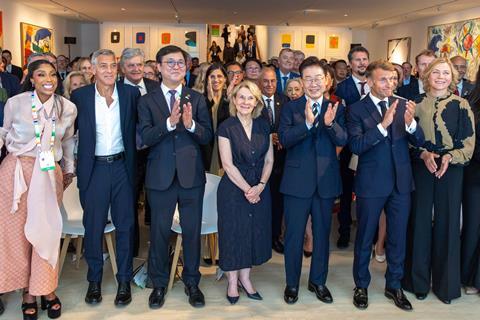
France gathered many of the world’s top film executives in the medieval village of Saint-Paul-de-Vence on Monday (September 7) for the Lumière Summit.
Organised by the French cinema body, the CNC, the summit was an initiative of French President Emmanuel Macron and Lee Jae Myung, President of South Korea.
It was billed as a chance to agree on strategies to tackle film industry and societal disruption from AI, social media and the creator economy. Macron said he wanted the summit to mark a new era of co-operation in the global industry.
By the end of the day, the Summit had published the Lumière Declaration, a document setting out 15 “principles for a new multilateralism for film and the moving image.” It also published five ‘declarations’ on AI, image education, gender equality, the environment and safe shooting sets.
There were initiatives to support independent cinemas and industry talent. The Summit also saw the launch of a global network for national film agencies, and a pact by France and Korea to jointly invest €1bn in the film and audiovisual sector.
But what did attendees make of the Summit and what were its concrete achievements?
Unparalleled gathering of top execs
Both the delegates and the press were hugely impressed by the convening power of the French and Korean presidents. It was an unparalleled opportunity to meet the heads of most US studios through to industry leaders from around the world, such as Japan’s Toho, South Korea’s CJ ENM, France’s Canal+ and Mexico’s Cinépolis.
Also attending were the heads of festivals including Cannes, Berlin and Toronto as well as key national film funding bodies and culture ministers from Indonesia through to Italy, Nigeria and the UK.
A smattering of talent also attended, with George Clooney popping in. Like him, many had flown over from the Venice film festival for the occasion. One exhibitor marvelled to Screen that he had enjoyed chats with both Netflix co-CEO Ted Sarandos and Macron, two people he’d unlikely meet in any other circumstance. Another participant said some of the most fruitful encounters came not just in planned bilateral meetings, but from unscheduled conversations in corridors, over lunch, or in the garden of the venue, the modern art museum Fondation Maeght.
Many saw it as a legacy-boosting move ahead of Macron’s term ending next May, and an attempt to bolster France’s reputation as a global film powerhouse.
Powerful statements of intent
The summit was billed as an opportunity to put cinema and the moving image centre stage at a time when audiences are hooked on scrolling, and AI is transforming content creation. The French organisers described it as the first gathering of its kind in over 100 years, akin to a major summit on climate change or global health. They treated it with the same seriousness, saying the future of the film industry and societies was at stake.
Like any global summit, there was a grand declaration of key principles, plus a host of initiatives to which many signed up. They were powerful, open and positive statements of intent by a diverse group of global film industry leaders, something that is often hard to come by.
For an industry that has felt on the back foot for so long, it felt like an important moment, said one attendee. The Lumiere Declaration, for example, championed issues the French industry has long cared about: the theatrical experience, protecting IP, supporting diversity and investment in the moving image.
“Big people agreeing positive things is never bad,” as one executive put it.
There was some scepticism, though. The commitments were adequately vague to make them easy to sign up to for the various factions present. “Will the Declaration be remembered in 10 years? Probably not,” was an oft-repeated sentiment.
Another attendee applauded the Summit’s global initiatives to fund independent cinemas and film companies, but pointed out that securing government financing for the film sector in their own country was hard enough, let alone asking for money for international initiatives.
Deepening of France-Korea partnership
The summit was also a powerful demonstration of co-operation between France and Korea, two powerhouses of the moving image industry. Presidents Macron and Lee were very visible at the summit, both delivering opening remarks and setting the tone. After the French, South Korea fielded the biggest press contingent for the event. President Lee gamely took part in a panel about creating local hits that travel globally, alongside senior Korean execs. (Netflix co-CEO Ted Sarandos and MPA chair Charles Rivkin had been advertised as taking part in the panel, but were replaced by deputies so they could join a meeting between Macron and the US studio heads.)
A number of Franco-Korean deals were announced, notably their €1bn audiovisual investment pact. For example, French group Mediawan and Korean content studio SLL signed a partnership at the summit to exchange content IP and develop co-productions.
Unavoidable logistical challenges
Pulling together such a summit is no mean feat. Unlike a major festival or annual conference, organisers have no established template to fall back on. Participants don’t know the venue, logistics or what to expect – or even where to charge their phone. Then there is the complex protocol and tight security of hosting two heads of state. It was inevitable this summit would come with challenges. However, organisers met most of these with good humour and treated everyone with courtesy.
But many felt the venue, while beautiful and packed full of breathtaking art, was on the small side; the opening plenary was held in a gallery room that overflowed with delegates and ultimately felt too cramped for the occasion, despite the priceless art on the walls. Many had to stand at the back or were ushered to an upstairs room to watch on a big screen that was beset with technical glitches.
The panels were brimming with industry leaders but were sparsely attended as delegates preferred private meetings. For journalists, it was often difficult to find out what was being announced, and there were tech and space issues.
“Whatever you journalists are feeling on the outside, we’re feeling it on the inside,” said one sympathetic attendee, who said – despite being in the room – they also had trouble finding out what was going on and what was being announced.
Another feared the potential punch of such a high-calibre event had been compromised by logistics and lack of organisation, and that its messaging could have been better choreographed before and during the summit to achieve maximum global impact and coverage. One said the summit would have worked better over two days, rather than being compressed into one packed day, particularly given how far so many people had come to attend.
(Nearly) everyone left on a high
With social networks identified alongside AI as one of the key threats to the industry and society by Macron, it was little wonder there was no representative from YouTube at the summit (although several execs from parent company Google attended). TikTok did bravely send along a representative. In a not-so-hidden swipe at social media, an underlying theme of the Declaration was its call to respect audiences: “As digital technologies evolve, we reaffirm that the attention of an audience is not a resource to be captured, but a trust to be honoured,” it said.
In the end, however, it never felt like the summit became a YouTube or social media bashing event. Neither was it a gathering of a downbeat industry.
Instead it turned out to be something of a celebration for the film industry, which enjoyed being the rare focus of political attention at the highest level. Many pointed out the summit was taking place at a time of rising optimism for many in the film business, noting that box office was bouncing back to its pre-pandemic highs. Festival bosses talked up their role in building audiences for cinemas, while the heads of global cinema chains were buoyed by rising ticket sales.
US execs were also encouraged by US President Donald Trump’s recent championing of federal tax credits, noting this marked a shift in policy away from threats to impose tariffs on international partners.





No comments yet