












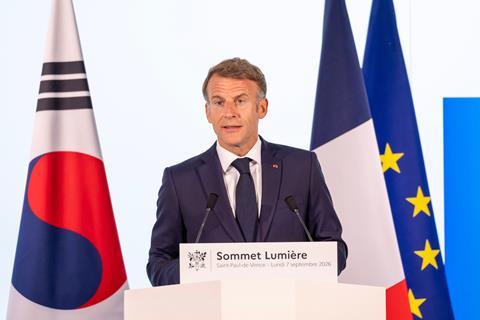
A who’s who of the global film industry gathered in the French resort of Saint-Paul-de-Vence today (September 7) for the Lumière Summit, which is aiming to find solutions for the screen sector amid disruptions from AI, streaming and the creator economy.
Organised by French cinema body the CNC, the summit was opened by French President Emmanuel Macron and Lee Jae Myung, President of South Korea
The daylong event was held at the modern art museum Fondation Maeght amid tight security.
Macron said he wanted the summit to mark the start of a new era of co-operation in the global industry.
The summit saw the publication and signing of the Lumière Declaration by key participants, setting out “principles for a new multilateralism for film and the moving image.” (Scroll down for full text of Declaration). The Summit also published five ‘declarations’, covering topics putting forward common positions on subjects such as AI, image education, gender equality, the environment and safe sets.
Independent cinema support
Initiatives announced include the launch of the International Resilience Initiative for Independent Screens (IRIS), designed to support independent cinemas, distributors and networks to help films circulate the world. It is backed by €1m in funding so far from the French culture and foreign ministries, and is looking to raise in €30m from international partners.
In a statement, the summit organisers said the initiative is led by an international council of more than 40 filmmakers and artists, including Juliette Binoche, Jane Campion, Sofia Coppola, Costa-Gavras, the Dardenne brothers, Isabelle Huppert, Jim Jarmusch, Hirokazu Kore-eda, Nanni Moretti, Jafar Panahi, Tilda Swinton, Denis Villeneuve and Wim Wenders. It said the initiative aims to establish “a permanent global network of solidarity and support for independent cinema.”
“In response to the growing vulnerabilities facing this ecosystem, which is essential to cultural diversity, IRIS will mobilise funding, expertise and international cooperation to sustainably strengthen independent cinema and its distribution to audiences,” said the summit organisers.
Lumière Alliance launch
The summit also saw the launch of the Lumière Alliance, billed as the first global network bringing together public institutions responsible for film and audiovisual policy.
Some 54 national film agencies have joined the network so far, which is being set up to exchange information, develop joint initiatives and co-ordinate positions on international issues. Its members will meet annually in Cannes, as well as at an annual congress hosted by a member state.
France-Korea partnership
Also launched is the Lumière Partnership, which will see France and Korea jointly invest €1bn in the film and audiovisual sector. France will invest €500m through Bpifrance between 2027 and 2031.
Summit organisers said the Lumière Partnership is open to other states, and aims to support the growth of companies in the sector and to promote ”the principles adopted in Saint-Paul-de-Vence: the primacy of human creativity, respect for copyright and cultural diversity.”
The summit also launched Audiovisual Next Gen, an international programme led by the CNC in partnership with Netflix, RTL Group and Mediawan.
Aimed at 20 professionals under the age of 35 from across the creative industries, the programme will offer an 18-month mentoring programme. The first cohort, which will be announced in January 2027, will consist exclusively of women. The summit said this was to promote greater representation of women at the highest levels of responsibility.
Unveiling the initiatives, a spokesperson said: “Against the backdrop of the creative, technological, economic and geopolitical upheavals affecting the film, audiovisual and video game sectors, the Lumière Summit sought to go beyond simply assessing the situation and to develop concrete solutions. The commitments announced demonstrate the international community’s ability to organise collectively around a shared vision: defending the irreplaceable value of works, creativity and their authors; supporting cultural diversity; fostering innovation within a framework for value-sharing that ensures fair remuneration for authors and creators; and guaranteeing the central role of people in the future of the moving image.”
High-profile attendees
Among the 200 high-profile executives attending the summit were Netflix co-CEO Ted Sarandos, Disney Entertainment president Dana Walden and chairman Alan Bergman, NBCUniversal Entertainment chairman Donna Langley, HBO chairman Casey Bloys, Sony Pictures Entertainment Motion Picture Group chairman Tom Rothman and CAA CEO Bryan Lourd.
International representatives included Cannes Film Festival general delegate Thierry Frémaux, Berlinale director Tricia Tuttle, BFI CEO Ben Roberts, Vue International CEO Tim Richards, Mubi CEO Efe Cakarel, Cinépolis CEO Alejandro Ramírez Magaña, Toho Cinemas president Hiro Matsuoka, Regal Cinemas CEO Eduardo Acuña, Canal+ Group CEO Maxime Saada, CJ ENM CEO Yoon Sang-hyun, Pathé president Ardavan Safaee and Mediawan co-founder Pierre-Antoine Capton.
Security for the event was tight, with access to the venue strictly controlled and multiple layers of security including sniffer dogs and scanners in place. Speaking to Screen, attendees said they were very impressed by the calibre of guests that had been convened for the event, likening it to a major international summit usually reserved for topics such as finance or climate change.
However, organisational challenges meant some were confused about timings and where events were taking place.
Gaëtan Bruel, president of the CNC, said that the Summit had been convened to address a very urgent challenge. “We live in a world that is shaped by images, but our relationship with screens is slipping out of our control, and this has major consequences both on our lives and our societies.”
He said the summit was about “making cinema and the moving image one of the defining issues of our time” and “addressing these issues with the same seriousness and the same method that we have applied to climate change or global health.”
Bruel added: “Do we want a world in which we are absorbed by our screens, trapped with them, rather than open up to the world?”
The Lumière Declaration in full:
On The Future Of Cinema And The Moving Image
”We, representatives of Countries, Regions, International Organizations, leaders of the film, television and gaming industries, creators, talents, festivals and cultural institutions from across the world, gathered in Saint-Paul-de-Vence on 7 September 2026 for the Lumière Summit, convened under the cochairmanship of the President of the French Republic and the President of the Republic of Korea, stand at a pivotal moment for the moving image.
As artificial intelligence transforms the conditions of creation, as audiences discover new ways to engage with stories, and as audiovisual experiences become an increasingly important part of our lives, the choices we make today will help ensure the value of the moving image continues to grow, culturally as much as economically. We recognise that this value engages the future of our industries as much as the future of our societies.
With these opportunities also comes a shared responsibility. Across our different roles, markets and cultures, we are connected by a common interest in a thriving and diverse audiovisual ecosystem.
Building on what unites us, we lay here the foundations of a multilateralism of the moving image. It rests on two convictions: first, that the issues which affect us all are best addressed through cooperation; and second, that every party - States, companies, creators and institutions - has a legitimate and important role to play in this shared endeavour.
To this end, we adopt the following principles and, each within our respective roles and competences, commit to act upon them.
1. We place works at the centre. Moving images are a common good: a vehicle for emotion, memory and knowledge, for individual emancipation and collective transformation, for shared culture. At a time when the supply of content has never been more abundant, ambitious and intentional works remain irreplaceable. They shape imaginations, convey shared narratives, open new perspectives on the world, give rise to the intellectual properties of tomorrow and create lasting cultural and economic value. The future of our industries will be defined by the works we choose to create and support.
2. We refuse to reduce images to the attention they capture. How societies, and young people first among them, engage with screens is a fundamental question, for the vitality of our sectors as much as for the development and wellbeing of future generations. Professional creators, producers, and distributors invest in the development, production, and stewardship of stories with a commitment to quality, responsibility, and accessibility for audiences. Where images are created, curated and distributed by those who answer for them, audiences find not only compelling stories but environments they can rely on. As digital technologies evolve, we reaffirm that the attention of an audience is not a resource to be captured, but a trust to be honoured.
3. We invest in creation and its renewal. The vitality of the moving image depends on its capacity for renewal: new voices, new talents, new stories, new intellectual properties, new technologies and new business models. This requires environments that reward creators’ experimentation and creative risktaking. Public support can play a vital role by enabling risk-taking and early-stage development, complementing the commitments of broadcasters, platforms, distributors, and other private partners. The capacity of creators and producers to develop their works over time is a condition of this renewal, as is the emergence of the next generation of professionals. Those who benefit from the distribution and exploitation of works have both a responsibility and a direct interest in the next generation of creation.
4. We defend the diversity of works. The diversity of works, across budgets, languages, genres, formats and geographies, is not a constraint on competitiveness; it is its foundation. Cultural diversity allows a plurality of stories, cultures and perspectives to flourish, and strengthens the vitality, resilience and attractiveness of our creative ecosystems.
5. We recognize the audiovisual industry as an engine of economic growth. Alongside its important cultural and social value, the audiovisual industry is a powerful engine of economic growth. It drives investment across a broad range of businesses, creates jobs, cultivates a highly skilled workforce, fosters innovation, and generates an important economic activity. We commit to promoting a competitive and sustainable audiovisual ecosystem.
6. We seek to promote discoverability. In an environment of abundance, ensuring that works can be discovered, circulate in a balanced manner across venues and platforms, and reach their audiences has become as essential as their creation. We are equally mindful of the new opportunities and challenges posed by agentic artificial intelligence and the possible advent of a world in which access to works would increasingly be mediated by automated agents. We recognize the importance of distinctive works being visible and accessible to audiences.
7. We reaffirm the enduring value of the theatrical experience. Cinema offers a unique way of turning a creative work into a collective experience, creating a sense of occasion that helps to build community, as well as cultural and economic value. Sustaining theatrical exhibition is a shared interest across the sector. Diversity needs cinemas in order to thrive; cinemas need diversity in order to fulfil their cultural, economic and social role.
8. We build works and creative universes that travel. Stories now move across formats and borders. International co-production diversifies risk, enriches works and binds our ecosystems together; cross media creation extends universes and brings them to new audiences. We will deepen cooperation and exchanges between established and emerging markets, share expertise and support the creative capacities of every territory, so that the diversity of the world’s stories finds its way onto the world’s screens.
9. We protect works against piracy. Piracy erodes the value of creation, the remuneration of creators and the financing of future works. When creation is not rewarded, it cannot be renewed. We commit to strengthening international cooperation to combat piracy in all its forms.
10. We embrace technology while protecting intellectual property. Cinema was born from the encounter of technology and art, and artificial intelligence can strengthen creativity, innovation and the circulation of works - provided it becomes a driver of creation. Human-created works remain the foundation of our creative industries and the source of the stories, characters, and cultural experiences that inspire and educate audiences worldwide. Human creation should always remain at the heart and foundation of works. Respect for intellectual property is foundational for the moving image industry’s viability.
11. We defend the freedom to create. Freedom of creation is a condition of the vitality and diversity of the moving image. In many parts of the world, creators continue to face political, economic or social pressures that threaten their ability to create and to be heard. We support the development of international networks of solidarity that protect endangered voices and uphold the conditions necessary for artistic expression.
12. We advance gender balance, safety and inclusion. Because the moving image sector has the power to shape and to change representations, our industry must be exemplary in the exercise of that power. The sector has the power to shape how we see ourselves and the world. The richness of the stories we tell depends on the diversity of those who create them. We will work to ensure that everyone can contribute fully to our industries in safe, fair and inclusive environments.
13. We recognise the urgency of safeguarding the world’s moving image heritage. Only a fraction of our common moving image legacy has been preserved to date, and we have entered the critical period for the conservation of physical archives, whose elements degrade inexorably over time. This heritage is an irreplaceable legacy, in which our stories, our languages, and our collective identities are inscribed. Its safeguarding demands sustained investment and international solidarity among governments, archives, foundations and philanthropies, so that every country can pass its memory on, alive and visible, to future generations.
14. We support more sustainable production solutions. We will work toward developing best practices, flexible standards, and practical tools for the design and implementation of sustainable production, distribution and exhibition.
15. We make image education a literacy for the twenty-first century. Just as previous centuries pursued universal literacy in the written word, the age of images demands an equally ambitious commitment to image literacy. Image education builds independent judgement, fosters a healthier and more active relationship to screens, opens the way to encounters with ambitious works and prepares the renewal of audiences on which our common future depends. It finds its privileged home in the cinema: one of the last places where individual screens are switched off and where we learn, again, to watch together. We support the launch, with UNESCO and partner countries, of an international initiative to recognise image education as a universal ambition and promote it, starting from early education programmes, worldwide.
We agree to remain collectively engaged with these questions and to review together the progress achieved.
Two hundred years after the first photograph, and one hundred and thirty years after the Lumière brothers’ first public screening of the Cinématographe, the Lumière Summit opens a new chapter: the moving image now has the beginnings of a global governance - a multilateralism meant to grow, through new initiatives, new partners and future gatherings






No comments yet