









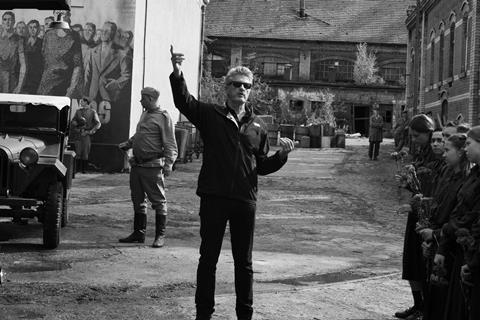
Pawel Pawlikowski is flying the flag for shorter film running times in an era of lengthy Hollywood releases, telling an audience during a masterclass at the Sarajevo Film Festival he has an “urge to avoid the pointless” in his filmmaking.
Fatherland, Pawlikowski’s latest feature, was the opening night film at this year’s Sarajevo, following its world premiere in Cannes Competition, where he won the best director award. It is only 82 minutes long.
The film is the third in a trilogy which also includes 2015 Oscar-winning Ida (82 minutes), and 2018’s Cold War (88 minutes).
“I try to avoid boring scenes, or scenes that just serve to explain the plot… I try to make films out of strong moments, images that imply a lot, rather than need words to explain, and build in a pretty simple plot with not many characters,” explained the filmmaker.
“I have an urge to concentrate – find a great landscape that’s photogenic, and can mean a lot of things… It’s an urge to avoid the pointless, to avoid the obvious and avoid something that looks strong visually that relies on exposition. It’s not an intellectual endeavour, it’s more that that’s what I like to watch myself.”
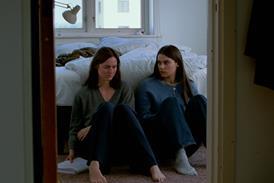
Fatherland takes place at the height of the Cold War and centres on the relationship between the writer Thomas Mann, played by Hanns Zischler, and his daughter, played by Sandra Hüller, as they embark upon a journey across a Germany in ruins after the Second World War.
He described Hüller as a “genius” whose process involved needing “to know the text, so my loose methods kind of unsettled her at the beginning”. Pawlikowski’s method involves constantly changing the lighting and framing of shots, while he said Hüller was used to directors that “give that stuff to the camera person”.
Mubi is releasing Fatherland in several territories, including UK-Ireland, North America and Germany.
BBC backstory
Poland-born Pawlikowski reflected on the early days of his career, which began while he was living in the UK and making documentaries at the BBC, after an unsuccessful music career and unfinished PHD at Oxford University.
“There was some kind of trainee scheme at the BBC where you could get in and pretend that you’re interested in television, which I never was,” he said.
The BBC, he recalled, “was a very interesting open organisation at the time. It wasn’t a corporate structure that most television [stations] were. BBC has become a corporation now too, full time.”
He made documentaries including Emmy award-winning From Moscow to Pietushki: A Journey With Benedict Yerofeyev in 1990, but noted a shift at the BBC around 1995. “You had to kind of sell yourself. You couldn’t keep cryptic and a little restrained and leave things to the imagination of the audience. You couldn’t have films that were purely subtitled and no English voice explaining what was going on.”
This triggered his move into fiction, but “fiction that has the texture of reality. I hated TV drama or feature films where you see the script, or feel the script.”
His first experiment was a formative experience making low-budget TV docudrama, Twockers, in 1998, ahead of his fiction feature debut, 2001 Bafta winner Last Resort, and 2005 Bafta winner My Summer Of Love. Twockers is about teenage car thieves living on an estate in the north of England. “We had just three heroes – I’ve had three heroes in every film I’ve ever made since.”
Sarajevo Film Festival runs until August 21.






No comments yet