



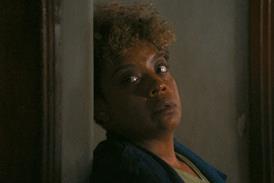






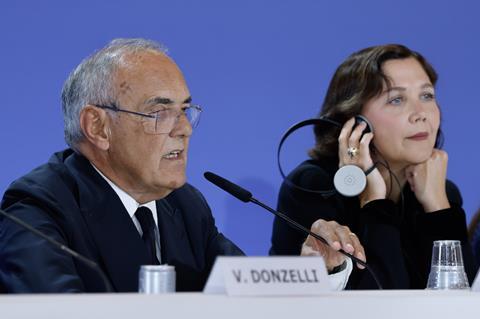
Maggie Gyllenhaal, jury president of the Venice Competition, said she “has a question” about the male-dominated Competition lineup at this year’s festival.
“I guess it’s just finally become clear that men make better movies than women do,” deadpanned Gyllenhaal, in answer to a question at the opening press conference about the lack of films by women directors in the Competition today.
Festival director Alberto Barbera laughed awkwardly beside Gyllenhaal before noting there are two films directed by women in the Competition – May el-Toukhy’s Woman Unknown, and Rachel Szor’s NAZA, co-directed with Yuval Abraham.
View this post on Instagram
Switching to a serious answer, Gyllenhaal said, “There’s a systemic problem. It’s much harder for women to get their films financed. Could it be possible that the things women, having had a different experience of being alive in the world, want to make movies about are not always deemed high art? Who decides what’s good and valuable?
“I will also say,” continued Gyllenhaal, “sitting next to one of the people who makes that decision [Barbera], that I am on a panel with many women, and have on my jury incredible female filmmakers. But also, that’s a question I have, and it’s a legitimate one.”
“There’s a systemic complication, confusion about what is valued,” said the filmmaker when the issue returned later in the press conference. “It’s been such a short time that women have had the opportunity to make films at all. It will take some time to get used to the fact that many women make movies quite differently than men do.
“I really am walking in with a question as to why there are so few women in the main Competition this year,” said Gyllenhaal. “But I think Alberto and Giulia asking me to be the head of the main jury, after the two films in particular that I have made, is a very important thing to consider too.”
Gyllenhaal was joined on stage by the presidents of the other festival juries, including Horizons president Valerie Donzelli. “I don’t think it’s just a question of gender,” said Donzelli. “There are some topics that are less visible in festivals, like comedy – they are less valued. We tend to select films that are more serious. But I adore comedy. There are marvellous comedies that are very political.”
Unavoidably political
The first question at the conference was about the political dimension of cinema, an issue that arose at this year’s Berlinale when Wim Wenders spoke on the difference between films and politics.
“We might as well get into it,” smiled Gyllenhaal at the question. “I will speak more on this tonight [at the opening ceremony]. We could say ‘how are we possibly here talking about movies right now when the world is in a state of emergency?’ To me, the answer is to do with empathy.
“I don’t believe there is any subject of filmmaking that shouldn’t be heard. We can challenge ourselves to hear stories about the most corrupt, perverse people, because it opens up the opportunity to find empathy for those people, and look at the ways in which we might have a little bad guy, a little perversity, a little corruption inside us.
“I am here open. I am here curious,” said Gyllenhaal. “If movies really are an honest look into other people’s experience, they are fundamentally, unavoidably political, as well as a lot of other things.”
The conference went ahead as usual, having been in doubt at the weekend due to what the festival said was “a conflicting schedule”.
The festival will open this evening with the world premiere of Danny Boyle’s newspaper drama Ink in Competition. George Clooney will receive a Golden Lion for lifetime achievement at this evening’s opening ceremony.



No comments yet