



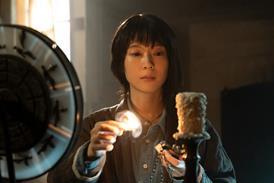





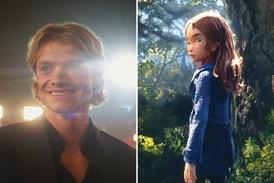

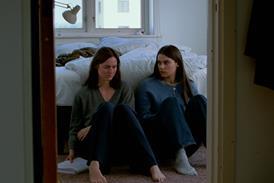

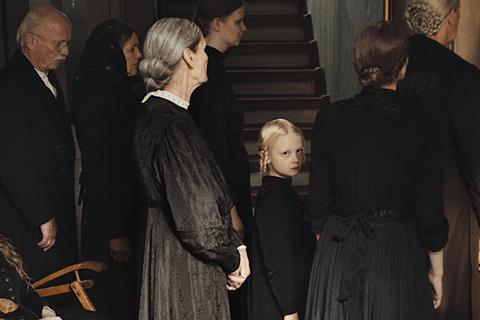
Mascha Schilinski’s Sound Of Falling swept the board at this year’s German Film Awards, clinching the Golden Lola in the best film category along with statuettes in another nine categories for direction, screenplay, supporting actress, cinematography, editing, sound, costume design, production design and make-up at the ceremony in Berlin on May 30.
Schilinski’s second feature had been this year’s hot favourite after it received 11 nominations from the German Film Academy’s members and now equals the record number of awards previously set by Robert Siodmak’s The Devil Strikes At Night in 1958 and Michael Haneke’s The White Ribbon in 2010.
The production by Studio Zentral had received its world premiere in last year’s Cannes Competition where it won the jury prize ex aequo.
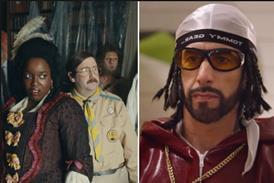
The Silver Lola for best film went to İlker Çatak’s Yellow Letters, which also received the Lola for best film score, while the Bronze Lola was presented to Simon Verhoeven’s Ach, diese Lücke, diese entsetzliche Lücke.
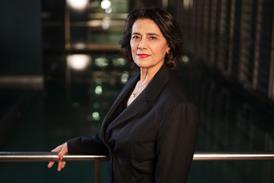
Verhoeven’s adaptation of Joachim Meyerhoff’s bestseller also picked up the Lola for best supporting actor for Michael Wittenborn. The ceremony’s 1,900-strong audience welcomed the Lola for best lead actress on the director’s mother Senta Berger, with a standing ovation from the audience as this was the first time in the 85-year-old actress’s career that she had ever been nominated for a German Film Award.
Meanwhile, Julia Lemke and Anna Koch’s documentary Circusboy, which had its world premiere in the Berlinale’s Generation Kplus last year, took home the Lola in the best children’s film category.
Sabine Lidl’s Siri Hustvedt - Dance Around The Self, first shown in this year’s Panorama Dokumente section of the Berlinale, was voted by the Film Academy members as the winner of the Lola for best documentary.
Lola statuettes were also handed to August Diehl for his lead performance in Kirill Serbrennikov’s The Disappearance Of Josef Mengele and to Michael Wortmann and Frank Schlegel for their visual effects in Christian Ditter’s Momo, while Munich-based producers Thomas Wöbke and Philipp Trauer were presented with the Bernd Eichinger Award in memory of the internationally acclaimed producer who died in 2011
Their production of the political thriller September 5 had received nine Lolas at the 2025 awards, including best film.
Although some technical issues meant the ceremony was much longer than planned – the audience were invited to leave the auditorium for a half-hour break about an hour into the proceedings while the technicians solved the problem – actor-singer-director Christian Friedl’s skills as the evening’s MC ensured any grumbling about delays was soon dispelled.
Meanwhile, the German film community’s solidarity with Berlinale director Tricia Tuttle was shown by a standing ovation in her honour even before she came on stage to announce the winner of the Lola for best director.
Tuttle became the first serving Berlinale director in the history of the German Film Awards to take on this role of presenter, and, after the ceremony, was one of the first to venture on the dance floor to celebrate the evening’s winners.
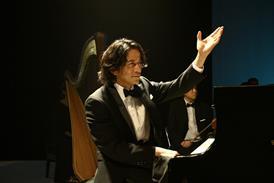
The warmest applause and standing ovations during the ceremony were afforded to Wim Wenders, who was this year’s recipient of the Honorary Lola for his services to German cinema.
In his acceptance speech after receiving the statuette from Film Academy co-president Florian Gallenberger, Wenders looked back at “an incredible journey” over the past 60 years as a filmmaker.
He then referred to “a difficult chapter in my life” and the recent calls from actress Nastassja Kinski to have a scene removed from his 1975 film The Wrong Move where she appears – as a 13-year-old – with an unclothed upper body.
“I wouldn’t do it that way today. I know more now – much more,” Wenders said. “Sensitivities have changed. We live in a completely different world from 50 years ago.”
“The question that arises is one that concerns you all. How do we deal with our cinematic heritage? Are we allowed to? Can we? Should we perhaps edit out a scene? If, as in this case, it hurts one of my actresses, whom I have greatly admired and continue to admire?”
The veteran filmmaker pointed to the example of his friend Steven Spielberg who had changed the soldiers’ machine guns to walkie-talkies in a scene with children in E.T., but then subsequently regretted having taken this decision in later years.
Wenders suggested that if he were to edit out this scene, “that sets a precedent that affects you all, and then it becomes possible with all your films later on,” and called on Gallenberger and the Film Academy to organise an event for him to discuss this issue with the younger generation of filmmakers.





No comments yet