











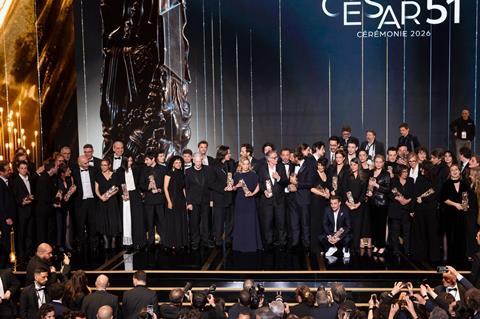
Carine Tardieu’s The Ties That Bind Us was named best French film of the year at the 51st César Awards on Thursday evening (February 26) at L’Olympia theatre in Paris.
The film premiered in Venice’s Horizons section in 2024 and stars Valeria Bruni Tedeschi as a woman who forms an unexpected bond with a young father and his children. It also took home prizes for best adapted screenplay and best supporting actress for Vimala Pons. The Ties That Bind Us sold an impressive 800,000 tickets at the French box office last year for distributor Diaphana.
Richard Linklater was named best director for Nouvelle Vague, centred on the production of Jean-Luc Godard’s 1960 film Breathless. Linklater did not attend the ceremony, but the film that premiered in Cannes’ competition last year also earned prizes for best cinematography, editing and costumes after heading into the ceremony with a leading 10 nominations.
Cannes-premiering films dominated the nominations this year with 18 films from the festival’s 2025 official selection for a total of 61 nominations across 21 categories.
Lea Drucker won the award for best actress for Dominik Moll’s Case 137 in which she stars as an investigator tasked with an incident involving a young man severely wounded during a protest in Paris that takes a personal turn.
Nadia Melliti won the best female breakthrough award for Hafsia Herzi’s The Little Sister following her win for best actress in Cannes.
Laurent Lafitte won the best actor prize for Thierry Klifa’s The Richest Woman In The World, which also stars Isabelle Huppert stars a fictionalised version of French billionaire Liliane Bettencourt. It played out of competition in Cannes and has performed well at the local box office with nearly one million admissions since its late October release through Haut et Court.
Pauline Loques’ Nino, which premiered at Critics’ Week, took home prizes for best first feature and best male breakthrough for Theodore Pellerin, who also won the Louis Roederer Foundation Rising Star Award in Cannes for his role as a young man whose bombshell medical diagnosis sends him all around Paris as he reflects on his life.
Vincent Munier’s nature documentary Whispers In the Woods took home prizes for best documentary and best sound. The film has been a box office success with some 1.2million tickets sold since its December release by Haut et Court.
While last year Jacques Audiard’s Emilia Pérez swept the awards with seven prizes including best film from 12 nominations, this year, the awards were more evenly distributed.
Ugo Bienvenu’s Oscar-nominated Arco won the award for best animated feature. Bienvenu thanked France and its film financing system, which he called “the most virtuous in the world.” The film also won the prize for best score.
Stephane Demoustier’s historical drama The Great Arch debuted in Cannes’ Un Certain Regard and won awards for set design and visual effects. The film stars Claes Bang as a Danish architect tasked with constructing the Great Arch of La Defense in the early 1980s.
This year, women represented a record 43% of nominees across all categories including two for best director (Hafsia Herzi and Carine Tardieu) after last year’s awards saw no women directors in that category and just 33% of women nominees in total.
Since the César Awards began in 1976, only two women have won in this category (Tonie Marshall for Venus Beauty Institute in 2000 and Justine Triet for Anatomy Of A Fall in 2024). Lise Fischer, who won the award for best visual effects for The Great Arch, became the first woman to win in the category in Cesar history.
Paul Thomas Anderson’s Oscar-nominated, BAFTA-winning One Battle After Another, won the prize for best international feature.
Highlights
Actress Camille Cottin was ceremony president and the host, actor Benjamin Laverhne, kicked off the evening with an elaborate musical number that saw him don a yellow suit as a nod to this year’s honorary César Award recipient Jim Carrey’s famous role in The Mask.
Later in the evening, Carrey received a long standing ovation as he addressed the crowd in fluent French when accepting the award from Cottin and director Michel Gondry. “How fortunate to be gathered here tonight with so many people who have given me their hearts in return,” Carrey said.
The Canadian star gave a shout-out to his distant ancestor, Marc-François Carré, who left Saint-Malo for Canada several centuries ago, saying: “This “Carré” [which means square in French] has come full circle. Perhaps this is what my family was looking for. Thank you to the Academy.” He later asked the crowd: “So how was my French? Almost mediocre, right?” He added, visibly moved: “I love you all from the bottom of my heart.”
David Cronenberg also earned a standing ovation when he came on stage to present the award for best director, joking: “Let me be honest with you – it’s really not that hard to direct a movie. You just run around all day and say ‘action!’ and ‘cut!’”
The evening was mostly light and festive, but speckled with more serious moments such as when Golshifteh Farahani took to the stage to honour the Iranian people and a video montage paid homage to Brigitte Bardot, who died in December.
Isabelle Adjani, presenting the award for best actor, asked all of the men in the room to rise for a standing ovation in honour of women victims of sexual assault and for Iranian women.
Cottin used her time on stage to defend France’s national film financing system, saying:
“French cinema is very much alive. It’s alive and fragile. In fact, I’d even say it’s alive because it’s fragile. You have to make a lot of films in order for a few gems to emerge. You have to train many people to attain excellence. And it’s precisely because art is fragile that we must protect it,” she said, and pointed out that “When you go to see Dune, you are financing Souleyman’s Story”.
Even US politics were not off-limits. At one point in the ceremony, Laverhne opened a mysterious envelope and joked “And the nominees in the Epstein files are…”
The César Awards, overseen by the country’s Academy of Cinema Arts and Techniques, were broadcast live on Canal+ and attended by a who’s who of French film industry heavyweights including Cannes Film Festival president Iris Knobloch, CNC president Gaetan Bruel, and Canal+ CEO Maxime Saada.
Full list of 2026 César Award winners
Best film
The Ties That Bind Us, dir. Carine Tardieu
Best director
Richard Linklater for Nouvelle Vague
Best actress
Léa Drucker for Case 137
Best actor
Laurent Lafitte, The Richest Woman In The World
Best supporting actress
Vimala Pons, The Ties That Bind Us
Best supporting actor
Pierre Lottin, The Stranger
Best female breakthrough
Nadia Melliti, The Little Sister
Best male breakthrough
Théodore Pellerin, Nino
Best international film
One Battle After Another, dir. Paul Thomas Anderson
Best original screenplay
Franck Dubosc and Sarah Kaminsky for How To Make a Killing
Best adapted screenplay
Carine Tardieu, Raphaël Moussafir and Agnès Feuvre for The Ties That Bind Us
Best original score
Arnaud Toulon for Arco
Best sound
Romain Cadilhac, Marc Namblard, Olivier Touche and Olivier Goinard for Whispers In The Woods
Best cinematography
David Chambille for Nouvelle Vague
Best editing
Catherine Schwartz for Nouvelle Vague
Best costume
Pascaline Chavanne for Nouvelle Vague
Best set design
Catherine Cosme for The Great Arch
Best visual effects
Lise Fischer for The Great Arch
Best animated feature
Arco, dir. Ugo Bienvenu
Best documentary
Whispers In The Woods dir. Vincent Munier.





No comments yet