






Martin Genovski’s Sarajevo premiere has been constructed with care and a good dose of humour
Dir: Martin Genovski. Bulgaria. 2026. 84 mins.
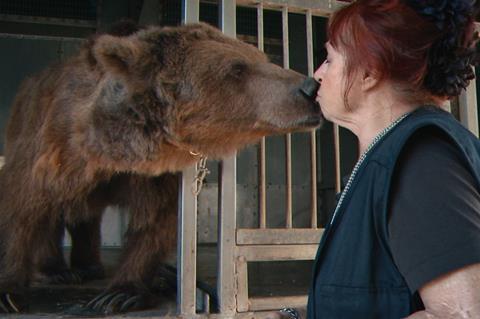
“I found comfort in our animals. They were the only ones to understand me,” says 80-year-old Maxy Niedermeyer. From the fifth generation of a circus family, she was around bears from childhood and went on to perform with them, as well as a menagerie including tigers and lions, for six decades. She worked with her final bear Natasha for 40 years, and Martin Genovski’s engrossing and moving documentary catches up with the pair of them in precarious retirement. Maxy’s unbreakable bond with Natasha, which is living on borrowed time, is the bedrock of the film. Genovski builds a picture around it of the history of circuses in western and, particularly, eastern Europe and the shift in societal attitudes towards their use of animals.
The director benefits from a large archive of material
Constructed with care and a good dose of humour, Bear With Me is a specific story with mass appeal thanks to the historic ubiquity of travelling circuses and the touching relationship at the film’s heart. Further festival play seems guaranteed after the premiere in competition at Sarajevo Film Festival, and it could catch the eye of a specialist distributor.
Society’s increasingly dim view of making wild animals perform is summed up in a single word by Genovski in an intertitle: “Cringe” — one of several playful definitions that pop up onscreen through the course of the film. While never suggesting that having these captive creatures was a good thing, the Bulgarian director, who previously made comedy-drama Bring Me Home, sets their use in the context of a period when it was considered acceptable. Maxy insists that trainers who use violence are cowards, and the undeniable co-dependency between her and Natasha speaks to a relationship built on trust. “She’s here for me, I’m here for her,” says the trainer.
The double-act, along with Maxy’s tigress Diana, were forced to retire as the clamour for an end to circus animals grew, and uncomfortable footage of a tiger riding on the back of a horse suggests that’s no bad thing. They found refuge at Hoenderdaell Zoo in The Netherlands, where Diana entered a big cat enclosure. Natasha, however, was considered so elderly and attached to Maxy that to separate them would kill her, so the performer was granted permission to live in her caravan in the zoo’s parking lot and care for her 43-year-old bear until the animal’s death.
The zoo assumed Natasha’s passing would be impending, but when Genovski begins filming the arrangement has already been in place for six years. In between capturing everyday life for Maxy and her husband Marcello, who is 22 years her junior, as Maxy feeds, washes and spends time with Natasha, Genovski pulls back to consider and contextualise her life and career via his own voiceover. He also invites contributions from her best friends, former circus acrobats Biliana and Kiril Kirilov, and others in her orbit.
While not trying to overly psychoanalyse, Genovski paints a portrait of Maxy’s tricky childhood with a stern father and a travelling life that meant constantly enrolling in new schools. He also touches on additional reasons why Maxy came to view Natasha and Diana as her surrogate children.
The director benefits from a large archive of material focused on Maxy and her animals, including a wealth of footage that stretches back to a quirky piece of German reportage showing her, aged six, with a bear called Charlie, and her father, in Frankfurt. The family fled to Hamburg and hid in a zoo during the Second World War as her father faced a death threat because of his Jewish origin. Later, as a young woman, Maxy found fame after moving to Bulgaria, where she was not only a circus star but appeared in short films with her bears, clips from which are included.
Genovski smoothly threads together this history, along with asides about Bulgarian life under Soviet influence, including the prejudice and jealousy Maxy faced despite embracing the country and its language. Oddly stilted, though thankfully infrequent, cutaways to moments of re-enactment featuring Martina Troanska as the young Maxy strike the film’s one false note. When the truth is this compelling, there’s no need for embellishment.
Production company: Agitprop
International sales: Autentic, info@autentic.com
Producer: Martichka Bozhilova
Cinematography: Vladimir Trifonov
Editing: Bohos Topakbashian
Music: Alexander Kostov