








Simon Stone’s dramatisation of Charleson’s portrayal of Hamlet bows in Telluride before traveling to Toronto and London

Dir: Simon Stone. UK. 2026. 111mins.
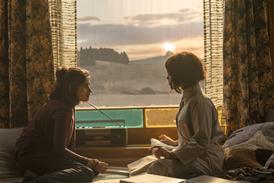
The power of art, if not to heal, then at least to offer a way of making sense of suffering is communicated movingly by this absorbing dramatic retelling of an extraordinary footnote in recent British theatre history. The Irish actor Andrew Scott triumphs as Ian Charleson, the Scottish actor who, in autumn 1989, replaced Daniel Day-Lewis as Hamlet at London’s National Theatre at short notice. Charleson did so knowing that he was terminally ill with HIV/AIDS, and while remaining as private about his illness as he was about his sexuality (not without some consternation within London’s LGBTQ+ creative community). The filmmakers, including director Simon Stone (Dig) and writer Stephen Beresford (Pride), successfully approach this remarkable real-life story determined to find the joy, as well as the pain.
Sharp and stirring but never sentimental
The ghost of Hamlet will surely haunt another awards season when audiences and voters connect with this sharp and stirring but never sentimental drama. Elsinore has its world premiere at Telluride, before travelling to Toronto and then opening the London Film Festival in October. Focus Features will release the film in November in the US, and Studiocanal will open it in the UK in January. Critical support, awards attention and strong word of mouth should steer it towards an appreciative audience.
Taking its cue from Charleson’s personality, Elsinore is as witty as it is serious, its humour softening its stark portrait of illness. It offers a superb performance from Scott, who is well supported by Olivia Colman as his doctor and Billie Piper as his fun, fruity friend Patsy. Other well-drawn smaller roles, from the sarky receptionist (Monica Dolan) at the National Theatre to Charleson’s touching sick friend Georgie (Luke Thompson), contribute to a strong ensemble and reinforce the film’s interest in professional families and communities of friends and fellow travellers.
Elsinore – the castle in Shakespeare’s Hamlet – assumes several guises here. On the surface it refers to the castle in the production of Hamlet that Charleson embarks on with director Richard Eyre (Johnny Flynn). The role lights a new and intense fire within Charleson. More obliquely, it also nods to two 1970s brutalist buildings which bear witness to Charleson’s final chapter: the National Theatre and the Royal Free Hospital, two institutions where the actor faces demons but finds a tribe. Both these places are given equal weighting in Elsinore and are well-conceived as living, breathing communities. But Elsinore is also offered as a state of mind: Charleson’s physical fate might be defined by his sickness, but emotionally he is shaped and strengthened by his art, his community, his wit and his passion.
Charleson is still best known for playing Eric Liddell, one of the lead characters in Chariots of Fire, winner of the Best Picture Oscar in 1982. Scott’s Charleson assumes a look of practiced, smiling forbearance whenever the film is mentioned (there’s an amusing scene with a cab driver who launches into Vangelis’s famous score). Before he takes on Hamlet, Charleson balances management of his illness with a lively social life among Soho’s gay community and his stalled ambitions to be a mainstream movie star. (The film’s sense of time and place is strong – especially places linked to the LGBTQ+ community in late 1980s London, whether that’s Soho or Hampstead Heath.)
The contradictions of Charleson’s private and public lives rile his old colleague, the gay filmmaker Derek Jarman (David Dawson), who accuses him of persisting with ‘heterosexual masquerades’. Themes of secrecy and honesty run through the film, inspiring especially touching scenes with Charleson’s parents (Peter Mullan and Georgie Glen) and the company of actors at the National.
Mike Eley’s handheld cinematography gives the film a welcome immediacy, supported by naturalistic lighting that leans into the glare of daylight and the darkness of nighttime domestic interiors. Editor Valerio Bonelli offers especially strong work cutting between the theatre and hospital scenes, reinforcing the connections between art and life without forcing them. Stefan Gregory’s relatively traditional and graceful score gets away with lending more overt sentiment to the film precisely because the script and the performances generally shy away from it.
One of the film’s biggest strengths is just how ingrained the play of Hamlet and, more generally, the world of theatre feel within it. That is surely helped by Stone and Beresford also being a theatre director and playwright respectively and, of course, by Scott himself having played Hamlet on stage. The film’s ring of truth is loud, which makes it all the more poignant.
Production companies: Studiocanal, LD Entertainment, Lucky Red, Magnolia Mae Films
International sales: Studiocanal, chloe.marquet@canal-plus.com
Producer: Andrea Occhipinti, Gabrielle Tana, Pete Shilaimon, Mickey Liddell, Carolyn Marks Blackwood, Andrew Scott
Screenplay: Stephen Beresford
Cinematography: Mike Eley
Production design: Helen Scott
Editing: Valerio Bonelli
Music: Stefan Gregory
Main cast: Andrew Scott, Olivia Colman, Billie Piper, Johnny Flynn