








Felipe Bustos Sierra explores 2021 demonstration through interviews, archive footage and reenactments
Dir: Felipe Bustos Sierra. UK. 2026. 98mins
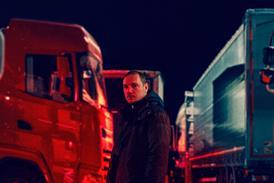
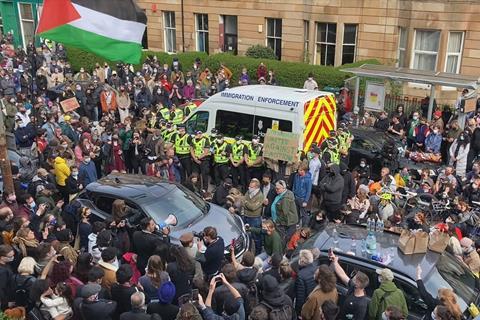
On May 13, 2021, the Home Office staged a dawn raid on Kenmure Street in Pollokshields, Glasgow, planning to deport two men they alleged had committed immigration violations. Yet things did not go to plan. Residents of the tenement-filled, diverse neighbourhood decided to stage a protest, and the eight-hour peaceful demonstration drew worldwide attention. Everybody To Kenmure Street offers an immersive view of how the events unfolded by speaking to those involved, and using crowd-sourced footage and judicious re-enactments to fill in the gaps. His hopeful film also sets the sit-in within a wider context of Glasgow’s history of protest; a reminder that such acts of solidarity are not as rare an one might think.
Set within a wider context of Glasgow’s history of protest
Solidarity is an idea that Scotland-based Chilean-Belgian director Felipe Bustos Sierra has explored in his BAFTA-Scotland winning documentary Nae Pasaran (2018), about a group of Scots Rolls Royce workers who refused to repair the engines of Chiliean warplanes in response to the country’s 1973 military coup. There’s added vibrancy to his second film because the events it describes are so recent and, although it unfolds in a specific place, it has broader resonance in the current era of global protests. It is particularly likely to strike a chord Stateside in light of the ongoing anti-ICE demonstrations there.
Following its premiere in Sundance’s World Cinema Documentary Competition, the film will doubtless receive a warm welcome on home turf as the opener of Glasgow Film Festival, and good word of mouth should help it attract audiences when it is released in the UK/Ireland by Conic on March 13.
What’s striking about what happened on Kenmure Street is just how immediate and cross-community the response was. One or two neighbours who had known the men for several years joined with others who simply didn’t like the idea of people being snatched up. Students and people on the school run became involved, as did a good chunk of the local Muslim community, who had been at the nearby Mosque praying ahead of Eid al-Fitr celebrations that day. Numbers gradually swelled to upwards of 1,000.
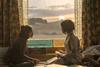
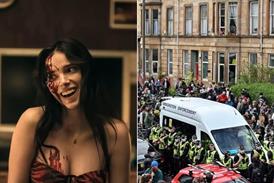
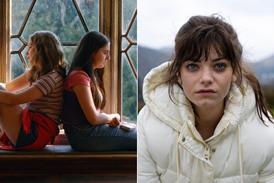
One individual – referred to only as ‘Van Man’ in the film – slipped quickly beneath the immigration vehicle to stop it moving away. He and the off-duty nurse who spent the day making sure he was OK, are anonymised – their experiences re-enacted, using their own words, by the film’s executive producer Emma Thompson (who plays Van Man) and Kate Dickie.
The use of re-enactment helps to put the viewer on the spot as Van Man offers his recollections from the cramped space beneath the vehicle, or the nurse addresses the camera as though it is squashed in alongside. The lens occasionally drifts upwards to a dark space, represented as a black screen with dust motes, as the two men who were detained recount their story. Along with a wealth of footage shot by witnesses, these interludes breaks up the ‘talking head’ nature of some of the other first person accounts.
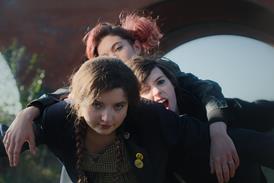
The documentary elegantly weaves in the city’s history of solidarity, including everything from early support for Nelson Mandela to the fact one woman involved that day had previously been part of the earlier Glasgow Girls protest – when a group of high schoolers successfully challenged the poor treatment of asylum seekers. Sierra is alive to the web of connections, also noting the involvement of Eileen Reid – the daughter of famed “work-in” shipyard trades unionist Jimmy – who just happened to live locally.
While the use of exclusively crowd-sourced footage, rather than anything from the mainstream news channels, may mean the film is a bit rough around the edges, there’s an authenticity at work that shears off any journalistic framing. The footage also adds intimacy and captures the energy on the day, which was peaceful if robust in terms of standing up to the police who descended on the area in numbers. Barry Burns uses vocals in his score to underline the sense of people acting in chorus rather than individually.
Sierra’s film not only stands as a love letter to peaceful protest but also to intelligent law enforcement that took the opportunity to de-escalate and resolve the situation without violence. Whether audiences agree that it has ’changed the narrative’ or not, it is a powerful testimony to a community’s ability to take control of their part of the story and give it a happy ending.
Production companies: Barry Crerar
International sales: The Party Film Sales, sales@thepartysales.com
Producers: Ciara Barry, Felipe Bustos Sierra
Cinematography: Kirstin McMahon
Editing: Colin Monie
Music: Barry Burns
Main cast: Emma Thompson, Kate Dickie, Keira Lucchesi