









A solitary woman’s bond with an abandoned dog anchors this textured Chilean film in Directors’ Fortnight
Dir: Dominga Sotomayor. Chile/Brazil. 2026. 112mins
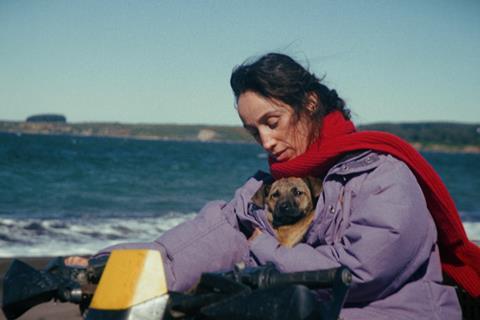
Relocating the action of Pilar Quintana’s original novel – which is set in and around the Colombian coastal jungle – to a windswept island off the Chilean coast, Chilean filmmaker Dominga Sotomayor’s latest feature, La Perra, makes her Cannes debut, in Directors’ Fortnight, nearly a decade on from becoming the first woman to win the Best Director award at Locarno with Too Late to Die Young (2018). La Perra is a beautifully-shot, close-to-the-ground character study depicting a quasi-maternal relationship between a woman, Silvia (Manuela Oyarzún), and a dog she adopts as a puppy, Yuri (named for a Mexican pop singer famous in the 1980s).
La Perra captures the sense of looking out of an open window at the world
Projecting an air of calm acceptance, Silvia is a childless middle-aged woman living an emotionally self-contained hardscrabble life involving lots of manual labour. It’s a life full of textures, which allows one of the stronger aspects of the filmmaking – the aesthetic – to come to the fore. Close-ups of seaweed make tangible a raw connection to the materials of the natural world with which Silvia lives and works, while the depth of the colours is unmatched. You could swear you can taste the salt in the air.
Cinematographer Simone D’Arcangelo rises admirably to the challenge of conveying the performance of the film’s canine star – and it really is a performance, with Sotomayor having evidently spent time thinking about how to capture the sense of a pet as a personality in its own right, complete with an emotional arc. The sometimes hound-height camera often seems to suggest roving and exploring with Yuri, though avoids tipping over all the way into a more comedic dog’s POV.
The territory Yuri explores is another asset – Santa María Island makes for a spectacular filming location. Vertiginous cliffs with loose rocks border a rocky windswept coastline, with variable tides and a cave system which is sometimes passable and sometimes under water. It is the perfect destination to allow young children to explore by themselves if you are not that bothered about seeing them again, which becomes a hard-to-watch key plot point.
That isn’t to say it’s a gruelling watch; indeed, the film exhibits a great deal of restraint. Gone is the book’s detailed description of the discovery of a child’s water-logged corpse – and perhaps that’s for the best. Similarly, the titular canine is depicted as a neglectful mother but without quite the same degree of overt condemnation (the book is explicit that she eats at least one of her puppies).
Most significant in terms of the film’s tasteful approach is the fact that we’re left to guess at so much of Silvia’s internal psychology, making the part a demanding one for any actor. Oyarzún’s performance captures very clearly the fact that this woman is guarded, resilient and stoical. The adoption of Yuri cracks something open and she begins to mother the abandoned puppy, but she remains somewhat enigmatic.
At a certain point we do start to infer that her reserve is the result of something more specific than natural temperament, and so it proves. There is a deep-rooted trauma in Silvia’s past which has stunted her life in some ways, and Sotomayor doesn’t shy away from focusing directly on the source of that trauma in the agonising shoreline flashback sequence. The film is perhaps not the work for which Sotomayor will be best remembered – it’s a song sung in a minor key, but it is very elegantly composed, with a couple of punchy standout scenes.
Production companies: RT Features, Planta
International sales: Lucky Number sales@luckynumber.fr
Producers: Rodrigo Teixeira, Fernando Bascuñán, Berta Marchiori
Screenplay: Inés Bortagaray, based on the novel by: Pilar Quintana
Cinematography: Simone D’Arcangelo
Production design: Natalia Geisse
Editing: Federico Rotstein
Music: Clint Mansell
Cast: Manuela Oyarzún, David Gaete, Selton Mello, Paula Luchsinger, Paula Dinamarca, Rafaella Grimberg