






Maria Silvia Esteve’s visceral second feature makes its bow in IDFA competition
Dir: Maria Silvia Esteve. Argentina/France/Romania. 2025. 89mins
The lingering, shape-shifting trauma of childhood abuse is expertly handled in Maria Silvia Esteve’s lyrical documentary Mailin, whose powerful narrative and sensitive craft choices serve to spotlight the bravery of its subject. Now in her 30s, Mailin Gobbo suffered 15 years of abuse from the priest who worked in her Argentinian community, memories of which she had mostly buried as a survival technique. Now a mother herself, Mailin has used therapy to understand what happened to her and give her the strength to seek justice, and Esteve documents this process with frankness and respect.
The vivid, vital testimony of a woman who refuses to remain silent
Premiering in international competition at IDFA, this is the second feature from Argentinian director Maria Silvia Esteve, following her personal essay Silvia, in which she explored her own childhood. Mailin also deals with the twists and turns of memory, and that Esteve spent several years earning the trust and friendship of her subject – who she was drawn to after seeing her speak about her ordeal on television – is evident in the film’s intimate, immersive approach. It should pique the interest of further festivals and deserves to find an audience via an arthouse distributor or streamer.
The film opens with an on-screen caption defining the legal term ‘statute-barred’ – an ominous hint the journey to healing and retribution is not going to be straightforward. But the way back from abuse is never easy, particularly when it begins at such a young age; Mailin thinks she was about five when Father Carlos Eduardo Jose began to sexually assault her (and, it transpires, many other girls), having worked his way into the community, into Mailin’s family, with his friendly manner, his passionate faith, his open smile.
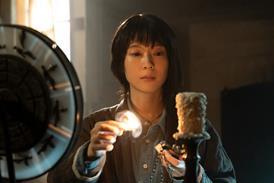
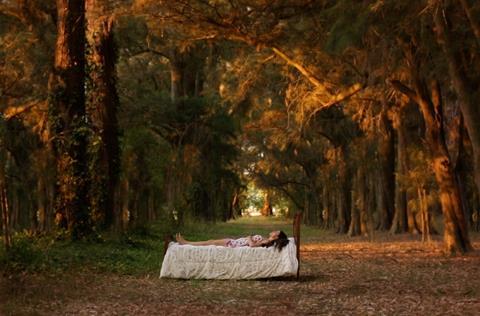
Mailin tells this painful story in two interweaving strands; one treads a standard non-fiction path of following Mailin as she and her family fight, first via the Catholic Church in Rome and then via the Argentinian courts, to have Jose convicted for his crimes. The second takes a more poetic, experimental tack as Mailin, in voiceover, tells her young daughter Ona the story of what happened to her in oblique, age-appropriate terms. It becomes a dark fairytale about a young girl and an evil beast and, combined with dreamlike dramatised woodland segments in which the image breaks and distorts, takes on a nightmarish tone which chimes with the revelations Mailin has had about her own life.
Similarly, in another astute move, Esteve plays home video footage of Mailin as a child, then rewinds and replays it, slows it down, so that small, uncomfortable details come to the fore, unforced. Other well-crafted sequences see the camera tight on Mailin’s face, staring silently down the camera, as harrowing audio of her courtroom cross-examinations play over her shifting expressions: grief, anger, resignation.
This is a deeply honest and personal film, both for its subject and its director – who has been public about the fact that she shares with Mailin the experience of abuse – and there are moments where it plays like an open wound. But there is a palpable determination here, too. Mailin is vocal in her desire to be strong for her daughter, to not let her trauma (which was also one suffered by both her mother and grandmother) affect Ona’s happiness, or define the rest of her life.
She is also voracious in her desire to see justice done, no matter the legal and cultural obstacles in her path. At one crucial point, the normally composed Mailin lets out a primal scream of rage; Esteve’s film is the vivid, vital testimony of a woman – and women – who refuses to remain silent.
Production companies: HANA Films, Ikki Films, deFilm
International sales: The Party Film Sales
Producers: Maria Silvia Esteve, Alejandra Lopez, Cristina Hanes, Radu Stancu
Cinematography: Maria Silvia Esteve, Victor R Caivano, Andrea Cabrera
Editing: Maria Silvia Esteve
Music: Maria Silvia Esteve, in collaboration with Ieronim Pogorilovschi and Codrin Lazar