






David Robert Mitchell’s follow-up to ’Under The Silver Lake’ and ’It Follows’ opens in US and UK cinemas on August 14
Dir/scr: David Robert Mitchell. US. 2026. 99mins
Writer/director David Robert Mitchell is no stranger to a high-concept premise; his previous features Under The Silver Lake (2018) and horror breakout It Follows (2014) both pivoted on an outlandish narrative that he adeptly kept under control. The End Of Oak Street returns him to the genre milieu of It Follows – although this time he’s operating within the realm of science fiction. Ewan McGregor and Anne Hathaway are well cast as the affable parents struggling to protect their kids when their neighbourhood is suddenly overrun by dinosaurs, and the film draws effectively on classic Spielbergian adventures to make for a fun, fast-paced, family-friendly creature feature.
Draws effectively on classic Spielbergian adventures
Produced by Joss Whedon (who also produced the Cloverfield franchise, with which this shares an uncanny sci-fi aesthetic), The End Of Oak Street is now rolling out globally and hits US and UK cinemas on August 14. It should appeal to a late-summer audience looking for post-Spiderman and Odyssey thrills, and the star power of Hathaway (riding high after The Devil Wears Prada 2 and The Odyssey) and McGregor, combined with its out-there plot and throwback to the golden age of ’80s action cinema, should help make this a much-needed success for Warner Bros following a challenging year at the box office.
Denise Platt (Hathaway), her husband Greg (McGregor) and their teenage kids Audrey (Maisy Stella) and Brian (Christian Convery) live on a friendly street in an idyllic Detroit suburb (the film largely shot in Atlanta). It’s the early 1980s – 1982, in fact, although that isn’t made explicit until film’s end, the era pinned down by costuming (including Brian’s disturbingly short shorts) and production design choices that lean very heavily into a late ‘70s, early ’80s aesthetic. In fact, it feels deliberately over-styled, giving the neighbourhood an eerie, place-out-of-time feel right from the off; the kind of uneasy suburbia in which Mitchell’s films tend to play out.
Early scenes establish that, while their lives seem to paint a perfect picture, the Platts are struggling. The ambitious Denise, who is writing a novel in secret, feels suffocated by her domestic responsibilities, her marriage to Greg seemingly dead in the water as much as they try to hide their unhappiness from the kids. The conceit is, of course, that it’s going to take something truly spectacular to keep this family together.
That stargazer daughter Audry is a fan of astronomer-author Carl Sagan, a key proponent of the idea of wormholes in time and space, is all the logic Mitchell’s screenplay needs to fuel its big idea – the Platt’s entire neighbourhood being whisked back to the Cretaceous period. Surrounded by volcanoes, lush jungles and, of course, a legion of dinosaurs, the family find themselves cut off from everything they have ever known, surrounded by things that want to eat them and, for the first time, entirely dependent on themselves for survival.
Sending an entire chunk of American suburbia millions of years into the past gives Mitchell and his effects team scope to create an uncanny environment in which dinosaurs stalk across manicured lawns, scavenge trash cans and hunt family pets – and their owners. We don’t need the several winking on-the-nose touches – a neighbourhood child hums The Flintstones theme, a T-rex stalks past a window through which we glimpse dinosaur bedding – to appreciate this mash-up of eras.
Most of the film plays like Jurassic Park on steroids, cinematographer Mike Gioulakis’s agile camera keeping up with the family as they face-off with one carnivorous creature after another – including, in one of the film’s best scenes, a giant snake that invades their home – armed with inefficient weapons like baseball bats and, in Brian’s case, a toy bow and arrow. This rinse-and-repeat formula of danger-escape-danger could feel repetitive, although there is enough novelty in the set-up, and enough surprises along the way, to keep things interesting. It helps that effects are superb, the dinosaurs operating seamlessly (and authentically) in this familiar setting, with Michael Giacchino’s soaring, John Williams-esque score emphasising the fantastical elements of the narrative.
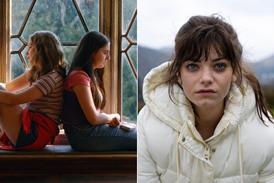
Away from the action, there’s also an undercurrent of genuine emotion and relatable family dynamics that ground this outlandish scenario. My Old Ass star Stella is great as Audrey, who finds her world changed just as she is on the cusp of understanding who she is, while Convery brings the requisite mix of adolescent bravado and childlike vulnerability to 13-year-old Brian. McGregor, too, is endearing, although his character is somewhat reduced to a US sitcom-dad-esque cipher of nice guy inaction and desperate optimism – a contrast to Hathaway’s tenacious Diane, who believes that being honest about the situation at hand is the only way to survive.
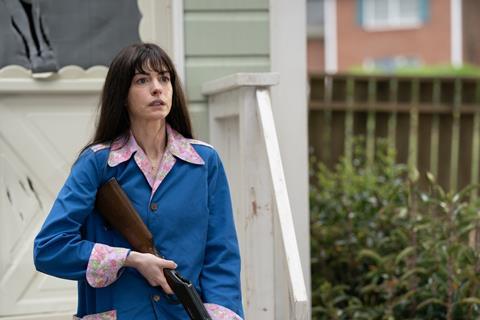
Indeed, it’s largely left to Hathaway to shoulder the film’s emotional heft, playing Diane as a woman who has found herself trapped in an impossible situation even before she is hurtled through time, burying her wants, needs and fears for the sake of her family. Through her experiences, The End Of Oak Street becomes, surprisingly, an effective and incisive paean to the challenges of parenthood, the everyday heroism of holding everything together for the kids even when your world is literally falling apart.
Production companies: Bad Robot, Good Fear Content, Jackson Pictures, Tommy Harper Productions
Worldwide distribution: Warner Bros
Producers: JJ Abrams, Jon Cohen, Tommy Harper, Matt Jackson, Hannah Minghella, David Robert Mitchell
Cinematography: Mike Gioulakis
Production design: Maya Shimoguchi
Editing: John Axelrad
Music: Michael Giacchino
Main cast: Anne Hathaway, Ewan McGregor, Maisy Stella, Christian Convery