





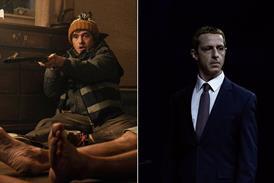



Josh Brolin and Elisabeth Shue also star in Brian Duffield’s crowd-pleasing adaptation of the novel by Daniel Kraus.
Dir.: Brian Duffield. US. 2026. 106mins
A survival story set almost entirely inside a sperm whale, Whalefall travels a fair way on its super-high-concept premise – and its intense visuals – but is elevated by a strong emotional core and an excellent lead performance from rising star Austin Abrams. Indeed, the actor almost single-handedly keeps the film on the rails through each increasingly outlandish twist of the narrative, and climactic sequences that make a surprising but effective move towards magical realism.
Abrams almost single-handedly keeps the film on the rails
Rolling out globally from October 14, Whalefall is named after the term used when a dead whale sinks to the bottom of the ocean and encourages a whole new ecosystem to flourish. It’s likely to pull in the punters thanks to its must-see plot and the presence of Abrams, who recently made a significant impact in Zach Cregger’s Resident Evil reboot, and Josh Brolin. Those familiar with the 2023 novel by Daniel Kraus, who co-writes the screenplay with director Brian Duffield – himself no stranger to the survival genre, having directed No One Will Save You (2023) and produced the likes of Cocaine Bear (2023) – will also be interested to see how this story translates on the big screen.
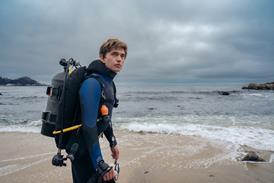
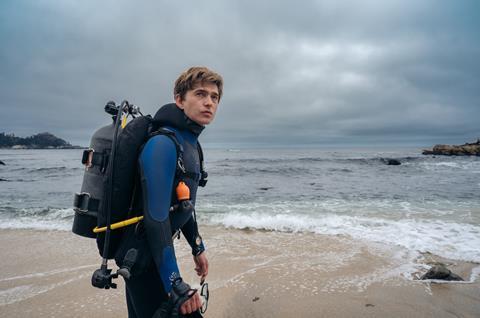
Twenty-something Jay (Abrams) is still attempting to come to terms with the loss of his father, Mitt (a gruff Josh Brolin), whose suicide by drowning opens the film and is then seen in flashback. While Jay and Mitt – a local scuba diving legend in their hometown of Monterey, California – had a fractious relationship, Jay is struggling with both grief and guilt; he refused to see his terminally ill father towards the end of his life. Desperate to ease his conscience, Jay decides to take a solo dive in search of Mitt’s undiscovered remains – but, thanks to a freak accident involving a sperm whale and a giant squid, finds himself trapped in the belly of the beast with only an hour’s worth of air remaining.
Those early sequences certainly make an impact, cinematographer Aaron Morton capturing the ominous depths of the ocean – audiences with thalassophobia may need to look away – and the speed and strength of these gigantic animals (believably rendered by visual effects supervisor Guillaume Rocheron and his team). Sound design from James Miller is also effective throughout, the deep sonar booms and echoing clicks adding to this otherworldly atmosphere. When Jay is inside the whale, dragged in after hitching an accidental ride on the animal’s squid supper, framing becomes claustrophobic, colour dulls, sound is muffled and the outside world seems entirely out of reach.
Both author Kraus and director Duffield carried out extensive research on whale anatomy, on what could feasibly happen if someone was swallowed whole and survived. (While such a fate has occurred in biblical parable – to the prophet Jonah – and literature – to Gepetto in The Adventures Of Pinocchio – it has never happened in real life.) Such dedication to authenticity is commendable but, of course, production design from Ramsey Avery was always going to amp up the grotesque; Jay is repeatedly pummelled by the whale’s oozy, fleshy innards, finds himself sizzling in stomach acid. Some creative choices are dictated by the film’s dark, isolated setting; Jay spends a lot of time talking to himself through his mouthpiece and, at one point, uses a jellyfish as a light source as he attempts to find his way out.
This mash-up of Moby Dick and Innerspace could easily have become ludicrous, but Abrams proves a grounding, sympathetic premise. As he proved in Resident Evil, the actor is excellent at portraying an ordinary guy floundering in extraordinary circumstances and, again, doesn’t attempt to imbue the character with gung-ho action hero energy. Jay remains absolutely terrified throughout his ordeal, his fight for survival powered by instinct rather than bravery or logic. “I’m in the fucking whale!” he screams, desperately, having inched his way up the creature’s gullet to its mouth and spotting a tourist boat. He sounds as incredulous as he is scared.
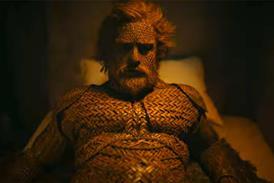
Flashbacks to moments Jay spent with his father offer some respite from the intensity and demonstrate that the pair were ill-matched: Mitt, a gruff, tattooed, heavy-drinking man of the sea; Jay, a more sensitive soul with dreams of going away to college. Their relationship gives the film its emotional undercurrent, and lays the groundwork for later scenes in which Jay, running out of both air and hope, begins to bare his soul to his father (heard in echoey voiceover). This fantastical, mystical element is a bold addition to an already surreal narrative but largely works, anchored by the gung-ho commitment of both story and performance.
Production companies: 20th Century Studios, 3 Arts Entertainment, Imagine Entertainment
International distribution: Walt Disney / US distribution: 20th Century Studios
Producers: Brian Grazer, Brian Duffield, Jeb Brody, Allan Mandelbaum
Screenplay: Brian Duffield and Daniel Kraus, based on the novel by Daniel Kraus
Cinematography: Aaron Morton
Production design: Ramsey Avery
Editing: Pietro Scalia
Music: Joseph Trapanese
Main cast: Austin Abrams, Josh Brolin, Elisabeth Shue, John Ortiz, Jane Levy, Emily Rudd