











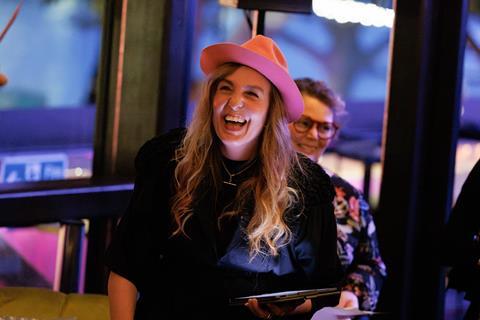
Mia Bays is feeling energised as she comes to the end of her five-year tenure as the director of the BFI Filmmaking Fund.
“I’m excited. I’m ready to do something else, to go back to the creative crucible,” she says.
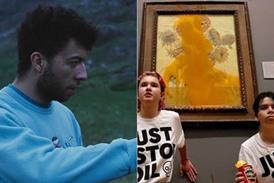
Bays, who previously headed the film charity Birds’ Eye View (now Reclaim The Frame), joined the BFI in 2021 at the tail end of the pandemic on a three-year contract, later extended to five. She steered the fund – investing National Lottery ‘good cause’ money – through choppy post-pandemic waters to see the BFI claim its highest-ever number of Bafta nominations in 2025, for films including Kneecap and Bird.
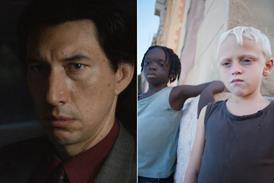
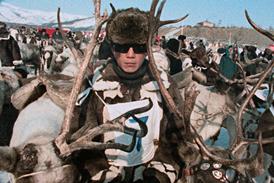
She helped to expand the view of what a ‘UK’ film looks like, backing India-shot films Santosh, Our Share Of Sand and Sister Midnight, and Nigeria-shot Bafta-winning My Father’s Shadow, and Lady.
Bays also took a keen interest in diversifying the backgrounds of those who received funding, and the BFI’s stats show improvement under her leadership, particularly for individuals with disabilities.
Recipients of production funding who self-identify as disabled (writer, producer or director) increased from 6% in the 2021-2 funding cycle to 42% in 2025-6. In 2023-4, the fund began reporting class, with 28% of recipients identifying as working class in the initial cycle, up to 36% in 2025-6.
Bays also restructured production funding into the Discovery Fund for debuts below £3.5m, and the Impact Fund for more ambitious projects, over £3.5m. She oversaw the introduction of the Creative Challenge Fund, supporting UK-wide labs to enable decentralised project development, and the Future Takes scheme for high-budget shorts, in partnership with Film4.
The inevitable challenges included a fall in the total annual BFI film funding pot to £20.3m per year, down from £25m, and ongoing debate about whether the films have drifted too far from what audiences will pay to go and see at the cinema.
“The job is relentless,” admits Bays of the intense industry scrutiny of being the face of a publicly supported funding institution. “There is no let up.”
As she hands over to incoming fund head Isabel Davis, Bays talks to Screen about the choices she made to balance “finite resources with infinite need”, why steering a slate of UK Dogma films is her next move, and takes the opportunity to correct several widespread misunderstandings about the BFI.
What has surprised you most about the BFI role?
You become a symbol of an organisation to such an extent that what you did before is forgotten, or almost erased. You’re a symbol of an organisation that does an enormous amount of work across the whole ecosystem. I’m surprised about how many people thought I ran the London Film Festival too, and the archive, and programmed BFI Southbank.
What are you most proud of?
The work we did to establish trust in the system, so that there is clarity, consistency and care. I hope that people felt that that care was being centred. That we’ve thought about how it feels when people approach us. I still don’t think any institution gets this right. It’s hard. There’s a power imbalance.
I do feel like there is more transparency with which we are trying to operate. I would hope there is a little bit of a shift to seeing us not as gatekeepers, but as stewards. I prefer that term.
You used the word ‘battle’ recently. What have those key battles been, and how have you navigated them?
It’s the emotional and political complexity of public funding and National Lottery funding, which is particularly what I’m responsible for, and how that is viewed, and the particular benefits it carries with it, from the industry impact to the audience impact.
There are a lot of considerations, and it takes a lot of thinking about, and often battling through. You’re balancing finite resources with infinite need. When I said battle, it wasn’t necessarily with people or parties, but the relentless nature of the job.
How do you feel the restructured funds have worked?
I feel really proud of that work – having a number of different funds, making it clear that the different funds have different priorities, and decentralising development with the Challenge Fund so you can come to us, but you also have other options. There are other gatekeepers, stewards of the money.
Sectioning the production fund into Discovery and Impact, so it’s really clear we have intentions to support debuts and we have intentions to support people at other stages of their career. Clarity was needed. You’re always navigating so much scrutiny and expectation, it’s incredible how much misinformation spreads and sets in.
One point that comes up with producers is the BFI no longer comes first in, as cornerstone financing. Is this correct, or an example of misinformation?
No, that’s not true. Because the industry is so uncertain, people hold onto truths and don’t check. There are lots of different stages we enter films.
The Incomer – we were there at the beginning, we developed that with Screen Scotland, that’s cornerstone finance. We board lots of things with Film4 and BBC Film, they are usually the first cornerstone but us boarding commits to a greenlight.
A phrase you’ve used a few times is the BFI’s National Lottery funding is there to address ‘market failure’. Can you explain what you mean by that phrase, and if you stand by it?
It’s baked into what National Lottery money has to be spent on. It’s not my invention. It’s ‘good cause’ funding.
Obviously, it’s an interpretation of what you mean by what is a ‘good cause’. It has to be there where the commercial sector isn’t, and that doesn’t mean to say that we’re making films that aren’t commercially viable. All films have to have a route to market. Impact Fund applications have to have a sales agent attached, so there has to be some gauge of international appeal.
As it is so hard to get films funded now, there are growing calls that the BFI should be backing more ‘commercial’ and ‘audience-facing’ films.
A film like The Incomer got picked up by Focus/Universal and is getting a really significant release. Kneecap had significant success [grossing £2.2m at the UK-Ireland box office]. So we are [backing commercial films]. We’ve got three or four quite significant-to-mid-range budget films coming through that people just haven’t seen yet.
There is a balance. We are triggered by applications. We can’t go out and solicit. We’re not able to do that. We can’t commission. We can’t buy in IP. We’re dependent on the films knocking on our door.
How closely are you working with your successor, Isabel Davis?
We’re doing a handover, and there are certain times where it’s best for me to not be there and for her to take the temperature herself. Other times, I’m in the meetings.
Your next move is to shepherd the first Dogma UK slate. Why were you drawn to that?
What I’ve observed so much is how hard it is for established filmmakers to sustain their creativity, to have a career, to have longevity in it, to not be broken by the experiences.
We’re in the process of building our model. We’ve got our filmmaker lineup.
Is there anything else in the pipeline?
It will be mainly Dogma. I’m interested in doing some consultancy. I’m talking to some other national funds about whether I can help as a recovering film fund head.
I’m really interested in executive producing. There is a space that I’m interested in filling; often I’ve seen it on films that we’ve funded, someone who might be an elder can be really helpful for the filmmaker navigating experiences that they have not been through before.
And you’re moving out of London…
I am very excited about that. I’m moving to the South West, I will base my business in Bristol and live in Exeter. That’s a real milestone for me – I’ve been in London my whole life. Relocating, changing my business base, is a deliberate choice to live the decentralisation we are talking about so much. That’s the political climate – if we want regional film cultures to thrive, some of us might need to take our bodies and businesses outside of London and the South East.
What do you hope your BFI legacy will be?
I hope people admire the range of films, the clarity and fairness, and that people really understand that I stand for inclusion and access in the various ways one can interpret what that means. And that I showed up. I felt I put a lot of time into being in person at events, not just in London and the southeast, but around the country, internationally.
People often commented, ‘I didn’t expect to see you here; I thought you’d be too busy or too grand.’ I don’t want to ever be either one of those things.






No comments yet