
















Cinemas are still struggling in the wake of the pandemic and many are turning to artificial intelligence tools in a bid to win back audiences. But AI is not just the preserve of major exhibition chains — scores of independent cinemas are embracing the technology too, despite environmental and ethical concerns.

The small town of Tynset in central Norway, surrounded by mountains and forest, is the unlikely setting for an AI-powered revolution in cinemagoing. Its two-screen municipal cinema — which serves the 6,000 people of the town and surrounding area — has grown admissions by 21% over the past year to 14,000, far ahead of the Norwegian average of 2.5% growth in 2025.

Tynset Kino cinema manager Sergio Chavez puts much of this growth down to AI, which has helped to improve both scheduling and marketing. In both cases, he has custom-built his own AI agents, using Anthropic’s AI assistant Claude.
His bespoke scheduling software can optimise the timing and selection of the films that are screening, based on national cinema data as well as Tynset’s own box-office figures. It will advise on the best time to programme films to secure the highest number of admissions, and recommend how many slots are best for a movie. Chavez says it is particularly useful for programming during holiday periods such as Easter and Christmas when audience habits change.
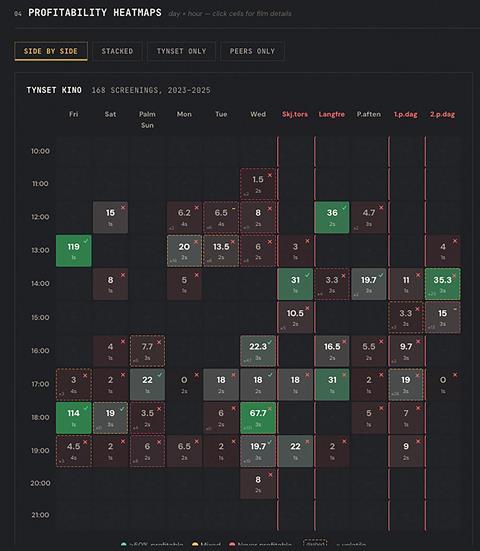
Meanwhile, his marketing AI agent can create copy about upcoming films and events, and then deliver it automatically to social-media platforms such as Facebook, Instagram and TikTok at pre-set times. The AI tools have been a gamechanger for Chavez, who is also responsible for running cultural projects in the town alongside his role as cinema manager. They are not only helping to increase admissions but also freeing him from routine administrative tasks. “It is crazy, they are saving me at least one day a week,” he says.
Asked if he thinks other exhibitors could create their own AI agents, the self-taught Chavez is emphatic: “Everyone can. You need a little bit of technical knowledge, but I think by the end of this year anyone will be able to,” he says, pointing to the rapid advances in AI programming.
The adoption of AI by cinemas is, of course, nothing new. Leading exhibition chain Vue is regarded as a pioneer, having launched its own bespoke algorithm-powered programming tool 10 years ago, long before the launch of well-known large-language models such as ChatGPT and Claude. Meanwhile, leading cinema management software firm Vista has offered its proprietary AI algorithms, which span marketing to scheduling, for more than a decade.
But the big change is how accessible and affordable AI has become, in particular for smaller independent cinemas like Tynset. For a modest monthly fee of around $12-$35 (€10-€30), exhibitors have access to a range of powerful AI tools such as ChatGPT Pro, Claude, Google Gemini, Perplexity AI and Microsoft Copilot for research, writing and analysis, through to design-focused tools Canva Magic Studio, Beautiful.AI and Midjourney.

Many cinemas that do not have the money to buy large-scale business intelligence and ticketing systems are turning to such pro AI tools, says Dan Kratky, who runs the two-screen Cinema Svet in the Czech spa town of Hodonin and is head of the Czech Cinema Association. He estimates at least half of independent Czech cinemas now use AI in some form.
Kratky says it is easy for exhibitors to create a simple app using ChatGPT or Claude. It can then be fed with cinema data to work out which films and slots work best to attract audiences. He does however add an important caveat — check the results carefully. “You have to know something about data science and film programming because AI still hallucinates a lot,” he warns.
Rules of attraction
Some see AI as a much-needed shot in the arm for exhibitors at a time when the industry is still managing the impacts of the pandemic, the rise of streaming and the Hollywood strikes. “It is going to completely optimise our business — from managing stock to scheduling and marketing,” says Mark de Quervain, head of operations and cinema strategy at global cinema technology business Indy Cinema Group. “If we can run our cinemas more efficiently, getting the right films in the right place at the right time, and communicating to the right audiences more effectively, we will get more people in.”
De Quervain recently ran two AI workshops, in Bologna and Valladolid, for independent exhibitor organisation Europa Cinemas. Many of its members’ cinemas are run by small teams that are stretched thin, he notes, so AI adoption is not about replacing jobs, it is about helping them do better. If AI removes the repetitive, time-consuming tasks, then teams are more able to focus on creative strategy and high-impact work.
AI can help in multiple areas, which include planning and segmenting marketing campaigns; comparing channels such as SMS, email and social media for cost, reach and impact; and generating creative assets quickly, such as trailer surveys, newsletters and marketing copy — all tuned to each audience segment. It can create personalised subject lines, calls to action and film spotlights — for example, describing a storyline in five words rather than long-winded paragraphs, and coming up with a dozen alternative options. De Quervain stresses that a human is still needed to choose or edit the right one, but it adds to their creative capabilities: “It is an amazing enabler.”
In operations, de Quervain says AI can save hours on admin and reporting, helping with everything from board updates to team summaries and meeting reports. He describes it as a “power tool” for analysing customer data, helping to discern clear patterns that inform marketing and programming. “We’ve got tonnes of data,” he says. “When you’re doing tens of thousands of transactions over a period of years, you’ve got lots of different kinds of customers, movies, events, membership programmes, etc. But how do you bubble all this up into sensible insights?”
One of the biggest changes sparked by AI is its conversational reporting facility, allowing users to query data using natural language to receive insights, summaries or visualisations, rather than having to rely on complex Excel formulas and dashboards. “Forget dashboards, they are going,” says de Quervain.
For example, cinemas can feed their raw data into an AI tool and ask a simple question: “What genres performed best among first-time customers?” and receive instant feedback. Or they might ask for help to analyse and optimise the performance of email marketing strategies or membership schemes. With conversational AI, it means the user does not need to be a data scientist or a whizz at Excel. “You gain back hours that you can use in a much better way. AI should take care of about 40% of your time that you don’t love using,” says de Quervain.
AI caution

De Quervain admits, however, that AI adopters need to proceed with caution. The key is understanding what you are doing: “If you don’t understand what you expect to get, or how to get there, you could end up in a terrible mess.”
There are ethical issues to consider too. AI can unintentionally amplify bias or stereotypes. It can over-polish language, losing a film’s authentic voice. AI-generated content must never replace human cultural interpretation, says de Quervain, who sets out some guiding principles: always verify facts and sources, ensure humans review creative and cultural outputs, and use AI to support local voices not homogenise them.
“It can do a lot of the data legwork, but it is not something you should follow 100%,” echoes Kratky. “You need to analyse its findings as a cinema operator, because you know the region, the cinema, the people and their habits.”
While one of the key concerns about AI is its impact on jobs, few people that Screen International spoke to thought it would affect employment in the independent exhibition sector.

“Most independent cinemas don’t have many jobs to get rid of,” notes Kino Svet’s Kratky, pointing out that a cinema manager will often be responsible for programming, marketing and event production through to managing technology. “It’s not a job killer for us. It is more of a tool to free you up to do more creative and useful things.”
For independent and arthouse-focused cinemas, there is understandable caution around AI scheduling. “Sometimes the numbers are not the only thing to consider,” observes Kratky. “Sometimes there is a film you really want to show off on a big screen, even though you know the potential [for ticket sales] is quite low.”
He sees it more like a “scheduling consultant”, pointing out what is working or not working, advising on when it might be time to switch a film out of a certain auditorium or drop it from a programme entirely. There is also the environmental impact to consider, as AI tools consume huge amounts of energy, and every prompt, image or video generation comes with a carbon footprint. De Quervain, for one, believes AI users should limit unnecessary generation of images or videos.
But there can also be sustainability gains, he suggests. “If you are able to run your business more efficiently, put more bums on seats, reduce power consumption or food waste with better AI management, then AI might help reduce your carbon footprint.”
Early adopter: Vue Cinemas
UK-based exhibition giant Vue is recognised as a pioneer in AI adoption, rolling out its own programming tool AI scheduling (AIS) more than 10 years ago. It helps Vue’s central programming team schedule all its UK sites and was launched into its Italian cinemas three years ago. It is soon to be used in the exhibitor’s Polish sites.

There is still a need for a core programming team, particularly for working with studios and viewing films ahead of release. “But they are supercharged” by AI when it comes to the “monumental task” of scheduling 30,000 film sessions a week in Vue’s UK cinemas, says chief commercial officer Otto Turton.
AIS has increased the number of films Vue can show, helping the chain fit in up to five shows per screen, each day. “An average eight-screen Vue will schedule as great a variety of films as a 14 or 15-screen cinema at one of the other multiplex operators,” says Turton.
It also helps the programming team to work out when to keep strong-performing films in the cinema. “One of the fundamental problems we have as an industry is awareness — people just don’t know films are available in the cinema and by the time they do, they’re not in the cinema anymore,” says Turton. AI can help solve this, he explains. “So you hold on to the long tail more effectively. In the UK, films reach 90% of their box office in about four weeks, on average. For us, it’s about six weeks — 50% longer.”
As well as its scheduling, Vue has AI tools including a third-party propensity marketing platform that analyses customer data to tailor marketing messages. It has been “transformative”, says Turton.
Vue also uses large language models to help process written feedback from customers and find insights and patterns, something that is difficult to analyse at scale. Recently, it helped Vue to remedy a puzzling fall in popcorn sales in the Netherlands. By using AI to crunch customer feedback, Vue worked out that its popcorn was being oversalted. Now, thanks to AI, less salt is used and sales are rising.
Local pioneer: Lillehammer Kino, Norway
Clarissa Bergh is a manager of a five-screen municipal cinema in the ski resort town of Lillehammer in Norway. “As a cinema manager, you have a lot of things to do because we’re in a tight economy,” she says.

Marketing is a priority, which has only grown in importance for bringing back audiences to cinemas since the pandemic and Hollywood strikes. To help save time and in search of inspiration, she has turned to AI to help with marketing, using ChatGPT to help write social-media marketing captions for films and events.
“I’ve been in this job for seven years, and I’ve made up a lot of captions — but after a point your head feels empty [of inspiration],” says Bergh. “Sometimes I also use it to get a younger feel in the language we use to promote movies.”
Looking to professionalise the cinema’s use of AI, Bergh contacted Norwegian AI consultancy Glassboks. It has provided what she describes as a “built-in marketing assistant” that can create newsletters and social-media posts, all in a tone that matches the cinema’s usual communications.
Every week, Bergh also receives a report from the AI tool, which is based on the pro version of ChatGPT. It analyses the impact of the cinema’s marketing content, working out which messages and posts engaged best with audiences. It also suggests possible improvements for the following week.
“I used to spend 70% of my time on marketing. Now it is down to 40%,” says Bergh. She also suggests the AI marketing assistant is helping to improve ticket sales at the cinema, noting a February spike in sales.
Cinema software: Vista Group
New Zealand-based cinema management software firm Vista Group provides digital solutions to major exhibitors such as Odeon, Kinepolis, Pathé and Village Cinemas Australia. It claims an estimated 46% global market share of the large cinema circuit outside of China and India. AI is nothing new for Vista, says Matthew Liebmann, Vista Group’s chief product, innovation and marketing officer, who points out the company has used proprietary AI algorithms developed by its team of data scientists for over a decade.

Among its software offers is Movio, a marketing and customer intelligence platform that uses AI to help identify customer segments and create content. Movio’s forecasting and planning tools include Moviegoer Personas, which segments customers based on their motivations, such as a preference for luxury formats or using the cinema to entertain the children. Other algorithms, such as Moviegoer Churn, calculate the likelihood they will visit a cinema in the coming three months.
Movio also has two AI content creation tools. Dynamic Content selects and ranks the movies each customer is most likely to enjoy. It then inserts the artwork associated with those films in the correct order in emails. Movio’s First Draft uses generative AI to draft copy for each movie.
Vista also has AI tools for programmers and operations teams. The Box Office Forecasting tool can predict domestic opening weekend “to an accuracy level of +/-15%,” claims Liebmann, helping exhibitors plan for audience numbers. He also suggests that Vista’s Assisted Scheduling tool can cut their scheduling time by up to 50%.
Liebmann stresses that the tools are aimed at all parts of the exhibition market, and are “equally easy to use by the largest multinationals as well as the most time-constrained, single-site independents”.
“That’s the great part of this AI revolution,” he adds. “It’s not just how it levels up all users, it’s also how easy it is for them to do so.”
Terms of use: Watershed, Bristol

Ethical and environmental concerns about AI mean some cinemas are clarifying how they use the technology to staff and customer
One cinema taking seriously the ethical questions around AI is the UK’s Watershed in Bristol, which has a reputation as an independent and counter-cultural city that is home to many creatives and artists.
In November 2025, the theatre was shortlisted in the British Independent Film Awards (BIFA) cinema of the year category, when it found out some people were under the impression its campaign artwork for the award had been created with AI — and accused the cinema of taking away an opportunity from a creative to design it.
The cinema — which is part of a cultural venue in Bristol — addressed the accusation head-on, stressing in a blog post that AI had not been used in any part of the design and that it strongly championed Bristol artists and creatives. It also shared its design process for the work, which was created by longtime collaborator Tony Stiles of Studio Stiles.

Watershed CEO Clare Reddington says the moment clarified the importance of organisations like hers in setting out how and when AI can be used. “Audiences are rightfully asking a lot of questions about it,” she notes. On the other hand, she points out that Watershed is also home to an innovation lab that supports around 250 creatives who are using emerging technology, such as AI, in their work.
Ironically, at the time of the BIFA campaign, Watershed was working on an updated AI policy — published in February 2026 — with the help of inclusive innovation studio Careful Industries.
Reddington describes Watershed’s approach to AI use as “intentional” and says that it is used only when necessary. For example, it allows staff to use AI tools as an assistive technology for tasks such as data analysis or to cross-reference legal documents. But it does not allow any creative content to be generated by AI that might be used to communicate with audiences, such as marketing copy or poster designs.
“Our tone of voice and our communication with our audience and our curation of film is the most important thing we have,” says Reddington. “It is why people come to us. Letting a bot take that over would, in the end, be counterproductive.”
Watershed’s policy says it “resists AI as a pervasive, ambient or default workplace tool”. Looking to support artists and creatives, Watershed’s policy is “not to commission or create artistic or creative work that has been wholly made using generative AI”. But it recognises that some staff members will use generative AI tools as assistive technologies. “We are realistic,” says the AI policy. “We recognise AI tools and assistants are being added to the software packages and systems used in Watershed’s day-to-day operation. Watershed is also operating in a context of shrinking resources. From time-to-time, we may need to use AI tools to support business operations. We will always strive to do so with intention.”
The cinema also says it conducts ethical, social and environmental impact assessments around new uses of AI, and ensures “transparent crediting that celebrates the people we work with and will always make it clear if and how AI has been used as part of a project”. It also keeps a register of AI tools and services that can be used at Watershed.






No comments yet