








Directors Jared Bush and Byron Howard and producer Yvett Merino on expanding the universe of the original Disney animation
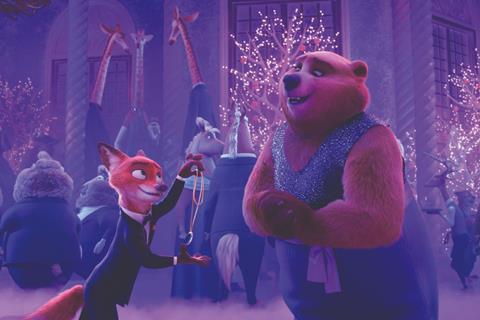
An unlikely team-up between a perky rabbit and a cynical fox was at the heart of the original Zootopia, Disney’s 2016 animated feature set in a bustling metropolis of anthropomorphic mammals. So when directors Jared Bush and Byron Howard started thinking about Zootopia 2 (released as Zootropolis 2 in most of Europe, due to a local trademark consideration), the relationship between bunny Judy Hopps and vulpine Nick Wilde was, says Bush, “our true north”.
But the directors also saw plenty of room to explore the film’s world, its menagerie of inhabitants and the subtle social commentary that had helped make the original Walt Disney Animation Studios film not just a $1bn-plus global hit but a best animated feature Oscar winner to boot.
“We had only talked about mammals in that first movie, but we had plans for many different areas of this world,” says Howard, who had directed the original film with Rich Moore. “Our thought was that this is one huge metropolis on a continent, a planet of animals.”
Equally important, says Bush, who also wrote the sequel and had served as co-writer and co-director on the original, “was making sure the thematic DNA of the first film was still represented here. We talked about bias and stereotypes in the first movie – we wanted to continue and deepen that through our main characters and the fact they really see the world differently.”
Picking up its story straight after the events of the first film, the sequel finds Judy (again voiced by Ginnifer Goodwin), Zootopia’s first bunny cop, being joined in the city’s police department by newly recruited ex-con artist Nick (a returning Jason Bateman). While struggling to adapt to their new working partnership, Judy and Nick are swept up in a mystery involving Gary De’Snake (a new character voiced by Ke Huy Quan), the first snake to be seen since the city’s creation a century before.
The investigation leads Judy and Nick through previously unexplored neighbourhoods, allows the film to introduce a gaggle of new characters and reveals why reptiles were once pushed out of the city by fearmongering fat cats.
New approach
Bringing the story to screen – with its tally of more than 2,000 shots and cast of 178 unique characters from 67 different species – took a crew of nearly 700 people. It prompted Bush, Howard and sequel producer Yvett Merino, who all started work on the project soon after completing their collaboration on Disney’s 2022 animated Oscar winner Encanto, to develop new working practices.
“When we first started, there were deep conversations about taking a different approach and getting out of that muscle memory [from the original film],” says Merino.
The traditional pipeline calls for story, animation, lighting and other departments to work on sequences consecutively, but that is not how the filmmakers on Zootopia 2 approached the project. “We wanted those different departments to intermingle much earlier,” explains Bush. “Great ideas can come from anywhere. Being able to lean into collaboration was key, specifically for a movie that’s about how our differences, when you combine them, make us all stronger. It was thematic in addition to being a great way to figure out what our story needed to be.”
The process gave rise to what the filmmakers christened ‘story jams’. “We would blue-sky ideas with multiple departments, sitting in a room for a couple of hours to just spitball, not worrying about the constraints of the story,” says Bush of the development sessions.
The collaborative approach was facilitated by some of the technology employed on the sequel. The original film was made with commercially available Maya software but the sequel switched to Presto, the proprietary software developed by Disney Animation’s sister studio Pixar and never previously used on an entire non-Pixar feature.
Though the software switch meant returning characters from the first film had to be rebuilt in Presto, it also promoted collaboration. “Presto allows different departments to work on the same shot at the same time,” explains Bush. “That allowed these different departments to learn from each other and to troubleshoot things that ordinarily would take several weeks to figure out. It allowed all the creative brains to work on things at the same time.”
To give the story’s central character of Gary a convincing look, the Disney team had to design an entirely new authoring toolset called Scute, which could create the impression of movement in the snake’s individual scales.
“We didn’t want to just map a texture onto Gary’s skin,” says Howard. “To really get the feeling that you’re seeing reptile scales, the software had to figure out how real snake scales work.”
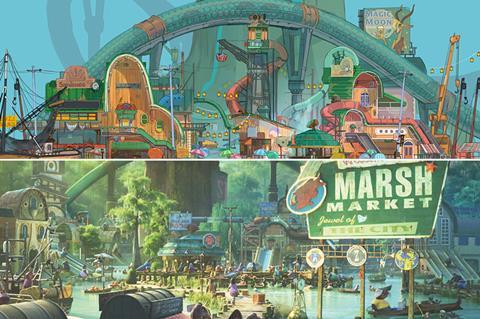
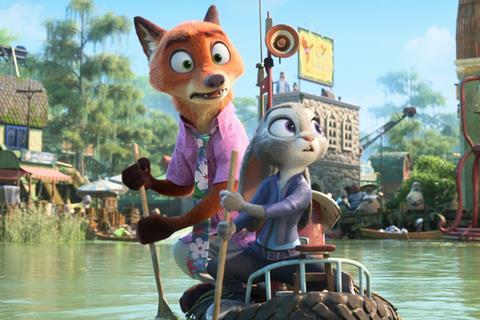
The software upgrades and collaborative practice came together in scenes such as the Marsh Market sequence, as Judy and Nick pursue Gary through an unfamiliar neighbourhood of semi-aquatic mammals.
Influenced by human environments such as Asian water markets and the ports of the southern US, the Marsh Market is populated by walruses, sea lions, dolphins and other animals moving between water and land, animals that combined the animation challenges of water and fur.
Ideas for the sequence were gleaned from one of the project’s story jams. Realising the neighbourhood and its inhabitants, meanwhile, turned out to be both technically challenging and, says Howard, “a playground for our effects artists and animators. It feels like you could walk around in this place for a week and not see everything.”
“We had to all hold hands early on and say we’re definitely going to this location,” confirms Bush. “It’s a very difficult thing to build and realise, so we couldn’t say later that we were not going to use it. But it’s what makes this movie feel special – the degree of difficulty is high and the execution is phenomenal. It’s something you haven’t seen done to this degree in animation before.”
Split teams
Zootopia 2 was only the second feature – after Moana 2 – to be animated both at Disney headquarters in Burbank, California and at the company’s four-year-old Canadian facility in Vancouver, British Columbia. That allowed the Zootopia sequel, with a reported budget of $150m, to claim the generous British Columbia production services tax credit as well as the Canadian federal credit.
Merino says Moana 2, on which she was also a producer, served as “a runway and a ramp into what we needed to accomplish on this film”.
“Our heads of animation were in Burbank but they travelled up to Vancouver a lot to be in the room,” she says of the Zootopia sequel. “We had a production management team in Burbank and one in Vancouver, but we are all considered one big team.”

Another notable element of the production was the September 2024 appointment of Bush, a 13-year Disney veteran, as Walt Disney Animation Studios’ new chief creative officer (CCO).
Bush took over the post from Jennifer Lee – who is now writing and directing the upcoming Frozen 3 – and says the appointment being made during his work on Zootopia 2 was fortuitous: “The number-one job that I have as CCO is making sure the next movie that comes out is as great as it can be,” he says. “So it was helpful it was the same movie I was already working on.
“When you’re at the height of production, you’re meeting with every department in the building,” he continues. “[Stepping into the CCO position] is when you want to hear about what’s working, what’s not working, and about new ideas that people have to make things better. So it couldn’t have come at a better time.”
Practices that Bush says were “pressure tested” on Zootopia 2 may now become standard company practice, such as a new system for canvassing and sharing unfiltered feedback on work-in-progress screenings with the entire Disney Animation workforce rather than just the crew of the project concerned.
For Zootopia 2 itself, the collaborative production methods, additional characters and newly discovered environments are delivering the desired results. The sequel opened over the long US Thanksgiving weekend with a global box office of nearly $560m, including more than $270m from China, where fans flock to a Zootopia-themed attraction at Shanghai Disneyland.
The sequel quickly zoomed past the original film’s final take of $1.03bn, and has picked up an Oscar nomination for best animated feature (in an otherwise notably international-skewed category) and two Bafta nods. Worldwide box office at press time stood at $1.71bn – a record for a US studio animation.
Sequel fans who stayed for the film’s post-credits sequence will have picked up a heavy hint that a third Zootopia feature – perhaps adding birds to the cast – is somewhere in Disney’s future. Howard, though, says he is not yet working on a new project, and Bush only confirms that in his CCO role he is currently involved in a Disney feature for 2028 that is not set in a human world. “Non-human characters allow people to read themselves into stories differently,” he suggests. “Ultimately we’re trying to tell stories that resonate with people globally, and that’s one way to do it.”
Both filmmakers, however, admit that a return to Zootopia’s ingeniously designed neighbourhoods and diverse cast of characters is always tempting. “Jared and I would play around in this world of Zootopia for the rest of our careers, if we could get away with it,” says Howard. “It’s just a blast.”
“It’s the most fun playground you can imagine,” confirms Bush. “There is fun everywhere, but there’s also substance everywhere, and to have both of those things is rare.”
Spotlight: new characters
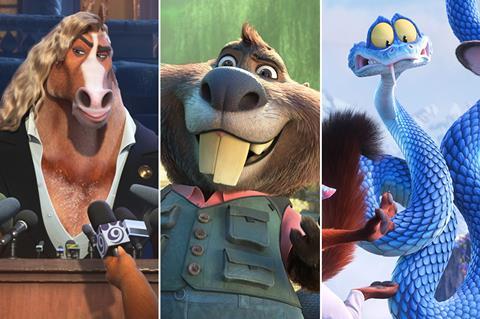
Of all the new characters in Zootopia 2 – including a laidback basilisk lizard, a villainous lynx and a briefly seen tiger meteorologist voiced by Disney CEO Bob Iger – three stand out for their dramatic and comedic contributions.
Gary De’Snake
The first fully CG-animated snake to appear in a Disney film, venomous pit viper Gary holds a key to the sequel’s plot and turns out to be an unexpectedly loveable ally to protagonists Judy and Nick. “He serves as the emotional anchor of the story,” says director Jared Bush.
Disney artists came up with software tool Scute to create Gary’s articulated scales and gave the character an intense blue colour. “Not only is he different because he’s a reptile and an outsider,” says fellow director Byron Howard, “he’s just visually very different within the palette of the film.”
Casting Everything Everywhere All At Once Oscar winner Ke Huy Quan to voice Gary helped make an often feared animal seem likeable. “We wanted to flip the trope, so the second he opens his mouth you realise he’s this vulnerable, emotional character,” says Bush.
Nibbles Maplestick
An oddball beaver whose podcast explores reptile mysteries and conspiracies, Nibbles is one of the characters encountered in the sequel’s Marsh Market sequence. Howard reports that the character was tried in a number of different roles in the script: “Finally this conspiracy theorist seemed perfect, because not only could she give us crucial information about the hidden history of reptiles in Zootopia, she could also plant her own suspicions with the audience.”
Writer and comedian Fortune Feimster was picked to voice Nibbles and proved to be a “huge influence” on the character. “Fortune would just go for it in the booth,” says Howard. “The more unhinged we went with [the character], the more successful it was.”
Brian Winddancer
Zootopia’s actor-turned-politician mayor is a charismatic but clueless stallion voiced by Patrick Warburton, the US sitcom star whose animation filmography includes voice performances in The Emperor’s New Groove, Chicken Little and Open Season.
Visual development artist Ami Thompson first suggested a belligerent kangaroo or a soft-spoken giraffe when tasked with designing a new figurehead for the sequel’s title city. Then she pitched a dimwitted horse.
“It was so immediately hilarious it was the end of that discussion,” recalls Bush. The process, he adds, showed the importance of collaboration on the sequel “and making sure that the best idea always wins, regardless of where it comes from”.



No comments yet