
















“Sirât is different,” says Lara P Camiña, co-founder of BTeam Pictures, the distributor that has steered Sirat to arthouse success of nearly €3m since opening in Spain on June 6.
“It’s not a crowd-pleaser and it rarely leaves people indifferent,” she explains. “The strategy was to go with a ‘this film will blow your mind’ approach.”
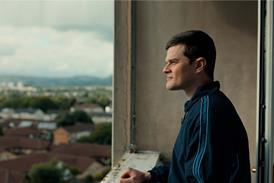
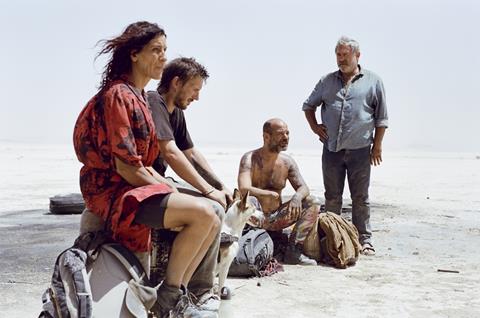
Directed by French-Spanish filmmaker Olivier Laxe, Sirât stars Sergi Lopez alongside a supporting cast of non-actors as a father embarking on a trippy trek across the Moroccan desert in search of his missing daughter.
“We mapped out three possible audience scenarios,” says Camiña. “The traditional cinephile crowd; the potential addition of a broader adult audience; and a third, more optimistic option inspired by The Substance — a hype-driven release capable of generating strong word of mouth and attracting younger viewers.
Camiña recalls The Substance was the film everyone was talking about in Cannes 2024 and sensed a similar reaction around Laxe’s film in May 2025, where Sirât premiered in Competition and went on to win the grand jury prize.
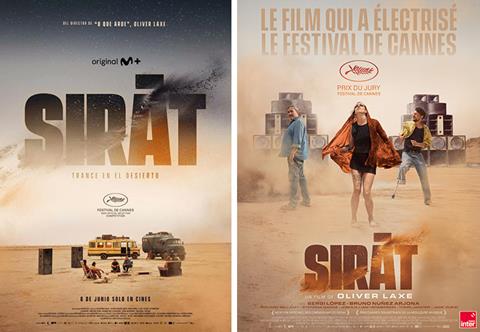
“Our early work focused on creative elements such as the poster, featuring trucks and loudspeakers dominating the desert landscape, and the subtitle ‘Sirât: Trance in the Desert’,” explains Camiña.
”Dance, Scream, Explode”
“After the Cannes premiere, we created another poster showing two characters dancing in front of the loudspeakers and Catalan actor Sergi López, who is well known in Spain, particularly among cinephile audiences, looking directly at the camera. We added the tagline ‘Dance, scream, explode’ (Baila, grita, explota).”
Laxe played a central role in the press campaign, travelling extensively to Q&As across the country. “The way he speaks about the film, his ability to articulate its deeper meaning, was crucial for engaging both media and audiences,” says Camiña.
López appeared on the popular late-night TV programme La Revuelta, which averages 2 million viewers per episode and rarely features arthouse releases.
“Releasing so soon after Cannes was a major advantage, as we could ride the wave of articles, reviews and interviews that followed the festival premiere,” Camiña adds.
Sirât was produced by local streaming platform Movistar Plus+ with Pedro and Agustín Almodóvar’s production outlet El Deseo, Filmes da Ermida, Uri Films in Spain and 4A4 Productions in France. The Match Factory has international rights.
Movistar Plus+’s marketing support was a decisive element of the film’s theatrical momentum. ”It takes you places you don’t expect,” says Germán Sela Orbe, head of marketing for film originals at Movistar Plus+, which produced the trailer, teaser and short 20-second spots in-house, and deployed them widely across all its platforms and promotional channels.
National rollout
The initial Spanish run of Sirât was so strong that BTeam increased the print count from 186 screens to 215 in the second week.
Madrid and Barcelona recorded the highest number of screens (17 and 11, respectively), but Sirât’s distribution was unusually wide, reaching medium-sized and smaller cities nationwide.
Beyond the central region and Catalonia, with 35 and 39 screens, the film was released in 22 screens in Galicia, a higher-than-usual local launch due to Laxe’s personal ties to the region.

Sirât continued screening in cinemas well into late October, even though it had been streaming on Movistar Plus+ since September 19, two days after the announcement it had been selected as Spain’s Oscar submission in the international feature category.
According to Guillermo Farré, the streamer’s head of original films and Spanish cinema, “In its first two days of streaming, Sirât’s performance matched that of a US blockbuster.”
As of mid-December, Sirât had grossed $3.4m (€2.9m) to make it the top-performing Spanish arthouse release handled by a local distributor in 2025. It is the 11th-highest-grossing Spanish title at the box office this year, a list led by family comedy Father There Is Only One 5.
Sirât has grossed almost as much as The Substance in Spain. In 2024, The Substance, alongside Poor Things with $5.3m, were the best-performing international arthouse titles in the territory according to Box Office Mojo. In contrast, Sean Baker’s 2024 Palme d’Or and Oscar winner Anora grossed $2.5m.
The film’s success is impressive as Spanish audiences traditionally favour mainstream comedies and genre films. Among recent Cannes titles by Spanish directors, Albert Serra’s Pacifiction grossed $92,366 in 2022, while Rodrigo Sorogoyen’s thriller The Beasts achieved $7.4m the same year.
Carla Simón’s Alcarràs, winner of the Golden Bear in 2022, took $2.6m, and her latest film Romería, which premiered in competition at Cannes alongside Sirât, has grossed $2m since its September release. Pedro Almodóvar’s The Room Next Door, winner of the Golden Lion at the Venice Film Festival, garnered $2.5m in 2024.
“Once Sirât opened in Spain, everything we saw, from social-media chatter to exhibitors’ feedback and even conversations with friends and family, pointed to a film audiences felt compelled to see, even if some ultimately didn’t like it or were shocked by it,” says Camiña.
Much of the controversy on social media and in post-screening comments gathered by exhibitors stemmed from a shocking plot twist involving a tragic accident and its aftermath.
“We know not everyone liked it, but many of those who did choose to see it again,” said Camiña.
A life of its own
Three months later, on September 10, Sirât opened in France via Pyramide Distribution. As of mid-December, it has garnered some 711,000 admissions (€5.3m) to become a breakout arthouse success and to make France the film’s biggest market for the film to date; Spain is the second.
“It took on a life of its own, particularly on social media, and among younger audiences, rare for an auteur film from Cannes,” says Eric Lagesse, CEO of Pyramide. ‘We wanted to lure that demographic to cinemas, but at the same time, we didn’t want to alienate our usual arthouse audiences of 40-70 year olds.”
Pyramide opted to tweak the marketing posters and trailer created in Spain, adding the line: ‘The film that electrified the Cannes Film Festival’, to the poster and shortening the trailer, cutting any references to war scenes that form part of the plot.
“We wanted to focus on the film’s sensorial, visual and music-oriented aspects,” Lagesse explains.
Viviana Andriani, whose Rendez Vous PR agency collaborated on the film’s French release, created a sense of mystery after Cannes by opting not to send screeners or screen the film for local press. Instead, Andriani organised a single packed screening at the 500-seater Max Linder theatre in Paris at the end of June, then added a few more closer to the film’s release in late August and early September to build word of mouth.
The plot twist added to the sense of intrigue. David Obadia, who runs France’s arthouse cinemas organisation AFCAE, says: “Audiences hear about this giant spoiler but don’t know specifically what it is. That is intriguing and gives them a reason to go see it to see what everyone has been talking about.”
The campaign blended traditional tactics such as bus billboards and advertising on Paris’ iconic vertical Morris columns, with more innovative methods, including a trailer on giant screens during the Rock en Seine music festival in late August.
Publicists were careful not to overexpose the talent at events and in the media, and instead hosted a fully sold-out premiere at Paris arthouse cinema Forum des Images with Laxe and Lopez in attendance, which also contributed to strong word of mouth.
The social media campaign, led by Gabriel De Bortoli’s digital marketing agency Happy Together, was launched in late July on Instagram, Facebook, TikTok and YouTube with what De Bortoli describes as “short, fast-paced, suspenseful videos with no spoilers that piggybacked on the Cannes buzz”.
“People have been sharing our content on TikTok, Instagram and telling their friends and followers how much they loved it or hated it but either way, to go out and see it.”
Sirât opened on 311 screens in its first week, then further expanded to 358 in week two, nearly 600 in week three and more than doubled its initial reach with 800 screens in week four. Nine weeks after its release, it is still showing on some 100 screens in France.
Lagesse estimates audiences in the 18-25 year-old age range make up around 30-35% of the total admissions of the film. Demographically, the film has a 4.32 “Paris-Province coefficient” - for every ticket sold in Paris, 4.32 are sold in regions outside of the French capital - and the film has been predominately successful in big cities such as Toulouse, Bordeaux, Montpellier and Lille, which also happen to be university cities with younger audiences.
The film received a mixed critical response in France, from rave reviews to scathing takedowns. ”The film has been divisive,” says Andriani cheerfully. “But the fact that it has elicited such strong reactions has made people intrigued and want to see it.”





No comments yet