





Vincent Garenq’s exploration of the Samuel Paty murder combines careful reconstruction with more heavy-handed flourishes
Dir. Vincent Garenq. France 2026. 100 mins
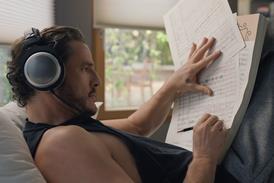
French docudrama Forsaken treads an uneasy line between ostensible quasi-journalistic objectivity and manipulative dramatics. In October 2020, French schoolteacher Samuel Paty was murdered by an Islamist terrorist after teaching a class on the 2015 Charlie Hebdo attacks. Based on the account of Paty’s last 11 days in a book by Stéphane Simon (also a producer here), Forsaken is, for the most part, a soberly executed, carefully paced quasi-thriller with a sensitive performance by Antoine Reinartz (Anatomy of a Fall) as Paty. But rhetorical flourishes and hyperbolic emphasis make this a problematic watch.
Samuel Paty’s tragedy surely called for cooler analytical detachment
Forsaken is likely to generate headlines and controversy on its May 13 domestic release following its Out of Competition premiere at Cannes, but the theme and the generally low-key stylistics may not resonate as strongly outside France.
Director Vincent Garenq, co-writing with Alexis Kebbas and with input from Paty’s sister, Mickaëlle Paty, has established himself as a specialist in real-life themes and issues of justice with previous films Guilty, The Clearstream Affair and Kalinka. Here, he addresses free speech and the secularism that is central to the French state. Paty (Reinartz) is first encountered on the day of his death walking to school in Éragny, northwest of Paris, musing in posthumous voiceover, à la Sunset Boulevard, that he never wanted to be a hero, just a good teacher. After a shadowy figure looms ominously in the background, the film skips back to the events that spell Paty’s doom.
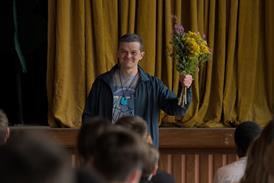
The offending lesson is one on tolerance and taboo, centred on the satirical magazine Charlie Hebdo and its publication of cartoons of the Prophet Muhammed, which led to the January 2015 killings. Paty warns his teenage class that he will show them the cartoons, but says that anyone likely to be offended is free to temporarily leave the room, which several students choose to do.
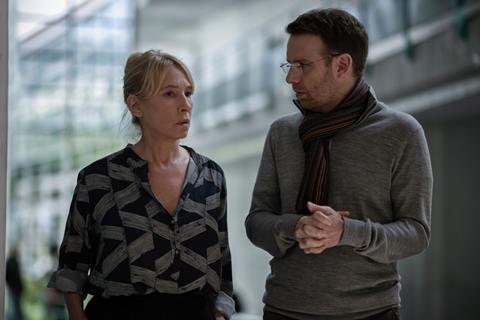
Yet word circulates that Paty specifically excluded Muslim pupils from the room, and volatile young student Bachira (impressive up-and-comer Emma Boumali), who is being disciplined by the school for behaviour issues, tells her father (Nedjim Bouizzoul) that she is being victimised by Paty. The case generates rage on social media and Paty finds himself characterised as a virulent Islamophobe. When the issue is taken up by Hadj Tahar Amara (Azize Kebbouche), presented as a representative of France’s imams, the situation escalates, despite the efforts of the school principal (actor-director Emmanuelle Bercot, persuasive here) to contain it. While some fellow teachers are supportive of Paty, others dissociate themselves, effectively abandoning him. As the title suggests, he is forsaken by his colleagues – but also, as explained in a somewhat on-the-nose coda, by the administrative and legal system that should have protected him.
An opening caption notes that, allowing for necessary modifications (some key figures have been renamed), Forsaken aims to present an accurate account of Paty’s last days. It certainly manages to not only outline the case in considerable detail, but also convey the ironies involved: seen by his critics as a singular transgressor, Paty was in fact teaching a required part of the national syllabus.
His essential mistake, we learn, was inviting students to leave the room – although it doesn’t entirely come across why this well-inentioned move is considered an egregious error. Indeed, aspects of the case presented here may make less obvious sense to viewers who have not grown up with the French principle of secularism – a tenet that in recent years has sparked intense debate regarding religious and racial identities and their position vis-à-vis the state.
Garenq makes a point of explicitly showing the cartoons – which may itself be seen as a provocation by some viewers (presumably, cinema audiences won’t be invited to step out of the auditorium). There are also certain heavy rhetorical touches: contrasting with the depiction of Paty as a gentle, devoted teacher and loving father, his principal opponents are seen as both intemperate and oppressive parents. Bachira’s ever more furious father bluntly refuses to listen to her when she suggests backing down, while Amara is denounced by his own daughter as a tyrant.
Certainly, there is every reason not to soft-pedal depictions of intolerant fundamentalists, but the melodramatic bluntness of Amara’s characterisation is nonetheless glaring – while the glimpses of Paty’s eventual killer as a silhouette skulking in chiaroscuro are pure genre-movie stylisation. As fuel for debate, Samuel Paty’s tragedy surely called for cooler analytical detachment, as opposed to the heated headline-driven register that Forsaken ultimately unhelpfully adopts.
Production companies: Outside Films, Les Films du Kiosque
International sales: Studio TF1, sales@studiotf1.com
Producers: Stéphane Simon, Marion De Blaÿ, François Kraus, Denis Pineau-Valencienne
Screenplay: Vincent Garenq and Alexis Kebbas, in collaboration with Mickaëlle Paty, based on the book ’Les Derniers Jours de Samuel Paty’ by Stéphane Simon
Cinematography: Renaud Chassaing
Editing: Aurique Delannoy
Production design: Isabelle Quillard
Music: Nicolas Errèra
Main cast: Antoine Reinartz, Emmanuelle Bercot, Emma Boumali, Nedjim Bouizzoul