

















Cold War 1994, the high-profile crime thriller produced by Bill Kong, is scheduled for release in China on May 1 during Labour Day – the next major holiday that aims to rebuild momentum at the local box office, which has been falling flat since the peak Chinese New Year sessions have fizzled out.
Produced by Edko Films and directed by Longman Leung, Cold War 1994 is one of the most anticipated crime thriller franchises from Hong Kong. It features a star-studded cast led by Daniel Wu, Terrance Lau, Wu Kang-ren and Tse Kwan-ho, along with special appearances by Chow Yun Fat, Aaron Kwok, Tony Leung Ka-fai and Louis Koo. It is a prequel to 2012’s Cold War and 2016’s Cold War 2, the latter of which took $99m (RMB676m) at China’s box office.
Soi Cheang’s Twilight Of The Warriors: Walled In also opened on May 1 In 2024 (and ended with $100.5m/RMB686m), ahead of its international premiere at Cannes’ Midnight Screening.
It is hoped this year’s holiday will reignite activity at the box office, which has slowed since Chinese New Year.
China’s box office earned $44.3m (RMB304m) over the Qingming holiday from April 4-6, down 19.6% year-on-year. Despite a record number of 1.45 million screenings over this year’s Qingming – a traditional tomb-sweeping festival – the box office contracted, with none of the top earners topping the landmark RMB100m ($14.6m), according to local data platform Beacon.
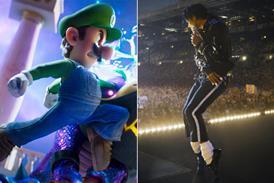
The biggest title was US animated feature The Super Mario Galaxy Movie, which grossed $9.29m (RMB63.4m); followed by Yang Lina’s It’s OK ($7m/RMB47.9m), a Chinese comedy drama starring Wen Qi and Qin Hailu, about a young woman whose plan for an urgent medical procedure is disrupted by the sudden visit of her mother; and US sci-fi Project Hail Mary ($6.22m/RMB42.5m).
While Qingming is usually a short three-day holiday – not as big as Chinese New Year (January or February), Labour Day (May 1) or National Day (October 1) – significant success was recorded two years ago when a record breaking $123.5m (RMB843m) was taken, compared to this year’s $44.3m (RMB304m).
In 2024, Hayao Miyazaki’s Japanese animated feature The Boy And The Heron topped the Qingming holiday, boosted by a timely release on the heels of its Oscar win. Its run ended with a final gross of $115.9m (RMB791m), making it the 10th highest grossing film of that year.
Japanese animation continues to prove a popular genre among local Chinese cinemagoers. Demon Slayer: Kimetsu no Yaiba – The Movie: Infinity Castle opened last November and went on to gross $99.3m (RMB678m).
However, recent diplomatic tensions between China and Japan have resulted in the suspension of Japanese releases, including Crayon Shin-chan The Movie: Super Hot! The Spicy Kasukabe Dancers and Mamoru Hosoda’s Scarlet from Sony Pictures. Their absence (along with the unofficial ban of Korean entertainment since 2016) has further pared down the diversity of film options, making it harder to find the next breakout hit to revive the box office.
The annual cumulative box office for China was $176.8bn as of April 5, down 50.7% from a year earlier, according to Artisan Gateway. Without the support of a blockbuster like last year’s animation Ne Zha 2, the Chinese New Year holiday period (February 15-23) also fell 39.5%.
Four Chinese New Year hits – Pegasus 3, Blades Of The Guardians: Wind Rises In The Desert, Scare Out and Boonie Bears: The Hidden Protector – continued to dominate as the top earners in March.




No comments yet