













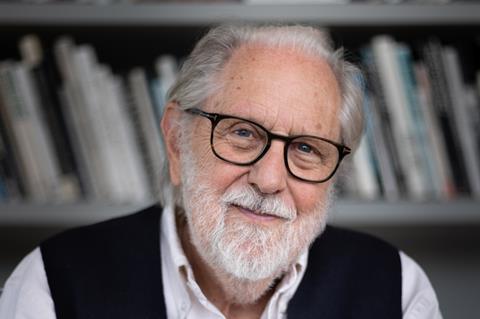
David Puttnam, the Oscar-winning producer of Chariots Of Fire, former CEO of Columbia Pictures, Labour peer and elder statesman of the UK film sector, has characteristically strong opinions on how the local industry could be transformed.
Foremost, he urges UK producers to be bolder and more adaptable.
“[The job] requires a level of financial imagination which maybe because of the scale of the public investment [in the UK], the tax shelter and everything else, has gone missing,” he suggests.
The ground will always be shifting beneath their feet when it comes to financing their films, he points out. “Each year, or every two or three years, you have to develop a whole new set of assumptions, and that is hard.”
He talks of “the lateral imagination required to hook together complex funding deals” when he was active as a producer. “I am not trying to pretend I am a genius; I am not, but it was the only way to get films made. At one point, it was overseas commitments from Germany and France. At least for 20 years in Cannes, I used to be racing up and down the bloody Croisette looking for that final little piece of the jigsaw puzzle.”
Puttnam believes young UK and Irish filmmakers have opportunities that were not available when he and his contemporaries like Ridley Scott and Alan Parker were beginning their careers in a “US-dominated and very rigid business” in the early 1970s. “The industry I entered was largely impenetrable for two reasons. One was the grip the unions had. And it was quite ageist. At 30, I was regarded as a child,” Puttnam reveals.
The opportunity to be noticed today is “infinitely greater than when I started. If you make a film, you can get it on a platform and, if it’s good enough, it will be noticed”.
Puttnam is optimistic about the health of UK and Irish cinema.
“I hate defeatism and I particularly hate it when it comes from within my own industry,” he says. “If you can hear one frustration in my voice, it’s that I think the opportunity is there to do extraordinary work.”
Puttman is also a strong believer in success flowing back to benefit the entire industry. According to the Film and TV Charity, at least £1m of Puttnam’s proceeds from Hugh Hudson’s 1981 Oscar-winning Chariots Of Fire, which he produced, have been received by the organisation in the past 40 years.
“That income has played a vital role in enabling us to provide financial assistance and mental health support when it’s needed most,” says the charity’s CEO Marcus Ryder. “This kind of long-term giving shows what’s possible when rights holders choose to invest in the wellbeing of industry workers.”
The amount represents 2.5% of the film’s proceeds over the past years. Puttnam believes every successful UK producer should do the same. “If every producer of films in the last 20 years had given 2.5% of their films too, can you imagine the revenues from Harry Potter, the revenues from Bond? It would have been colossal.”
“What is really interesting,” he adds, “is that the current revenues from what we earn from streaming pretty much equate to not far off the peak of DVD.”
Tax credits and Brexit
Three years after he stepped down as president of the UK’s Film Distributors Association (FDA), Puttnam also continues to support the FDA’s proposal for a Distribution Tax Expenditure Credit for UK productions at £23.5m and under – a new measure designed to shadow the Independent Film Tax Credit for production and boost audience engagement with UK films.
Puttnam is speaking midway through the latest masterclasses in his Atticus Education scholarship programme. This is run together with Northern Ireland Screen and Screen Ireland and aims to foster cross-border creative activity. Eight participants, all with one film behind them, are taking part. Puttnam brings in special guests, ranging this year from casting director Shaheen Baig to Philippa Lowthorpe, director of H Is For Hawk, to join the sessions on creativity, storytelling, business and the future of filmmaking.
A decade ago, Puttnam warned Brexit would “impoverish” the film, TV and creative industries. Now he suggests the situation is not as dire as he had anticipated.
“In theory, you would have expected that the film industry in the Republic [of Ireland] would have accelerated in a way that was impossible for the film industry in the North. That actually hasn’t happened,” he notes. “The film industry in Northern Ireland has done disproportionately well. I would suggest that the content industry in particular has been less affected by Brexit than most.”
Puttnam is now based in West Cork, Ireland, but remains connected to the UK government in London. He recalls how just days after Tony Blair’s Labour government swept to power in 1997, Puttnam went to meet the then-culture minister Chris Smith. He shook hands with a “new young spad” (as special advisors are called) who had just joined Smith’s office.
“It was Andy Burnham,” says Puttnam of the former mayor of Manchester who is expected to become the UK prime minister later this month.
“He was very, very amiable. I liked him. I bumped into him any number of times. Not only did he do a good job in Manchester, but something that hasn’t been remarked on enough is the consistency of the team he has held together. He has had very, very good people up there. That to me is very much part and parcel of being a successful prime minister.”






No comments yet