















Key figures in the Japanese animation industry are considerating how to collaborate with international partners to further grow the powerhouse industry.
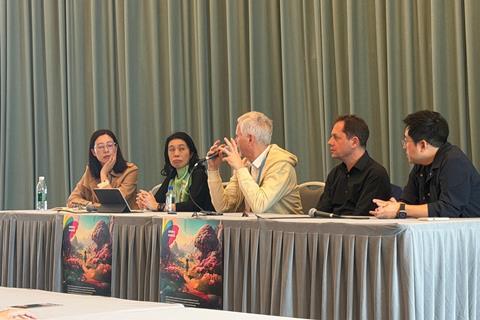
Speaking on a panel at Hong Kong Filmart, Japanese producer Noriko Matsumoto said: “Now we know [anime] works globally, we’re starting to consider how to collaborate outside of Japan. Japanese animation only thinks about Japanese people; but now it’s time to think about the global market.”
Matsumoto is a co-founder at stop-motion animation specialist Dwarf Studios and played a leading role in positioning the studio as one of the first Japanese studios to collaborate with global streamers. The Netflix series Rilakkuma And Kaoru and Rilakkuma’s Theme Park Adventure (2022) have been among their titles to draw attention..
Teikoku Databank’s latest Anime Production Market report showed that annual anime revenue in Japan was up 4% to $2.5bn but the number of anime production companies dropped 8% to 293 companies with only 40% of those posting profits.
A reliance on pre-existing IP and reticence on overseas productions may be holding back the Japanese sector, suggested Matsumoto.
“Japan loves films where they already know the story,” said the producer. “European animation is [considered] arthouse. We don’t know what European animation is. It’s a weak point in Japan.”
“IP-based animation is huge. It’s tough to make something very original in Japan,” added Matsumoto. “Everything is from manga, character and gaming IP.”
Producer Ron Dyens of France’s Sacrebleu Productions, who won the Oscar for best animated feature last year for Gints Zilbalodis’ Flow, provided a European perspective on the panel. “As an island, it’s very complicated to situate yourself regarding other countries,” said Dyens. “It’s difficult to accept someone in your island.”
Dyens added that he believes “Japan is in a situation to collaborate”.
“In Europe, 25 years ago, we discovered anime through series,” said Dyens. “There is a new generation of animators that rebuilt the history of manga, through mirroring Japan. We have to accept mixing [of cultures] now, and it’s very good.”
Dyens cited his own Oscar-winning title as example of cross-border animation success. “Flow is not a European movie, it’s a worldwide movie,” said the producer, noting the international spread of the film’s animal characters. “Cats and dogs are everywhere in the world; but capybaras are typically from South America; lemurs are more connected with Africa.”
The European animation sector can also learn from Japan, said Dyens – including through government promotion of screen content. “In France and Europe, the state gives lots of [production] funds,” said the producer. “In Japan it’s private funding; but the government helps to spread manga culture outside the country – because it’s a big soft power, to make people come to Japan.
“It’s not the same case [in Europe],” continued Dyens. “We receive funds from the government, but they don’t help us enough to spread outside Europe – in Japan, Korea and China.”
Recognisable IP and filmmakers can help augment collaboration between Asian and European animation sectors, said Handae Rhee, CEO at Korean production and distribution firm Locus Animation, who cited Bong Joon Ho’s upcoming adult animation feature The Valley, which is scheduled to complete production this year.
“If it is successful, maybe it will lead to more production between Korea and Europe,” said Rhee. The executive also noted the attractiveness of K-pop, as seen by the best animated feature Oscar win for Netflix’s Kpop Demon Hunters. “If a project mixes K-pop with French animation, maybe it can persuade the investors [to back it],” said Rhee.
Franchise
Animation was in focus on Filmart’s third day, with a subsequent session titled ‘The Power of IP in Animation’.
Establishing IP before thinking about franchising is key, according to Sai Abishek, Warner Bros Discovery’s head of factual entertainment, lifestyle and kids for South Asia. “Build the IP so the characters can go from small, to medium, to big,” said Abishkek. “Make the franchise more popular before trying to do five other things around it. Then you can get into toys and all the other ways kids can react with it.”
Aurelien Dirler, head of international cooperation and partnerships at France’s CNC, noted the duality between promoting the French animation sector, and working with international partners. “Working on projects for foreign studios and IP owners keeps our ecosystem up to date and state of the art,” said Dirler. “Those two things seem like opposing forces, but they work together.”
The session was prefaced by positive remarks from Gabriel Pang, chairman of the Hong Kong Digital Entertainment Association. “Animation is one of the most exciting and borderless creative industries today. Original IPs are becoming global powerhouses through smart financing, innovative monetisation and truly international partnerships.”






No comments yet