






EXCLUSIVE: Leading independent film organisations in Georgia have written an open letter to warn the international community they believe the country’s state-backed cultural events are being hijacked to mask the “deterioration of human rights, growing restrictions on freedom of expression and the shrinking of civic space”.
In a letter published in full below, they write these events “present only a carefully curated version of reality, creating the illusion that everything is well at home”.
Speaking to Screen, one of the signatories alleged: “The situation in Georgia is difficult. Many innocent people are in prison now. We want the international community to be aware of what is happening.”
The signatories include Tbilisi International Film Festival, Pen Georgia, The Georgia Film Institute, DOCA - Documentary Association Georgia, Culture for Democracy and Kutaisi International Short Film Festival.
Several leading Georgian actors, journalists, poets and politicians are serving jail terms in Georgia as a result of what the letter called “politically motivated prosecutions and unfair judicial proceedings”.
Among those are actor Andro Chichinadze and opera singer Paata Burchuladze.
Human rights groups have warned recent changes to laws dealing with hate speech and public protest could have a further “chilling effect on freedom of expression”.
The ruling Georgian Dream party, which has long been seeking closer ties with Russia, has been accused by Amnesty International of “waves of repressive legislation targeting media, civil society and political opposition”.
The letter calls on international visitors to cultural events in Georgia to ask themselves if their presence in the country is “legitimising an authoritarian regime”.
“The mere existence of cultural events or a country’s official presence on international cultural platforms should never be mistaken for evidence of freedom or democracy. The purpose of this strategy is simple: to construct a parallel reality in which repression becomes invisible,” the letter noted.
“Visitors are not shown political prisoners, beaten protesters, persecuted journalists, dismissed public servants or repressed artists. Instead, they are shown historic cities, hospitality, exotic landmarks, cultural diversity, traditions and the façade of international cooperation.”
Festivals
The letter has been published at the start of the Svaneti International Film Festival, which is being held in Ushguli, Georgia, from July 20-27.
The festival, which is supported by the Ministry of Culture of Georgia and the Georgian National Film Centre, has attracted several prominent international guests, including Iranian director Amir Naderi, producer and former Venice festival director Marco Muller, Frederic Boyer, artistic director of the Tribeca Festival, Khalil Benkirane, head of grants at the Doha Film Institute, and Tunisian actress and filmmaker Afef Ben Mahmoud.
The festival has both works in progress and pitching forum sections and includes some new Georgian titles.
Filmmaker and festival co-founder Mariam Khatchvani told Screen Svaneti exists to “support young Georgian filmmakers” and has strongly defended its artistic independence.
“We do not apply political loyalty tests to filmmakers, guests, or staff, and participation is not dependent on political agreement with the government, the festival management, or with one another,” she said.
“There is a serious public discussion currently taking place in Georgia regarding freedom of expression and the relationship between artists and state institutions. This discussion should not be reduced to slogans, and we cannot ignore the concerns or experiences of other artists. At the same time, I can responsibly speak about the festival that I lead: no funder determines our programme, and we do not exclude participants because of their political views,” she said.
However, the signatories have claimed international visitors to events like this are “unaware of the reality” and risk being used by an authoritarian regime. Many Georgian filmmakers are refusing to work with the Georgian National Film Centre.
Production
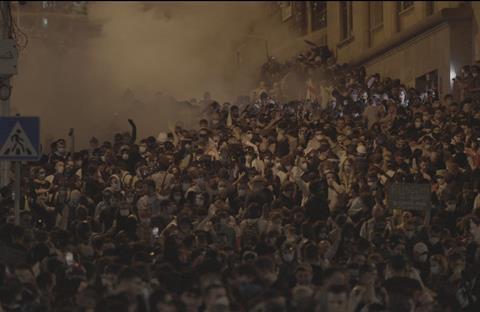
Despite the turmoil, some Georgian films are continuing to be made. For instance, Uta Beria’s Tear Gas, about a couple who meet during the protests in Tbilisi in 2019, will have its world premiere in Locarno next month.
Tear Gas was not invited to the Svaneti Festival. The Georgian National Film Centre initially backed the film but then failed to provide the expected second funding instalment and is not supporting the premiere in Locarno.
Screen has contacted the Georgian National Film Centre for comment.
Open Letter from Georgia
To the Organisers, Directors, Curators, Programmers, and Participants of International Film Festivals, Book Fairs, International Exhibition Spaces, Museums, Theatre, Music, and Other Arts Events
Dear Colleagues,
We are writing to you from Georgia, a country where democratic institutions, civil society, independent media, and artistic freedom are under growing pressure.
History teaches us that authoritarian regimes do not survive through violence alone. They also survive through normalisation. They rely not only on police, courts and propaganda, but also on the creation of a cultural landscape that persuades the outside world that everything is normal.
This is why nearly every authoritarian regime invests heavily in cultural events, festivals, exhibitions and international forums.
Visitors are not shown political prisoners, beaten protesters, persecuted journalists, dismissed public servants or repressed artists. Instead, they are shown historic cities, hospitality, exotic landmarks, cultural diversity, traditions and the façade of international cooperation.
The mere existence of cultural events or a country’s official presence on international cultural platforms should never be mistaken for evidence of freedom or democracy.
The purpose of this strategy is simple: to construct a parallel reality in which repression becomes invisible.
Today, Georgia finds itself facing precisely this danger.
In recent years, international organisations have increasingly raised concerns about the deterioration of human rights in Georgia, growing restrictions on freedom of expression and the shrinking of civic space. Laws have been adopted that restrict artistic freedom, independent media, civil society organisations, civic activism and international cooperation.
Political persecution, mass fines, criminal prosecutions and impunity for violence have become part of everyday life.
According to international human rights organizations, more than 150 people are currently imprisoned in Georgia as a result of politically motivated prosecutions and unfair judicial proceedings. Among them are the journalist Mzia Amaghlobeli, poet Zviad Ratiani, world-renowned opera singer Paata Burchuladze, actor Andro Chichinadze as well as political leaders are imprisoned in Georgia. Many of them participated in peaceful demonstrations in defence of Georgia’s European future and democratic values.
Against this backdrop, festivals, conferences, and international cultural events continue to take place. Invitations are extended. State-funded cultural institutions continue to appear on international cultural platforms, projecting an image of normality while concealing the reality of persecuted artists and citizens. And the impression is created that cultural life is continuing as usual.
This is where personal responsibility begins.
Everyone invited to such an event has a choice: To accept. To decline. Or to ask questions.
And take an interest in the situation of the artists and citizens on whose behalf a cultural platform, institution, or event claims to speak.
Lack of awareness does not absolve us of responsibility.
Never before has it been easier to verify information.
Before agreeing to take part in such a project, partnership, or cultural event, ask yourself a few questions:
What is happening today in the country whose state cultural institution I am collaborating with?
Does this project, partnership, or event reflect the country’s actual political, social, and cultural reality or does it present only a carefully curated, politically sanitised image of the country?
Is there space for open and critical discussion? Is it possible to speak openly about the role of art, freedom of expression, censorship, political repression and the state of democracy?
Are independent artists and journalists included, are there any critical voices or are only views acceptable to the authorities being represented?
Could my participation, even if well-intentioned, serve to legitimise an authoritarian regime or reinforce the illusion of “normality” that it seeks to project?
Whose voices does this collaboration amplify: those of the independent cultural community, or those of state-controlled institutions?
We urge you to ask questions. Do not be satisfied with the reality that those in power choose to present.
Because the purpose of art is not to legitimise power.
Art exists to make truth visible, not to conceal it.
And when art begins to conceal reality, it ceases to be art and becomes propaganda.
This is why we are addressing you, the recipients of this letter.
Please do not become part of the normalisation and propaganda that conceal repression. Do not allow your name, your reputation, or your professional standing to be used in the service of hiding reality.
If a cultural event, project, or partnership systematically remains silent about repression, conceals injustice, and creates the illusion that everything is well, it contributes, whether intentionally or not, to the normalisation of oppression.
And history has never looked kindly on such complicity.
On behalf of independent Georgian artists
Tbilisi, Georgia
21 July, 2026
This letter is endorsed by the following independent organisations and unions in Georgia:
- GFI - Georgian Film Institute
- DOCA - Documentary Association Georgia
- GCA - Georgian Cinematographers Association
- PEN Georgia
- Georgian Book Association
- Tbilisi International Film Festival
- Kutaisi International Short Film Festival
- Culture for Democracy
- Public Assembly Cultural Heritage Working Group
- Kolga Tbilisi Photo
- Photo Festival Tbilisi
- Projection 24


No comments yet