











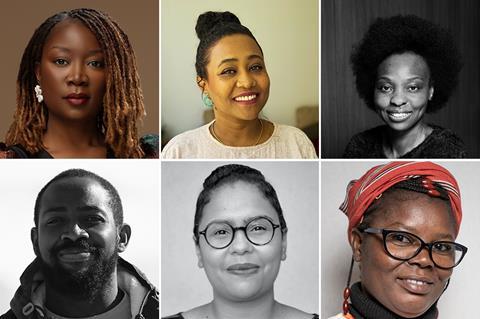
The producer participants of Open Doors 2026, the co-production and talent development programme of the Locarno Film Festival, come from six African countries, each with its own challenges from within its borders and beyond.
Mamounata Nikiema from Burkina Faso is well known throughout the African film industry. After studying documentary filmmaking at the Gaston Berger University of Saint-Louis in Senegal, Nikiema has worked as a director since 2007 and started producing in 2011, and served as general secretary of the Africadoc Association Burkina from 2009 until 2014. She was honoured at the Pan-African Film and Television Festival of Ouagadougou, Africa’s largest cinema festival, in 2021 for her contributions to cinema.
Bur Nikiema says the biggest challenge to mounting film projects in Burkina Faso is having sufficient cash flow to support project development rather than relying entirely on grants.
Taking part in Open Doors offers Nikiema the chance to build out analysis and evaluation of a film project, from budgeting and financing strategy to managing director-producer relationships and identifying a target audience to strengthen the project’s positioning in the market.
“Being involved in the creation of a film, especially when the filmmaker’s perspective really captivates us, is an inexhaustible source of motivation,” Nikiema notes.
Cape Verde’s Natasha Craveiro will arrive in Locarno having produced Carlos Yuri Ceuninck’s Omi NobuI (The New Man), a Portugal-Cape Verde co-production, which screened as part of last year’s Locarno Open Doors screenings programme. She describes producing films from Cape Verde as an exercise in resistance.
“Our greatest challenge is the lack of a robust ecosystem and national funding to support the sector,” she says. “That gap condemns us to a structural dependency on international grants, which frequently impose Eurocentric aesthetics and narratives.”
For Craveiro, de-colonising the gaze is not an academic concept but a practical urgency. “I view cinema as a profound tool for historical reparation and a catalyst for social transformation,” she says. “My creative process is fuelled by the social tensions that define my society and the wider world, with a persistent focus on the lived experiences of girls and women.”
Cape Verde is a nation of 500,000 people still building its cinematic industry from the ground up. Craveiro views Open Doors not just as a professional stepping stone but as a laboratory for sustainability.
“Being surrounded by peers from the Global South is a rare and powerful opportunity,” she says. “The future of our cinema lies in horizontal dialogue between our regions, in building a genuine, lasting network of South-South cooperation.”
Ivory Coast-based filmmaker Adja Soro, who heads Studio Kä, the animation studio she founded in Abidjan, is producing in an industry that is still very young. “Every project is an opportunity to train talent, strengthen our network, attract new partners and demonstrate that high-quality animation can be produced from Africa for audiences everywhere,” she says.
She develops her projects in both French and English, with international audiences in mind. She also hopes to offer African-language versions that add authenticity. Soro is attending Open Doors with Kinafo, a story weaving supernatural forces and social realities to explore courage, identity and the tension between heritage and change, while celebrating African mythology.
“Animation gives me complete creative freedom,” Soro notes. “It allows us to build worlds, reinvent reality and tell stories that would be impossible in any other medium. It’s also a universal language that travels naturally across cultures.”
Nigerian producer David Ikeata of Vox Cinematic Films has worked across borders, co-producing the Kazakhstan-Nigeria fiction film Adam Bol in 2024. He is now developing Moondust with Egyptian director and writer Ahmed Essam. For Ikeata, the biggest obstacle is a lack of institutional support. “The ecosystem is not very friendly toward filmmaking in Nigeria,” he says. “There are no regulatory bodies that help things move smoothly, and that absence makes every step harder than it needs to be.”
Working both within and outside Nigeria, he holds himself to what he describes as two options: “telling an agonising truth or a beautiful, humane lie”.
“When it comes to stories set in my own community, I want to shine a light on something damning so that change can happen. It’s a form of activism. But with stories outside my community, I want to offer my perspective on the beauty and complexity of humans and the world.”
Sudan’s Rua Osman has extensive experience, producing features including Amjad Abu Alala’ s 2019 Venice title You Will Die at Twenty, and Mohamed Kordofani’s Goodbye Julia in 2023, the first Sudanese film selected for Cannes.
He founded Helomur Pictures in 2024 and is attending Open Doors with Emma Howes’ Manageable Matter, a Germany-Sudan-Canada feature in pre-production.
Even before the ongoing war, Sudan had no established crew base, limited equipment and no sustainable funding. For You Will Die At Twenty and Goodbye Julia, Osman brought equipment from Egypt and Germany and assembled crews from across Africa, Europe and the Arab world, because those resources did not exist locally.
“Since the war began, the challenge has become more fundamental; we’ve lost access to the country itself,” he says. “Many places we want to film have been destroyed, become inaccessible or remain unsafe. Making a film now also means finding ways to preserve memory and continue telling stories from a place we can no longer physically reach.”
Before he became a filmmaker, Osman was a biologist. He says studying biology taught him nothing exists in isolation, an observation he is taking to film producing. Chances to meet fellow African producers and build relationships that grow into long-term collaborations are vital - but rare.
“I hope to leave Locarno not only with stronger projects, but with lasting relationships that continue to shape my work and the future of Sudanese and African cinema.”
Rounding out the selection is Zimbabwe’s Tapiwa Chipfupa, an EAVE alumnus who launched the international training and mentorship programme Audiovisual Entrepreneurs Laboratory (AVEL) in May. She says Zimbabwe’s industry is still in the early stages, with little tangible infrastructure to support filmmaking.
“Opportunities for mentorship and funding are limited. It takes tenacity, resilience and innovation to get a film made,” she says. “It challenges you to be pioneer-like.”
Driven by a vision of making the “impossible possible,” Chipfupa reflects on her late father’s belief that work should be a calling, not just a job. Through her production company Ambidextrous Pictures, she focuses on storytelling that “profiles unique female voices with brave narratives,” and will be at Open Doors with the feature documentary The Other Half Of The African Sky.
“When you see an African film in the lineup at Cannes, Berlinale, Toronto and Locarno, you know it’s taken a lot of resilience and ingenuity from African producers to get made,” says Tiny Mungwe, one of the five-strong artistic team of this year’s Open Doors.
“The people selected are innovating, building solutions around co-operation and collaborative ways of structuring their ecosystems.”






No comments yet