









Cairo-based Tunisian actress and producer Hend Sabry has called for a deeper look at the challenges facing Arab cinema, from financing and distribution to international representation. arguing that the region has the talent, audiences and financial resources needed to build a stronger industry, but lacks the structures and investment required to support its growth.
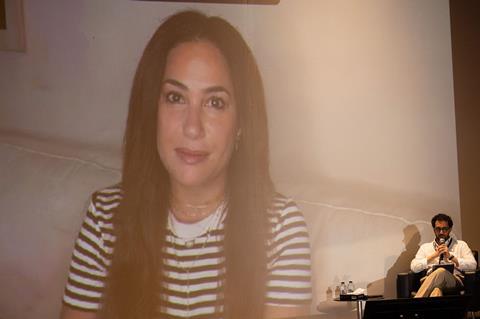
Speaking during an in-conversation session at Amman International Film Festival – Awal Film, Sabry said Arab cinema remains caught between dependence on international funding, limited distribution opportunities and a private sector reluctant to take risks on local productions.
Addressing the state of independent Arab cinema, she noted that the industry remains heavily dependent on international funding. “Our main problem is that we are very dependent on foreign financing”, she said. “We have not created a plan B for other ways of financing.”
Sabry linked financing structures to deeper issues of representation and post-colonial narratives. She pointed out that Arab cinema continues to confront a form of dehumanisation, with international perceptions often reducing the region to stereotypical images of poverty and helplessness rather than recognising its complexity and shared cultural references.
“They do not want to see us as normal human beings, and I feel the need to fight that,” she said. “Over the past three or four years, we’ve realised that almost all the major international film funds have become increasingly unwilling to support Arab cinema because Arab filmmakers are trying to move beyond the post-colonial era. I don’t have to show you filth in the streets or misery to earn your approval. I don’t have to portray all our characters as defeated for our stories to be accepted.”
In 2015, Sabry founded her Cairo-based production company, Salam PROD, a female-led company focused on supporting independent Arab talents and producing distinctive, female-driven stories from the region.
Its first production was The Flower Of Aleppo, which she co-produced with Tunisian filmmaker Ridha Behi and Lebanese producer Sadiq Al-Sabah, marking her first step into producing after establishing herself as one of the region’s leading actresses. She said the experience led her to explore producing as a way for actors to play a more active role in bringing projects to the screen, pointing to Hollywood stars such as Brad Pitt, whose producing work on Babel illustrated how actors can use their influence to champion ambitious films.
That approach continued with Finding Ola, which Sabry produced and starred in for Netflix in 2022. The series reflected her interest in creating contemporary Arab stories centred on complex female characters, while also demonstrating the changing opportunities for regional productions through streaming platforms.
The show achieved international success, reaching Netflix’s Top 10 list in 17 countries worldwide, and demonstrating the global appeal of contemporary Arab stories. However, Sabry noted that such success has not necessarily translated into greater confidence from streaming platforms towards the region. “I wasn’t asked for a third season”, she said, “Streaming platforms have become increasingly conservative in their approach to the region, with fewer risks being taken on ambitious Arab projects and original voices.”
Sabry questioned why a region of around 350 million Arabic-speaking people has not yet secured a stronger position in the global entertainment market. “We have everything: talent and a market with strong potential that should be attractive to streamers, international companies and private investors. Yet investors remain cautious about backing Arab content,” she said.
The producer also expressed her desire to work on literary adaptations, noting that the Arab world has a rich contemporary literary scene that remains largely unexplored on screen.
Her latest acting project, His Weakest Creatures, is in post-production and was written and directed by Omar Hilal, known for 2023’s Voy Voy Voy. The film marks her first collaboration with Egyptian actor Ahmed Helmy and is produced by Cairo-based Film Clinic and Dubai-based Front Row Filmed Entertainment.
She is also starring in Ahmed Fawzy Saleh’s Hamlet From The Slums, a contemporary Egyptian adaptation of Shakespeare’s classic tragedy, alongside Ahmed Dash and Tarek Lotfy. Written by Ahmed Amer and Ahmed Fawzy Saleh, the film is produced by Ahmed Amer’s Cairo-based A. A. Films, with Erik Andersson of Malmö-based production company LÄSK serving as co-producer.
The festival’s Spotlight on Tunisian Cinema programme featured a screening of The Silences of the Palace (Samt al-Qusur), directed by Moufida Tlatli. The acclaimed 1994 film marked her screen debut at the age of 14.
The acclaimed actress, who is serving as president of the jury for this edition, joined the session remotely from Cairo after cancelling her in-person appearance due to family commitments. She apologised to the Jordanian audience for not attending the festival in person.




No comments yet