















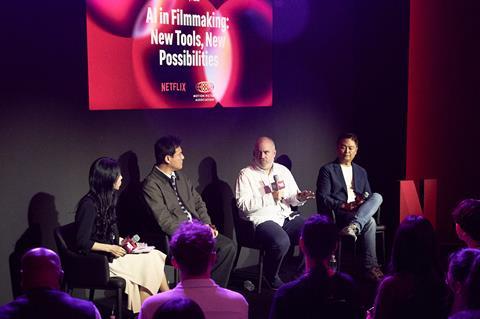
More than 300 Netflix titles use AI “in many different formats”, a panel hosted by the streaming giant in Busan revealed.
Sung Q Lee, senior director of APAC production at Netflix, discussed how the technology is used in several areas including pre-visualisation, production, editorial and VFX. “AI can help accelerate everything and at the same time, it can help us address realistic issues we face,” he told an industry audience at the Creative Asia forum.
Also on the panel, Kang Yun-sung, South Korean director of Run To The West and The Outlaws, said how the advancement of AI had reduced filmmaking costs, explaining how budgetary constraints have previously held Korean cinema back from growing to “its full potential”.
Using the technology in the development of his upcoming film, Gulf Of Aden, Kang claimed to have saved up to 40% of his budget, “simplifying and streamlining” the filmmaking process with a shortened production period.
Sung said Netflix’s goal is “not only to make production affordable, quicker, faster” using AI, but to achieve what wasn’t possible before, to “move beyond our constraints and our limitations”.
Despite the benefits, Sung emphasised the importance of the “human touch”. “AI gets the job done, but does it touch human emotion? The human touch is critical and necessary,” he said.
When asked about fears that AI might replace actors in the future, Kang responded: “No matter how advanced AI tech is, an actor has the role of delivering emotions to audiences… It’s very difficult for actors to be replaced by AI.”
Its role is to “assist” actors, he added, suggesting AI could be used in the role of stunt doubles which “can be wholly generated because that’s not very relevant to the actor’s skills or character”.
Rounding out the panel was Weta FX CTO Kimball Thurston, who described the use of the technology in filmmaking as “assistive AI,” which is not “allowed to change the creative intent in any way.”
“That’s the fundamental message here,” he said. “To not treat all AI like one big giant.”


No comments yet