












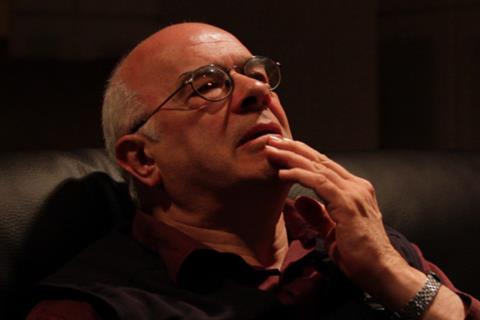
Tony Rayns, a UK film critic and programmer who was a leading expert in East Asian cinema, has died aged 77.
Rayns died at his home in London earlier this month, people close to him confirmed to Screen. He had been battling illness for some time.
Renowned Chinese filmmaker Jia Zhangke – whose work was brought to international attention by Rayns – led a wave of tributes from across the industry. “Throughout the 28 years we knew each other, it was always me asking things of you,” said Jia. “Whenever I reached out, it was almost always because I needed something – whether it was having you subtitle my films or seeking your advice on a problem.
“I feel I should have called you more often… You were a free spirit in the realm of cinema.”
Born September 20, 1948, Rayns’ love of cinema began when he started a film society in secondary school, before going on to run three separate film societies at university.
His lifelong career as a critic began in the 1970s and saw his work appear in Sight & Sound, Film Comment, Artforum, Cine 21 and others, specialising in the cinema of East Asia.
Rayns wrote and edited books on Jang Sunwoo, Wong Kar Wai and Rainer Werner Fassbinder, as well as on Chinese, Japanese and Korean cinema. He also wrote lengthy essays on Apichatpong Weerasethakul, Garin Nugroho, Edward Yang and Jia Zhangke.
Rayns was known to many cinephiles for his film commentaries for Criterion, Masters of Cinema, Arrow and other home entertainment labels.
He served on festival juries in Cannes, Sapporo, San Sebastian, San Francisco, Vladivostok and Beijing and was awarded the first Korean Film Award at Busan International Film Festival for services to Korean cinema, the Kawakita Award in 2004 and the Foreign Ministry of Japan’s Commendation in 2008, the latter both for services to Japanese cinema.
Rayns previously worked as a programme advisor at the BFI London Film Festival, first in 1979 and for several years from 1997. He also worked with Vancouver International Film Festival from 1998-2006, coordinating the Dragons and Tigers competition for Asian films.
As a director, Rayns made 1989 documentary series New Chinese Cinema – exploring the innovative Fifth Generation of filmmakers that emerged during the 1980s in China – and 2001’s The Jang Sun-woo Variations about the controversial South Korean director, which premiered at Rotterdam.
He was the subject of documentary Tony Rayns And A Quarter Century Of Korean Cinema, which screened at Busan in 2012 and served on the festival’s jury in 2017.
The Korean Film Council (Kofic) commisioned Rayns to write Just Like Starting Over: A Personal View Of The Reinvention Of Korean Cinema, a book that recalled decades of his encounters across the country’s film industry. “Tony Rayns introduced Korean cinema to the world and made a significant contribution to establishing the international status of Korean cinema,” said a statement from Kofic. “We will forever remember his deep affection and dedication to the Korean film industry.”




No comments yet