
















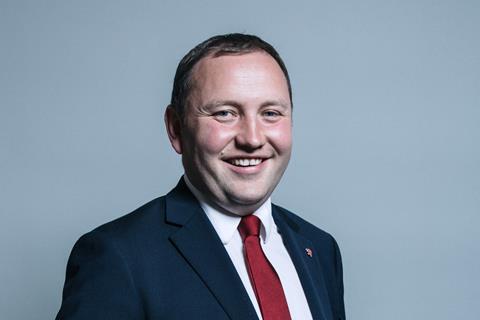
Ian Murray, the UK minister of state in the Department for Digital, Culture, Media and Sport, said the government is taking the implications of the proposed US federal film and TV production incentive on the UK “incredibly seriously”.
Addressing the annual British Screen Forum Conference today (November 19), Murray said the government was working with industry to ensure the UK remained an attractive, competitive place to work for both international and local UK filmmakers.
He ruled out an immediate change to the UK’s own relief rate but said the rates are always kept under review.
“They’re simplistic, they’re not capped, and therefore we have a really good ecosystem,” he said of the UK’s range of film and high-end TV reliefs. “The Treasury have accepted the principle that actually those taxes in the sector have worked, and we really see a growth in the sector that we wouldn’t see without them…We’re working with the sector to make sure things are as effective as possible.”
But he admitted the government was “really concerned” about the potential impact of a new US stackable tax relief system on a highly mobile industry. “When I was at the Toronto Film Festival this year, and Vancouver had just added a 3% stackable relief onto television production, [the new relief] moved pretty much everything from Toronto to Vancouver.”
However, Murray was optimistic the UK’s appeal as a production hub was not only economic. “The UK is a great place to make film and TV. It also has the talent pipeline, which is very strong. Producers and talent want to work here, particularly in London, so there is a pull factor and a great history.”
He pointed to the fact the government had named film, TV, and video games as priority sectors in its industrial strategy. “We are proud of our creativity and innovation, and we want to ensure the UK remains the home of award-winning film, TV, and games, where screen businesses can be built, scaled, and retained, and where both domestic creators and inward investors can thrive.”
Murray said there were four areas in which the government was working to achieve this.
“Firstly, getting the foundations right with our public service media system.. Secondly, across our screen sectors, building an environment that enables innovation, access to finance, invest in IP retention…Thirdly, investing in our regions, empowering them to build strong, resilient, streaming ecosystem…. And fourthly, harnessing AI in the right way to capture its benefits while protecting our world-class creators.”
“We’ve got your back”
Murray’s tone was optimistic, while recognising the challenges faced by the sector. Significantly, he strove to emphasise how important the screen sector is to the government and the wider economy.
“By placing the creative industries at the heart of our industrial strategy, the government has already shown that we will stand with the sector to face those challenges head on. By working together, we can protect what was good about the sector and build towards bright and exciting new horizons. As we do that together, this government has your back,” he told the audience.
“There’s not another country in the world that doesn’t look enviously on the UK film, TV, and gaming sectors,” he suggested. “But they do want to eat our lunch.”
Beyond the tax reliefs, Murray said the government was “delivering sector-specific packages”, including £75m for screen growth and £30m games growth.
“We’re also supporting screen infrastructure with business rates relief for both film studios and cinemas, and we’re investing in the talent pipeline, doubling the size of the BFI Film Academy, publishing a new creative industries job plan [in December] and investing £10m towards the expansion of the National Film and Television School.”
Murray said the government wanted to inspire ongoing innovation and creativity by creating “the right environment to encourage innovation, gain access to finance, and improve IP protection”.
“In January, I announced a record-breaking £500m package of support for R&D and innovation in the sector. This includes £100m to support new creative clusters, as well as a major backing for high-growth, innovative businesses.
“We’re also increasing access to cutting-edge technology through £25m of additional funding for the CoSTAR network.”
British Business Bank
The government was also working to increase private investment in the UK screen sector, and Murray said he recognised that accessing finance is “a key piece of this puzzle”.
He first mentioned the British Business Bank.
“Building on the base of our stable and competitive tax incentives, we are expanding private finance through the British Business Bank, and as part of this, working through specialist lenders and fund managers,” he said. “The bank has introduced a £500 million allocation for IP rich funds. This will help businesses to access debt finance when they don’t have traditional assets or collateral. And the British Business Bank has also expanded its growth guarantee scheme, aiming to increase the availability of commercial lending to cater to industry businesses.”
Murray also referred to the £150m commitment to the Creative Places Growth Fund, which empowers local industry leaders to make decisions for their region.
“This fund is already making its way out to the screen sector through initiatives like the West Midlands Content Production Fund, the Greater Manchester Production Fund and Green Light West, led by the West of England Combined Authority,” he said.
Artificial intelligence
On the subject of AI, Murray reflected on how the UK is grappling with how to “balance innovation and regulation with technology and human creativity”, as he put it.
“We’re determined to protect the UK’s position as a world-leading creative powerhouse while unlocking the potential of AI to support creativity, support businesses, and of course grow the economy.
“We are taking forward work in [several] areas,” he explained. “Firstly, before the end of the year, we will launch a consultation with digital replicas so that performers have control of their own image and voice for protecting legitimate innovation. Secondly, we will establish a task force on AI labelling to ensure audiences know whether they are seeing their screens as real or as AI-generated. Thirdly, we will also publish a review of how creators control their works online. We have already launched a working group to look at options for supporting independent and smaller creative organisations with content licensing.
”We know that there are concerns to consider and barriers to overcome. There are also remarkable potential benefits for the sector, like enhancing storyboarding, post-production, and audio analytics.
“We either embrace [AI} or have it done to us,” Murray suggested “I think the UK should be the safest and best place in the world to adopt and develop AI.”
BBC
In his wide-ranging address, Murray expressed the government’s full-throated support for the BBC. “Our public service media is the backbone of our film and TV sector, giving people a foot in the door of the industry and making sure that great British stories are told,” he said. “The BBC in particular is a unique and vital national asset, the cornerstone of our world-leading screen sector. The ongoing BBC charter review will set out a range of fundamental reforms so that the BBC not just survives but thrives for decades to come.
“The government fundamentally rejects the prospect of a smaller BBC or a settlement that would see it continuing into managed decline. The next charter will be permanent but must therefore put the BBC on a sustainable financial footing.
“This will enable it to be even more ambitious in delivering the best outcomes for audiences, while also supercharging our creative economy and ensuring that it delivers healthy growth across the nations and regions.”
Safeguarding
On the topic of the convicted rapist and former broadcaster and film and TV actor Russell Brand and the wider issue of safeguarding in the screen industry, Murray was adamant there should be a zero-tolerance approach.
“It’s all our responsibility,” he said. ”CIISA [Creative Industries Independent Standards Authority] is a great organisation. Everyone should be a part of i… I just plead with everyone in this room to sort it out because it’s not for government to legislate. But actually, it’s just a moral thing. It needs to be sorted.
”And my final plea would be: if YouTube could take Russell Brand’s channel down, they would have taken it down [if he was] a mass murderer. ”






No comments yet