













The director’s follow up to ‘Orphan’ plays in Cannes Competition
Dir Laszlo Nemes. France. 2026. 130mins
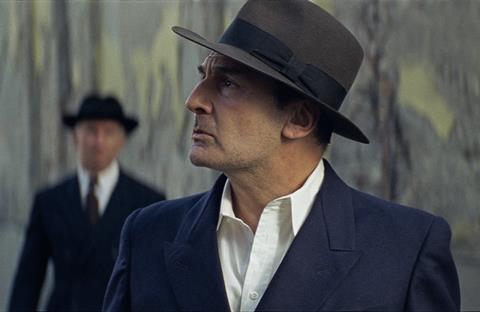
The French wartime resistance leader Jean Moulin could easily inspire a whole birth-to-death biopic or streaming series. But Son of Saul director László Nemes goes straight for the tragedy – and horror – of his downfall with this tense and terrifying study of his 1943 arrest and subsequent fate. Dark and sinister don’t only sum up the look and sound of Nemes’s film: its entire strangulating story and atmosphere are designed to pit good against evil as Moulin (Gilles Lellouche) is snared and manipulated by Gestapo officer Klaus Barbie (Lars Eidinger), known for good reason as the ‘Butcher of Lyon’. Moulin delivers top-class artistry in the service of taking us to the depths of moral hell.
The sense is powerful in Moulin of a moral order turned upside down
Nemes’s French-language film plays in competition at Cannes, where the Hungarian filmmaker won the Grand Prix in 2015 for his debut, the Auschwitz-set Son Of Saul, which went on to win the Oscar for Best Foreign Language Film. His next two movies, Sunset and Orphan, played in Venice competition to praise but a more muted broader reception. Moulin opens in France on October 28 via Studio TF1 and is likely to connect strongly with domestic audiences. Disney+ and HBO already have streaming and broadcasting rights, and interest should be strong among festival programmers and local theatrical distributors for a title which could well embark on a similar awards trajectory to Son of Saul.
It’s March 1943: in the dead of night, Moulin, codename ‘Max’, parachutes into rural France, returning secretly from London. By this point in the war, Moulin, once a regional administrator in Chartres, was a senior member of The Resistance, tasked by the exiled leader of the Free French, Charles de Gaulle, with uniting various groupings working to overthrow Nazi occupation. That mission brings Moulin to Lyon: he’s there, under the alias of Jacques Martel, for a clandestine meeting of fellow resistance leaders.
His every move feels loaded with dread. But you wouldn’t know it from Moulin’s calm demeanour or his efficient interactions with the younger operative Colette (Hortense de Gromard) or with Comtesse de Forez (Louise Bourgoin), the wealthy client who allows him to pose undercover as an interior decorator. Lellouche gives a subtle performance of deep control and reserve – one which only deepens as the world turns on his character.
An extreme noir approach characterises these Lyon scenes, with the faces of Moulin and others often almost entirely obscured in the dark. Cinematographer Mátyás Erdély, Nemes’s regular collaborator, shoots entirely on 35mm film in true anamorphic CinemaScope, and in ample nighttime scenes throws long shadows across alleyways, steps, streets and courtyards, with Stéphane Rozenbaum’s design convincingly creating ample locations across wartime Lyon. It’s intense, but it’s also a pleasure to be taken to this world where every interaction has such meaning. Olivier Demangel’s screenplay keeps us close to Moulin, knowing only what he knows.
Capture only ever feels one beat away, and when it arrives, it unleashes a sense of terror which never dissipates. You need strong nerves especially for the later scenes of Moulin, as Nemes doesn’t flinch from the realities of torture and interrogation. Lars Eidinger is reliably unsettling as Barbie, and there’s a scene of intense perversion when Moulin is forced as part of his interrogation to encounter Comtesse de Forez in the presence of Barbie. Also going directly for the nerves are Tamás Zányi’s sound design (which especially shines during Moulin’s prison-cell scenes) and Laetitia Pansanel-Garric’s score, which is sparingly used but increasingly discomforting.
The sense is powerful in Moulin of a moral order turned upside down. ‘We’re masters of life and death,’ Barbie says in a scene that feels almost hallucinatory in its level of evil. What does it really mean to resist, ask Nemes. His film answers that in engrossing and creative ways in its depiction of Moulin’s work and its portrait of his steadfastness during capture. But it also answers it in a less tangible spiritual sense in the moving encounters between Moulin and his young cellmate Martin (Felix Lefebvre). Heroes are often given big speeches and major acts, but heroism is finally defined in Moulin as saying nothing and doing nothing – resisting with the full force of your body and your mind.
Production companies: Pitchipoï Productions, Studio TF1, TF1 Films Production, Umedia
International sales: 193 Legendary, sales@legendary-193.com
Producer: Alain Goldman
Screenplay: Olivier Demangel
Cinematography: Mátyás Erdély
Production design: Stéphane Rozenbaum
Editing: Péter Politzer
Music: Laetitia Pansanel-Garric
Main cast: Gilles Lellouche, Lars Eidinger, Louise Bourgoin, Marcin Czarnik, Max Warburton, Felix Lefebvre