












The director’s follow-up to ‘The Wailing’ stars Hwang Jung-min and ’Squid Game’’s Hoyeon
Dir-scr. Na Hong-jin. South Korea. 2026. 160mins
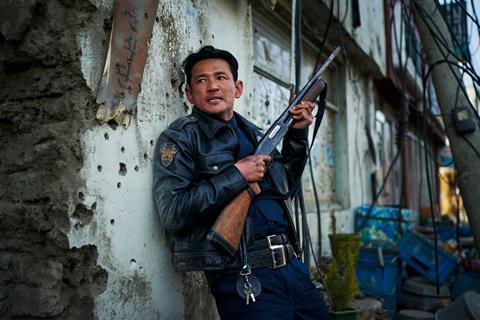
A small-town cop in a coastal community in rural South Korea has the worst day of his life in Na Hong-jin’s sprawling but thunderously entertaining genre mash-up. Sergeant Bum-Seok (Hwang Jung-min), prone to a jittery, jelly-legged dance of panic in moments of stress, is perhaps not the man you want to lead the fight against an unkillable, unimaginable threat. But he’s the best the town of Hope Harbour has.
A pedal-to-the-metal slaughterfest that barely lets up on its breathless pace
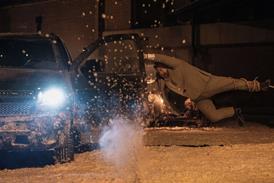
The latest picture from The Wailing director Na is a pedal-to-the-metal slaughterfest that barely lets up on its breathless pace, gallows humour and wall-to-wall guts and gore. The running time might prove challenging – there’s only so many handbrake turns, high-powered automatic weapons and skewered supporting cast members you can take before it starts getting repetitive. But then Na flips the perspective, making us question our allegiances and ask who the real monsters are.
The film, which has been acquired by Neon for the US and UK and Mubi for multiple other territories, marks Na’s fourth Cannes selection following 2008’s The Chaser (out of competition), 2011’s The Yellow Sea (Un Certain Regard); and 2016’s internationally acclaimed horror ’The Wailing’ (out of competition). Hope has perhaps the most in common with the latter – both feature communities flung into terror and paranoia by an external threat they can’t begin to understand. And both feature half-baked law enforcement officers who are ill-equipped to deal with the unfolding carnage. The backing of Neon and Mubi should help Hope at least match the international breakout success of The Wailing; the presence in the cast of Squid Game actress Hoyeon, plus barely recognisable appearances from Michael Fassbender, Alicia Vikander and Taylor Russell, should also help to boost the film’s profile.
The film’s first hour is its strongest, and it’s no coincidence that we are nearly 50 minutes in before we even see a gore-crusted claw of the thing that is wreaking havoc in the village. It’s always more effective to hide your monsters, particularly if, like these, they seem to reveal the limitations of the VFX budget. In contrast, the dense, detailed production design is exceptional. Every inch of the location – this part of the film was shot on Jeju Island in Sumang-ri, South Korea – tells a story.
As an increasingly frenzied Bum-Seok burns around the empty streets in his squad car (the stunt driving is also first-rate), we see the kind of devastation that usually results from a rampaging kaiju. The bodies of villagers are strewn on the streets, heads crushed like eggs. Never one to miss a moment of pitch-black visual humour, Na puts one man next to a pile of squashed pumpkins, just to drive home his point. There’s something huge and terrifying on the loose. The bicycles and cars hurled over buildings attest to this. But it takes Bum-seok an age to lay eyes on the thing that menaces his town, and it takes the help of his unfeasibly well-armed deputy Sung-ae (Hoyeon), plus a bit of blind luck, to defeat it. “This is how it ends,” says Sung-ae but of course, it has barely started.
The expansive wide-screen cinematography really comes into its own from the second hour, in which most of the action switches from the village to the ominously forested mountain slopes where the locals hunt game (this section was filmed in Romania). The squelchy sound design also gets well-used. We follow the group of deadbeat hunters who first alerted Bum-Seok to the threat, having discovered the mauled corpse of a prize bull. They are, if it’s possible, even more trigger-happy, vengeful and dull-witted than Bum-seok (who at least has a momentary flash of empathy early in the film). But this, it becomes clear, is part of the point that Na is making.
The more we see of the creatures that terrorise the town, the more the limitations of the visual effects become clear – there are moments when the monsters look AI generated or like computer game graphics. But we also see more of the intentional design details: Na’s very pointed creature references become clear. There’s an evident debt to H.R Giger’s Alien Xenomorphs, but perhaps even more than this, in a final coda, we see the clear influence of Avatar’s Na’vi. Who, as we all know, are the good guys. The shift of perspective that comes at the end of the picture bears some similarities to that of Bugonia. And like Yorgos Lanthimos, Na ultimately aims to bring the failings of the insular, hostile and deeply stupid human race into sharp focus.
Production company: Forged Films Co, Ltd
International sales: Plus M Entertainment kim.ahyeon@megabox.co.kr
Producers: Na Hong-jin, Saemi Kim, Saerom Kim
Cinematography: Hong Kyung-pyo
Production design: Hwokyoung Lee
Editing: Sunmin Kim
Animation: Hanjoon Kim
Music: Michael Abels
Main cast: Hwang Jung-min, Zo In-sung, Hoyeon, Michael Fassbender, Alicia Vikander, Taylor Russell, Cameron Britton