












Mehran Tamadon’s absorbing IDFA premiere is the result of a decade-long project
Dir: Mehran Tamadon. France. 2026. 120mins
That old adage about the inmates taking over the asylum is taken literally in Mehran Tamadon’s absorbing, thought-provoking documentary, the result of a decade-long project during which the director periodically embedded himself, and his camera, within a Parisian psychiatric hospital. The provocative premise is dealt with early on: as residential care facilities like this are hemorrhaging staff, might it make sense to train the patients to look after themselves? The film is, essentially, the record of that experiment – one whose predictable failure makes it no less fascinating.
Continually forces its audience to question their assumptions
Crack in the Head, Crack in the Sky will draw obvious comparisons with veteran French documentarian Nicholas Phillibert’s Berlin Golden Bear-winning On the Adamant (2023), a warm, willfully utopian study of a Seine barge that has become a day centre for people with mental disorders. Tamadon’s unflinching documentary is the more challenging of the two, but its realism does not torpedo what is an engaging ride; one photographed with a cinematic flair for sharp, shallow focus and carefully edited to take the audience on a learning journey with a satisfying arc. At two hours, the film does not outstay its welcome, and should generate traction following its IDFA premiere.
Tamadon – an Iranian whose family moved to Paris when he was 12 – is not new to such documentary games. His last two films, My Worst Enemy and Where God is Not, which premiered as a diptych at the 2023 Berlinale, used roleplay both to expose the torture of political prisoners in Iran and attempt to understand the mentality of the perpetrators. Crack in the Head, Crack in the Sky again sees the director position himself as the agent provocateur of a dialogue designed to raise questions – not only of institutional inmates and those who care for them, but also of a society that demands the segregation of its most troubled and troubling elements.
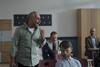
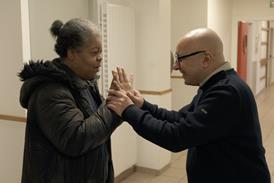
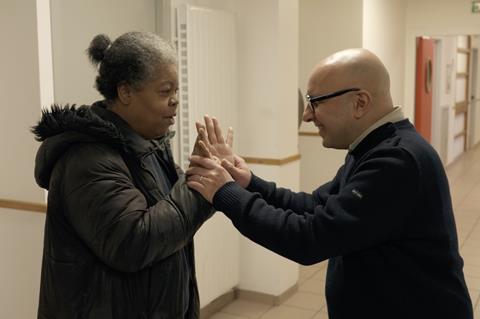
There’s enjoyable confusion in the film’s refusal to present its experiment as a cinematic exercise. In fact, spectators unfamiliar with Tamadon could be excused for thinking that the affable bald guy we see interacting with inmates here is the director not of the film, but of the institution. He could quite easily be an enlightened public service visionary – like Italy’s Giorgio Bassani, the psychiatrist whose belief that the mentally ill belonged in the community eventually led to the complete closure of the country’s psychiatric hospitals.
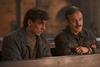
The proposal Tamadon tables to patients who clearly know him well (they’re all on first name terms) is a little less radical – not so much shutting down the asylum as turning it into a self-service facility. Some, like tense, tattooed Tyson, embrace the idea enthusiastically: he turns out to be an excellent, if a little over-enthusiastic, cleaner of mirrors, floors and toilets. Another, who has a professorial look and manner, opts to become a psychiatrist – a role he follows through with such conviction that he finds himself on the phone to another inmate’s mother, as Tamadon and one of the hospital’s actual psychiatrists exchange looks of horrified “what have we unleashed?” embarrassment.
But such moments are rare. This is at heart a deeply empathetic film. An inmate we see rocking catatonically in one scene, apparently beyond help and beyond reach, turns out, in the next, to be smart and articulate. She tells the director she could help out with the hospital administration, as she’s a dab hand with Excel and used to work at French rail infrastructure company Alstom.
In a tense meeting during which Tamadon brings up the case of a schizophrenic inmate who has visibly declined and turned in on himself in the seven years since the director has known him, one psychiatrist reluctantly explains that one of her jobs is to reassure the outside world and maintain social order. “But you’ll probably cut that”, she adds.
In these ways, the film continually forces its audience to question their assumptions. Yet it also does the same to the committed but overworked hospital staff, whose attitudes towards Tamadon’s experiment are shown to be, at best, indulgently sceptical. By setting himself up as the jejeune proponent of a game inspired by a kind of One Flew Over the Cuckoo’s Nest idealism, the director pushes professionals who may have begun their careers in the same romantic spirit to take stock .
Production company: TS Productions
International sales: Andana Films contact@andanafilms.com
Producer: Delphine Morel
Cinematography: Patrick Tresch
Editing; Luc Forveille, Mehran Tamadon