Dione Roach and Steve Happi’s Tribeca-winning film is executive produced by Taika Waititi and Rita Ora

Jail Time Records

Source: Dione Roach

‘Jail Time Records’

Dirs: Dione Roach, Steve Happi. US/Cameroon. 2026. 94mins

The Central Prison of Douala, in Cameroon, is one of the most overcrowded penitentiaries in Africa; built during the colonial era with a capacity of 800 prisoners, it now holds over 6,000 men. The inhumanely cramped conditions mean that violence is rife – “even food is war here,” says one inmate – and disease can spread like wildfire. The strength of documentary Jail Time Records, however, is that it explores the challenges of life behind these bars through the prism of something entirely more positive: the inmate’s own in-house record label, established in 2018 by co-director and former prisoner Steve Happi.

Blends harsh daily realities with more hallucinatory artistic elements

There have been many films about the redemptive power of art in prisons, including documentaries Shakespeare Behind Bars (2005) and Tehachapi (2023), and 2024 feature Sing Sing. Yet Happi, who still serves as Jail Time Records’ producer, and co-director Dione Roach – who has worked in the prison since 2017, helping the prisoners with visual art – have crafted something special here; a film that gives itself over entirely to its subjects, that blends harsh daily realities with more hallucinatory artistic elements, but maintains a clear-eyed editorial focus.

Winning the best documentary feature award at this month’s Tribeca Film Festival (alongside awards for best cinematography in a documentary and the Albert Maysles award for best new documentary director) will help attract attention, as will the presence of Taika Waititi and Rita Ora as executive producers.  Jail Time Records should travel within the festival circuit, and could also interest distributors looking for exciting global non-fiction projects; the propulsive music will be a key selling point.

A breathless opening sequence drops the viewer directly in the middle of the prison, a disorienting melee of men squaring up to each other, clamouring for meagre rations, crowded together in the main courtyard where those without beds live, eat and sleep cheek by jowl. Dapper prisoner La PJ, sporting a tie and peaked captain’s hat, acts as a guide, giving a whistlestop tour of the facility and introducing the film’s key individuals.

One of those is former presidential guard soldier Stone, who runs Jail Time Records and is nearing the end of a 10-year sentence for being an (he says unwitting) accomplice in a weapons crime. He pens his own music – although is suffering from writer’s block – leads rap collective ‘La meute des penseur’ and acts as something of a mentor to other artists. Clearly haunted by his violent past and trying to become a better man for his young daughter, Stone uses his music to explore those feelings that he cannot bring himself to speak directly about.

That’s true of all the artists here, for whom music is a pathway to deeper introspection, their songs capturing their experiences both in and out of prison, their pasts, their hopes for the future. Music is also an essential form of escapism, a way to not so much transcend the everyday, but to harness and shape the narrative, to bring an element of hope to an otherwise difficult reality.

Empereur, for example, is the charismatic yet hard-edged leader of the prison’s Latino gang, and a fantastically gifted artist whose afro-house music blends his intimidating persona with more deeply held feelings of regret, fear and tentative hope. And for the popular Transporteur (so called because he used to be a getaway driver), his upbeat, crowd-pleasing music acts as something of a currency, uniting inmates behind him and creating a valuable sense of community as he awaits a trial that is continually delayed.

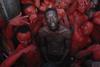
Immersive, eye-level handheld cinematography stays rooted within this claustrophobic place, which operates more like a small town where, notes La PJ, “the mice eat the cats.” (Indeed, guards are hardly seen or heard, aside from at a Jail Time Records concert which turns into one big dance party.) The film also includes music videos made by the prisoners and overseen by Roach, impressive collaborative endeavours that yield striking results – in one for an Empereur track, fellow inmates are painted red and blue, one dons angel’s wings. Elsewhere, the men paint a lush jungle landscape on the bare concrete walls.

Some of the sequences are clearly staged – La PJ’s irreverent guide, for example, or Empereur practising his best snarls in front of the mirror – and there is a sense that the presence of the camera turns these men into performers. Their music, however, remains raw, honest and infectious, and acts as the driving force of a film that celebrates the power of creative expression to bring light to the darkest of places.

Production companies: Artists Equity, Jail Time Production

International sales: Artists Equity, Caitlin Alba-Rothstein caitlin@artistsequity.com

Producers: Dione Roach, Steve Happi, Giacomo Stucchi-Prinetti

Cinematography: Dione Roach, Uberto Rapisardi, Steve Happi

Editing: Jocelyne Chaput, Marie Helene Dozo, Dione Roach

Music: Steve Happi