








Uneven Cannes Special Screening is structured around Lennon and Yoko Ono’s final interview
Dir. Steven Soderbergh. US. 2026. 97mins
There’s some enlightening substance and much poignancy in the words of John Lennon and Yoko Ono – but also much egregious AI-created visual ugliness – in John Lennon: The Last Interview, which premieres in Cannes’ Special Screenings. Steven Soderbergh’s documentary derives its power from the candour and upbeat enthusiasm of counterculture’s royal couple, and from the fact that the radio interview featured was conducted only hours before Lennon was shot dead by Mark Chapman. But elaborately distracting AI embellishments make this an erratic entry in the current cycle of Beatles-related material, including recent McCartney feature Man on the Run, as well as 2025’s Borrowed Time: Lennon’s Last Decade and Kevin MacDonald’s hugely entertaining One to One: John and Yoko (2024).
Elaborately distracting AI embellishments
The film is built around the interview that Lennon and Ono granted on December 8, 1980 to a four-person crew from a San Francisco radio station – Laurie Kaye, Dave Sholin, Ron Hummel and Bert Keane, the first three interviewed here on camera. They enthusiastically recall arriving at Lennon and Ono’s home at New York’s Dakota Building, waiting briefly while the stars were photographed by Annie Leibowitz, then having a brief solo chat with Ono. She is heard offering some sharp insight on the need to reinvent the relations between men and women – a key theme on their duo LP Starting Over, which the interview was ostensibly intended to promote.
While the interviewers had been instructed only to discuss the album, and to steer clear of Lennon’s past and the Beatles, once Lennon joins in the conversation proves very wide-ranging. He is cheerful and animated, and needs little prompting to bring up the Beatles, his first meeting with McCartney, the band’s gruelling work rate that left him burned out and disillusioned. He also reminisces about his first meeting with Ono at a mid-60s London exhibition of hers, recounting a slow-burning courtship finally consummated the morning after they stayed up recording their experimental album Two Virgins.
Most of all, however, the conversation yields insights into life with the couple’s son Sean, and Lennon’s role as doting father following the couple’s mid-70s separation (while he was partnered by May Pang, seen in photos but not named). He even gives an hour-by-hour account of the couple’s daily life, from rising at 6 a.m. for coffee, through giving Sean his breakfast and getting together at night after Yoko’s ‘workaholic’ business day. Ths focus on Sean is particularly poignant, as Lennon admits that he never gave enough time to his first son (Julian, similarly seen but never named). And unlike many veteran rockers of the time, Lennon is also enthusiastic about disco and New Wave music.
Ono talks about how the 60s Sexual Revolution was really a revolution for men only, and the two express faith in the enduring possibilities for social change at a time when the US and Britain were turning to the right. Bittersweet indeed is Lennon’s revived enthusiasm about writing, recording and possibly touring, given how soon – in mere hours – his ambitions would be scotched. In fact, they would be ended by the very man who pestered the interviewers on their way out of the building.
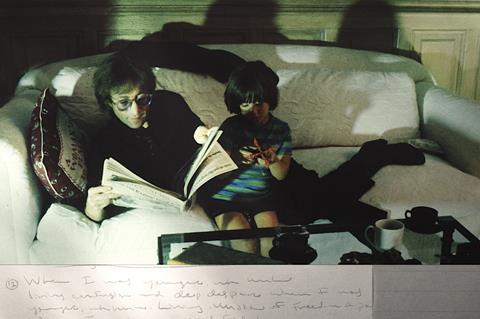
The interview, a sound recording only, is accompanied by a mass of visual material, the best of it a vast array of still photos of the couple, mostly taken throughout the 70s. Some pictures are familiar, others very much not, holiday pics included – a strange element being the way that Lennon’s hairstyles, looks and even body shape change constantly. But the photos are often unnecessarily gussied up with digital water colour effects, light flashes and other treatments.
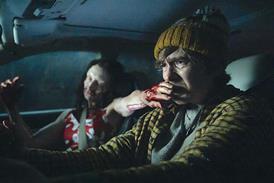
Additionally there is the use – over a reported 10 percent of the film – of what Soderbergh has called ’thematic surrealism’. This is a set of AI-created sequences in partnership with Meta (credited as ‘technology partner’) in which the couple’s comments are illustrated with a range of artificial images, some abstract, mostly figurative. At their best, the images suggest de luxe versions of the Hipgnosis/Pink Floyd school of 60s/70s record sleeve design; at their worst, they are grotesquely kitsch (a bizarre caveman sequence to illustrate traditional notions of maleness) and/or clunkingly literal (imaginary footage of Napoleon to illustrate… a mention of Napoleon). It all comes as a surprise in a film authored by Soderbergh – who shot the film under his DoP nom de camera Peter Andrews, his usual unfailing visual elegance barely evident here.
There’s lots of great music, of course, including a very rough acoustic demo of Lennon’s late-period ‘I’m Losing You’ – although, whisper it, the odd Beatles song and the early 70s Lennon material knock the politely melodic Double Fantasy numbers into a Sergeant Pepper cocked hat.
Production companies: Mishpookah Entertainment Group, Sugar23
International sales: 93 chumber@legendary-193.com / US sales: CAA filmsales@caa.com
Producer: Nancy Saslow
Cinematography: Peter Andrews
Editing: Nancy Main