













The actor-turned-filmmaker’s paean to the golden age of air travel bows in Cannes Premiere
Dir: John Travolta. USA. 2026. 60mins
Written, directed, narrated and produced by two-time Academy Award nominee John Travolta and based on his own novella, Propeller One-Way Night Coach enters the pantheon of eccentric passion projects with a bang, screening in Cannes Premiere. And Travolta’s passion project is writing and directing an hour-long visual illustration of his memories of a formative cross-country flight he took as a child during the golden age of aviation, which premieres on Apple TV+ on May 29.
There is a strong sense of childlike wonder to this curio
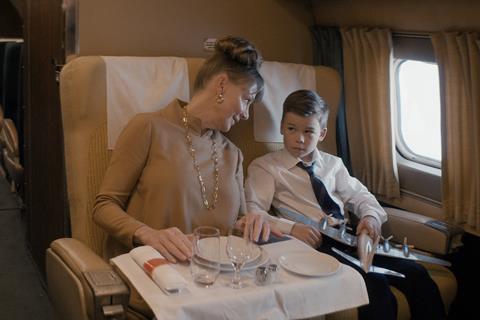
Travolta has cast his daughter Ella Bleu Travolta and his siblings, Ellen, Margaret, Ann, Sam and Joey Travolta in this opus. (While Ella Bleu’s air hostess role doesn’t give her much to do beyond twinkle winningly, there is the sense that she may have inherited some of her father’s undeniable star quality). The two leads, young Jeff (newcomer Clark Shotwell) and his mother, Helen (Kelly Eviston-Quinnett) are not related to the Travoltas (Although Shotwell has previously been cast by Ellen Travolta in a Christmas show in Idaho, while Eviston-Quinnett currently works as Head of Performance at the University of Idaho).
There is a strong sense of childlike wonder to this curio. On the most straightforward level, it views the world through a child’s eyes, as young aviation fanatic Jeff takes the trip of a lifetime. The persistent narration, read by John Travolta, ostensibly offers an adult’s eye view, looking back on the trip with worldly wisdom and hoping to mine comedy from Jeff’s innocent misreadings of adult behavioural nuances. One of the things that makes the film unusual however, is that the adult’s point of view is essentially childlike too: the narrator is as thrilled as the child by the brave new world of commercial air travel.
This breathless affection for the world of air travel during the Mad Men-era comes through not just in the narration, but in the fabric of the film itself. Paul de Lumen’s camera lingers lovingly on period production design such as painstakingly sourced airline crockery and cutlery, while the narrative finds reasons to have characters do things like turn over a plate so that the audience too can check its provenance and sigh over the beautiful vintage items. Travolta’s expression of love for this particular time and place has taken the form of a movie, rather than an expensive period dollhouse, but the sincere impulse is similar. Building the film must have been like stepping into a memory (which oddly gives it something in common with Sandra Wollner’s more artistically robust Everytime, also at Cannes this year).
Travolta has already made several enduring contributions to pop culture. Early roles like in Grease and Saturday Night Fever showcased a crackling charm and snake-hipped moves. In Pulp Fiction he was the human equivalent of the songs on the film’s retro pastiche soundtrack: a crowd-pleasing number that had somehow lost cultural currency but retained the old magic, with a chic new veneer of irony. By the time he starred in John Woo’s Face/Off in 1997 in the juicy double role of anguished hero and sleazy villain, that veneer had splintered into the persona of a star with a certain reservoir of old school Hollyweird eccentricity. And, of course, there is his unforgettable 2014 Academy Awards introduction of Idina Menzel.
While rather compelling as a Travoltan artefact, as a film Propeller One-Way Night Coach has a few problems. The lavishly-applied narration is most successful when there is a productive dramatic tension between what is being shown and what is being said. Too often, the narration is simply describing what is shown, and more confusingly, sometimes describing something slightly different to what is shown. This could be an interesting artistic strategy used to make a comment on the tendency of memories to edit themselves, if it had been employed with a more potent sense of intentionality, but alas.
The biggest difficulty is the story itself, which doesn’t offer much by way of structure or payoff. It is reminiscent of the way that a child will tell you all about an event, including several extraneous details, neglecting to conclude minor episodes, and barreling merrily along, incident by incident. The sheer enthusiasm is at times infectious, and at other times you wish he’d worked with a forthright script editor. Still, it’s diverting to see an authentic and genuine oddity of a project.
Production company: JTP Films Inc, Kids At Play
International distribution: Apple
Producer: John Travolta, Anson Downes, Linda Favila, Angie Losito, Alison Bell, Jason Berger, Amy Laslett
Screenplay: John Travolta
Cinematography: Paul de Lumen
Production design: Chelsea Turner
Editing: Adam Varney
Main cast: Kelly Eviston-Quinnett, Clark Shotwell, Ella Bleu Travolta, Olga Hoffmann