







Joe Bird and Stacy Clausen impress in Adrian Chiarella’s feature debut
Dir/scr: Adrian Chiarella. Australia. 2026. 88mins
Queer desire is something to be feared in Leviticus, the impressive, disquieting feature debut from Australian filmmaker Adrian Chiarella. Writer/director Chiarella brings a restrained tone and sharp insight to this unnerving tale in which two teen boys are stalked by an evil entity because of their sexuality, which elevates this small-town LGBTQ+ horror. Striking performances from young leads Joe Bird and Stacy Clausen also give the film an undeniable power.
Chiarella brings a restrained tone and sharp insight
These elements should help Leviticus – which is produced by Causeway Films, the outfit behind Australian genre hits Talk To Me (2022) and The Babadook (2014) – as it begins its theatrical journey following a Sundance premiere and healthy festival run. It opened in various territories on June 19 via Neon (who hold worldwide rights) including Australia and the US where it took $2.75m in its opening weekend. That it follows hot on the heels of Gen Z horror hits Backrooms and Obsession should also help it find an audience, and comparisons with 2014 horror hit It Follows may also help drive interest. Strong word-of-mouth should also translate into long legs on streaming.
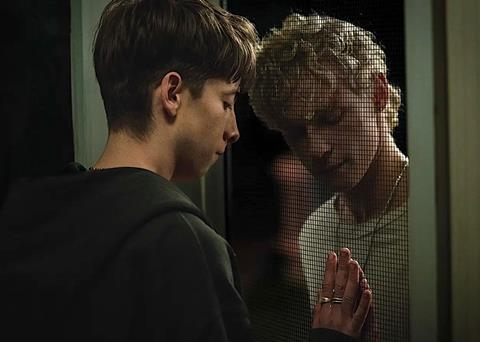
The softly-spoken Naim (Bird, who had a small but memorable role in Talk To Me) has moved with his devoutly religious mother (Mia Wasikowska) to a small rural Australian town following the tragic death of his father – an event which is barely mentioned, but which has left an indelible mark on them both. Naim is struggling to fit into his quiet new home, although a burgeoning friendship with the sandy-haired Ryan (Clausen, recently seen in Netflix horror Thrash) is helping lift his spirits. When their banter crosses the line into the physical, Naim feels like he may finally have found a sense of belonging.
That sense of freedom is reflected in Tyson Perkin’s cinematography, which begins to widen and move away from gloomy interiors, and in the sunlight which bathes the screen. Yet the ominous, insidious score from Jed Kurzel (The Babadook), with its deep rumbles and sickly strings, sounds a warning – and, indeed, Naim’s freedom is fleeting. In this community of traditional faith, homosexuality is treated as a kind of possession; when Ryan, and later Naim, are outed, a deliverance preacher (Nicholas Hope) is called in to perform a violent ritual to cleanse their troubled souls.
Religious conversion therapy is a topic that has previously been explored on screen in dramas like The Miseducation Of Cameron Post (2018) and Boy Erased (2018) and documentaries including Netflix’s Pray Away (2021). Leviticus – named after the book of the bible which states that homosexuality is a sin before God – effectively explores the psychological impact of such prejudicial practices by turning it into something that leaves physical scars. Anyone undergoing the cleansing ritual finds themselves targeted by a malevolent, violent presence which manifests as the person to whom the individual is most attracted. For Naim, it appears as Ryan, and vice versa. Soon, neither boy feels able to trust the other, their fear and shame driving a wedge between them – exactly as the church decrees.
Fear is a powerful tool of control, and Leviticus pushes this idea to its obvious extremes. With most of the supporting characters operating very much in the periphery, a great deal rests on the shoulders of Bird and Clausen and they are terrific as the central protagonists. Their chemistry is natural and tender, and together they capture the potent adolescent mix of swaggering bravado and deep vulnerability, the confusion and excitement of discovering one’s true identity – and the terror at realising that may be at odds with the expectations of those closest to you.
The fact that the adults of this community seem nonplussed as their teens show up wounded – or worse – may seem like a narrative weakness, but the point is well made that, in this ultra-conservative environment, it’s better to be dead and absolved of sin than to continue to live in immorality. Wasikowska, impressive in a very limited role, is the most powerful embodiment of this draconian dogma, her maternal love for Nairn eclipsed by her faith in the word of God and her determination that her son should follow it to the letter – no matter the toll it may take on him, and on their relationship. The fact that kind of damaging real-world ideology continues to exist, says Chiarella, is a far more horrifying prospect than any supernatural manifestation could ever be.
Production companies: Causeway Films, Salmira Productions
Worldwide distribution: Neon
Producers: Kristina Ceyton, Samantha Jennings, Hannah Ngo
Cinematography: Tyson Perkins
Production design: Bethany Ryan
Editing: Nick Fenton
Music: Jed Kurzel
Main cast: Joe Bird, Stacy Clausen, Mia Wasikowska, Jeremy Blewitt, Nicholas Hope, Ewan Leslie