










Olivier Clért’s feature debut plays Annecy competition following its Cannes premiere
Dir. Olivier Clért. France. 2026. 89mins
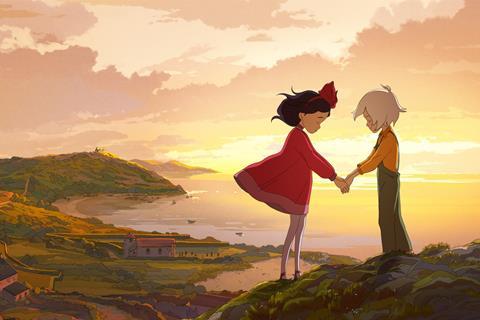
A friendship between white-haired, wounded Lucy, an outsider in her small island community, and Milly, a little girl only she can see, is at the heart of this beguiling and creatively loose animated adaptation of Michael Morpurgo’s First World War-set novel Listen To The Moon. It’s an assured directorial debut from Olivier Clért, which elegantly hits the sweet spot of balancing weighty themes – there are scenes of mob hostility, intolerance and aggression towards a perceived enemy – with a child-friendly playfulness and gentle humour.
The colour palette is a lush collision of greens, golds and that distinctive Cornish sea blue
Clért’s previous credits include work as a creative consultant on Klaus and as a storyboard artist on The Little Prince and, more recently, Little Amelie Or The Character of Rain. Lucy Lost feels closest to the latter in terms of visual and storytelling approach. Both employ 2D animation techniques to striking effect; both owe a considerable debt to Japanese animation. And like Little Amelie, Lucy may find herself as part of the awards conversation going forward. The film screens in the main competition in Annecy, following its world premiere as a Special Screening at Cannes. Sales to multiple territories were announced in advance of the picture’s Annecy bow.
The story, which takes place on the Isles of Scilly off the coast of Cornwall in 1915, departs from the structure of the book, which tells the two parallel stories of Lucy and Milly (both of whom are voiced by Charlie Rosenzweig in the film) without the girls ever meeting. The film hints from the outset at Lucy’s uncanny ability to see people who aren’t there – a gift that her island family is keen to keep quiet from the rest of the community.
While Lucy’s older brother Alfie goes to school (he and the other kids are rowed across the harbour by a cantankerous, pipe-chewing seadog every morning and evening), she is kept at home to recuperate from a mysterious accident. This only serves to fuel the sharp glances and suspicions of the other islanders. The children think that this snowy-haired creature, with her otherworldly, foundling quality, is a witch. The adults mutter that she’s bad luck. It’s no wonder that Lucy, alone with her imagination, grasps at the friendship offered by Milly, She may not exist, but she’s a lot more fun than the village kids who throw insults like rocks.
There are moments in this undeniably charming film that feel a little derivative. A scene in which a school textbook about America opens up into a pop-up world for the girls to explore is delightful, but also rather close in execution to a similar scene in Paddington 2. The character design is close to that of some of Studio Ghibli’s female protagonists, which, while appealing, is perhaps something of a missed opportunity to put a more distinctive visual stamp on the picture. There’s a thematic Ghibli parallel, too – there are shared elements between this picture and Hiromasa Yonebayashi’s When Marnie Was There, and a similar time-looping narrative device.
What does feel distinctive, however, is the way in which the Scilly Isles backdrop is captured: using a wide aspect ratio to evoke the sense of boundless horizons, the film’s colour palette is a lush collision of greens, golds and that distinctive, deep Cornish sea blue. The region’s wildlife plays a key supporting role, with puffins, seals, gulls and, in one particularly gorgeous sequence, a whale joining Lucy on her adventures.
The music by Anne-Sophie Versnaeyen tells its own story. Early in the film, the use of a harp gives Lucy’s story a delicate, eerie quality which is fleshed out and made more substantial with fuller orchestration as Lucy grows into her friendship with mischievous, feisty Milly. At one point, we even see the musicians: a string quartet, figments of Lucy’s imagination, play on the beach. Later, we see them again, and it’s around this point that the pieces of the story finally start to fit together.
Production Company: Xilam Films
International Sales: Goodfellas Animation
Producers: Marc Du Pontavice
Screenplay: Olivier Clert, Helen Blakeman
Animation: Carlo Toselli
Artistic Direction: Joyce Colson
Editing: Ivy Buirette, Guillaume Vantroys
Music: Anne-Sophie Versnaeyen
Main voice cast: Charlie Rosenzweig, Zach Valentin-Dattas, Quentin Faure, Keanu Peyran, Léonie Didier-Chiara, Haïly Yseembourg, Rafael Didier-Chiara, Gustave Briere, Titouan Daviaud, Benjamin Penamaria, Nicolas Marie, Leslie Lipkins, Luc Antoine Diquero




No comments yet